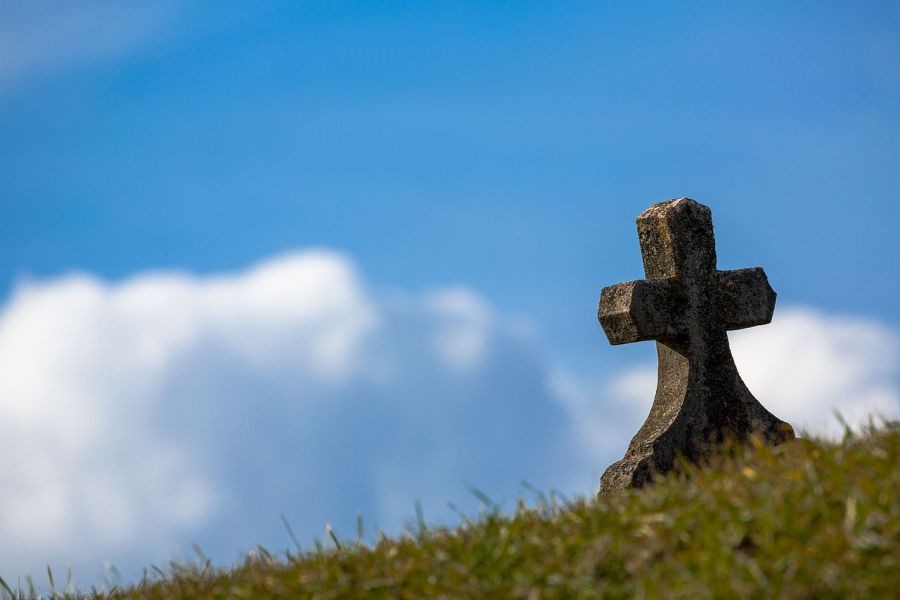
Photo Courtesy: Image by Gabor Bejo from Pixabay| For representational purpose only
Toli Pikuto Awomi
4th Mile, Chümoukedima
I have a little knowledge about Shothumi village.
Shothumi is a rural settlement divided into Shothumi ‘A’ and Shothumi ‘B’, located in the Seyochung sub-district of Kiphire district, Nagaland. One of the unique practices in Shothumi village is the way they bury their dead.
The village follows a tradition of burial where flowers and memorials are not part of the funeral practice. When someone in the village dies, the body is not kept for long. The body is buried within the family’s own compound, and the graves are often left plain and unmarked, leaving no visible sign that someone rests beneath the ground.
This is not something I learned from a textbook, textual description, or online source. Recently, I attended a funeral in Shothumi village and learned about this practice through my own experience. But out of curiosity, I did some research to know more about it. This experience made me think about how much knowledge we can gain simply by observing, asking questions, and being curious about the practices around us. Perhaps, this is what I mean by “Little Knowledge.”
A village Gaon Bura (GB) of Shothumi said that the tradition has been practiced by the community since the village was established. He also mentioned that the village has no designated cemetery and that there is not a single grave in Shothumi village. When someone dies, the funeral takes place immediately if all the family members are in the village. They do not keep the body for a day. He also added that they do not plaster the grave with cement or make any memorial on it.
For someone reading this, it might be difficult to imagine that when someone we love dies, there is no place to leave flowers or create a memorial in their memory. Such practices are not permitted by the traditional customs of the community. However, what we need to understand is that the villagers are continuing a practice that has been followed for generations, keeping the tradition alive as a natural part of the community’s way of mourning and remembering the dead.
This experience made me wonder: how much do we really know about the society we belong to? How much do we really know about the traditions that are still being practiced and passed down from generation to generation?
If there are practices within one community that I came to know through experience, how many other practices, customs, and forms of knowledge exist that I have never encountered? Do we understand society only through textual descriptions or textbooks that have been recorded? What about the practices and knowledge that have never been documented? Where do they remain, and how will we know about them? What happens when the people who carry that knowledge never get the opportunity or never think it important enough to share it?
What if ‘Little Knowledge’ is simply the beginning of a question?
We can contribute our ‘Little Knowledge’ by trying to understand it more deeply, but where do we begin? Perhaps research begins here—not always with a book or a formal study, but with noticing something and becoming more curious to understand it.
We can think about the things we learn from our grandparents and elders, the stories they tell, the customs they explain, the proverbs they use, or the practices they learned from their grandparents, parents, and elders. Much of this knowledge may never appear in a textbook, but if it has never been written down, does that mean it is not knowledge?
We might know about a traditional practice through our own experience, but do we really understand it just because we have seen it or lived through it ourselves? We might think, “I know this because I have seen it,” but is seeing something enough to understand it? Perhaps not. Seeing a practice tells us that it exists, but it may not tell us why it exists, why people practice it, or how it came to be. That is when curiosity can take us beyond what we have simply seen. We can ask questions, listen, and learn more.
My ‘Little Knowledge’ of the burial practice began with what I saw and knew from experience. But knowing it wasn’t enough; it was just the beginning of understanding it. It required me to ask, listen, and research.
We often associate knowledge with degrees, researchers, books, and published work. But what about the knowledge you carry about your community and traditions, or the knowledge carried by an elder, a farmer, a craftsperson, a parent, or a villager? Why do we sometimes recognise knowledge only after it has been formally recorded?
Much of the knowledge about our traditions, customs, and practices around us is simply part of our everyday life. You know your village customs and the traditions your village follows. You may know why a certain practice is followed or how your community has changed over the years. But these things may never be written on paper, so you may not call yourself knowledgeable. You carry pieces of knowledge that came from living within your community.
Perhaps knowledge does not always announce itself as knowledge. Sometimes, it is simply something people know because they have lived it. None of us may know enough to tell the whole story of our society, but each of us may carry only a small piece—a memory, a practice, a story, an observation, or something learned from those who came before us.
I call these pieces “Little Knowledge” not because they are not important, but because they may be only a beginning.
So, we should become more curious about what surrounds us. Ask an elder, a grandparent, or a parent about a practice we have never understood. Listen to the stories of our villages. Observe what is changing. Question what we think we already know. And when we know only a little, let that little knowledge lead us to learn more.
We do not have to be scholars, researchers, or experts to begin asking questions about the society we belong to. Sometimes, all we need is curiosity and the willingness to listen, learn, and understand.
Your little knowledge may teach me something that I do not know. Mine may teach someone else. Another person’s may answer a question we have carried for years. And when these small pieces are shared, questioned, and understood, perhaps we begin to see a much larger picture of who we are.
Maybe we will never know everything. But together, we can know a little more.
And these ordinary pieces of knowledge are the “Little Knowledge” I’m talking about.