MLA and Chairman of the Study Committee on KMMTTP and Railway Line Services in Mizoram, Pu T Lalhlimpula, addresses a consultation meeting with stakeholders at the Deputy Conference Hall, Dimapur, on February 5. (DIPR Photo)
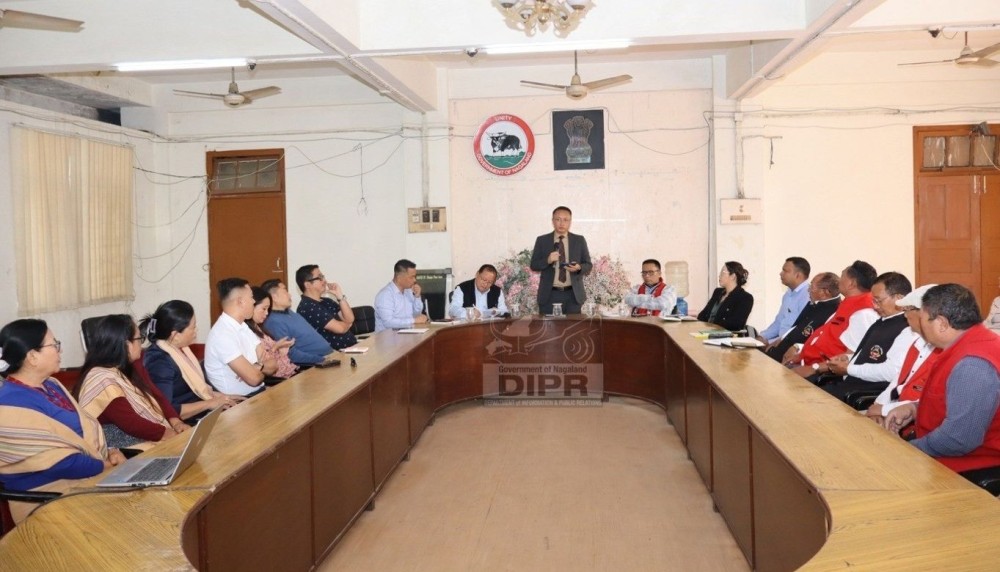
Dimapur, February 5 (MExN): A study committee of Mizoram’s Planning & Programme Implementation Department held a meeting with stakeholders in Dimapur on February 5, seeking insights into new railway services as well as the Kaladan Multi-Modal Transit Transport Project (KMMTTP) in the State.
Heading the Study Committee on KMMTTP and Railway Line Services, Mizoram MLA Pu T Lalhlimpula said the dialogue focused on two major infrastructure initiatives—the proposed railway line from Bairabi to Sairang in Mizoram and the transit project.
The two projects are expected to shape the future of the region, he noted.
Lalhlimpula highlighted that the KMMTTP aims to connect Kolkata to Sittwe Port in Myanmar by sea, further extending through inland waterways to Paletwa and by road to Mizoram.
Funded by the Government of India and targeted for completion by 2027, the project is expected to provide a crucial alternative connectivity route to the Northeast states by bypassing the Siliguri Corridor and reducing travel distance by over 700 kilometres, he said.
Referring to Dimapur as a city deeply shaped by railway connectivity, Lalhlimpula said the committee’s visit was not for abstract discussions but to draw from Nagaland’s long-standing experience in rail infrastructure to help guide future projects in Mizoram.
He further informed that the committee was constituted to examine the socio-cultural and economic impacts of railway connectivity, particularly in tribal areas.
Over the past months, the committee has conducted field visits and community consultations across southern Mizoram, engaging village leaders, youth groups, civil society organisations and local communities to assess perceptions, expectations and concerns related to railway expansion, he added.
The MLA further noted that Nagaland, with its century-old railway history dating back to 1903, offers valuable lessons for Mizoram, which saw Bairabi connected by broad-gauge rail only in 2016 and Aizawl linked by rail in September 2025.
Highlighting the socio-cultural and religious similarities between the two states, where Christianity plays a central role in social, cultural and community life, he added that one of the primary objectives of the visit was to understand how railway connectivity impacts social structures, cultural practices and economic transformation.
The other, he said, was to learn how Nagaland has managed both the opportunities and challenges arising from improved connectivity.
Emphasising that enhanced connectivity brings both growth prospects and concerns related to culture, identity and livelihoods, the Mizoram delegation expressed keenness to learn from Nagaland’s experiences.
This included both positive and negative aspects, to maximise benefits while minimising adverse impacts, the delegation held.
To this end, Lalhlimpula expressed hope that the interaction would strengthen cooperation and mutual understanding between the two states and lead to informed planning for future infrastructure development in Mizoram.
Committee member Pu Zomuana, in his presentation, further highlighted details on the KMMTTP and railway lines in Mizoram. The KMMTTP, launched by the Government of India in 2008, will provide an alternative trade route linking Kolkata to Aizawl through sea, river and land corridors via Myanmar and is expected to become operational by 2027, he said.
The corridor, spanning about 880 km, includes nearly 90 km within Mizoram and is expected to benefit Mizoram, Tripura and lower Assam.
Preparatory measures by the State include field studies, stakeholder consultations and visits to ports in Kolkata and Myanmar, with a final report due by August–September, Zomuana added.
Meanwhile, Mizoram entered the railway map with the opening of Bairabi railway station in 2016, while the Sairang station near Aizawl was completed in 2025.
Daily train services now operate between Guwahati and Sairang, with twice-weekly services to New Delhi and Kolkata, Zomuana informed.
The meeting featured a brainstorming interaction with stakeholders on the social, cultural, economic and developmental implications of the railway project, highlighting both positive and negative effects.
As per the State DIPR, the meeting concluded on a positive note with a vote of thanks proposed by Deputy Commissioner Dimapur, Dr Tinojongshi Chang.
Earlier, Lalhlimpula expressed gratitude to the Government of Nagaland for convening the meeting and for the hospitality extended to the visiting delegation. He also thanked MLA Achumbemo Kikon for facilitating and coordinating with the State government.
.jpg)