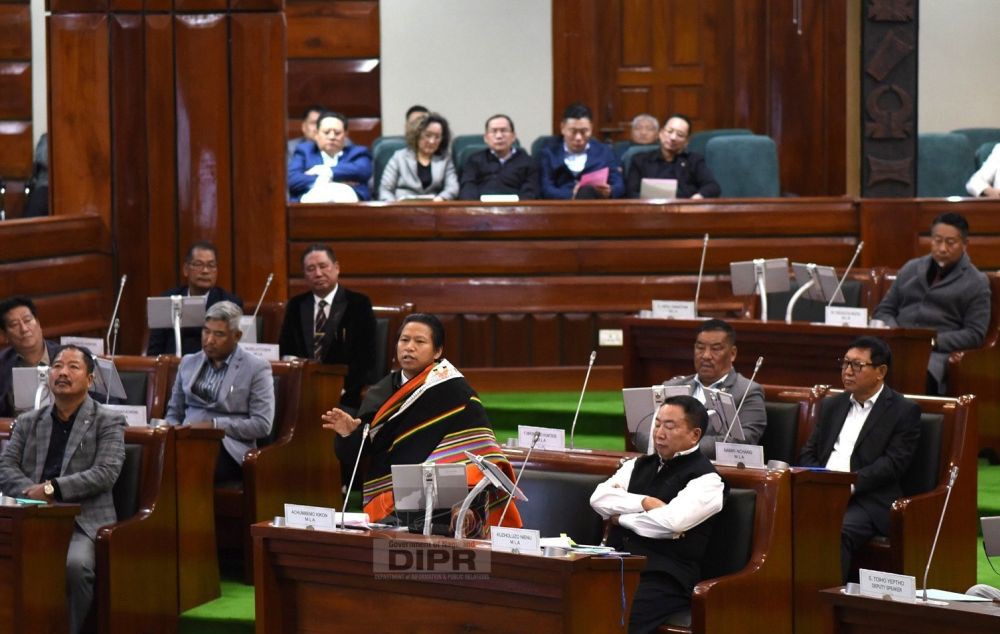
MLA, Achumbemo Kikon sepeaking during the Zero hour of the Eight Session of the 14th Nagaland Legislative Assembly at NLA Hall, Kohima on March 3. (DIPR Photo)
Our Correspondent
Kohima | March 3
With cases of human-elephant conflict in the Bhandari region, MLA Achumbemo Kikon on Tuesday proposed massive cultivation of Jatropha as a dual-purpose solution to both curb the menace and boost green energy production in Nagaland.
Raising the matter during Zero Hour on the second day of the 8th Session of the 14th Nagaland Legislative Assembly (NLA), Kikon informed the House that many farmers in his constituency have abandoned their paddy fields and farms because of the frequent intrusion and rampaging of the cultivation by the wild elephants.
Kikon informed he had tried exploring some other means to reduce the Human-Elephant conflicts in his constituency and could tie-up with an organisation called TERRATROTH,” and added that the organisation, through its technical partner JATROPOWER, has conducted sustained research on the benefits of Jatropha cultivation.
The MLA expressed confidence that planting Jatropha, a plant unpalatable to wild elephants, could serve as a natural barrier. “Jatropha plants and its seeds are not friendly to wild elephants. This plantation will bring impetus to the economy of poor villagers whose fields have been constantly destroyed by wild elephants,” he stated.
He said the focus of Jatropha cultivation will be in the area where cultivable land has been abandoned by the villagers due to constant disturbance caused by the wild elephants.
It will also frame a policy by engaging a proper understanding by way of written agreement with the villagers to buy back the raw material (Jatropha Seeds) from the villagers by fixing a stipulated price giving maximum profits and benefits to the farmers.
He added that the organisation also plans to establish a refinery and factory to convert Jatropha seeds into biofuel at the foothill section of Nagaland, along with a research centre and academy programmes on green energy and medicinal plants.
The Bhandari Sub-Divisional Planning & Development Board (SDPDB), in its meeting held on February 13, 2026, decided to engage with TERRATROTH for massive Jatropha cultivation, both as monocropping and mix cropping. The DPDB Wokha, adopted a similar resolution on February 24, 2026, to encourage the initiative in wild elephant-affected areas.
Kikon noted that the United Nations General Assembly has extended the Decade of Sustainable Energy for All until 2030 through Resolution A/RES/79/211. He emphasised that India, under the National Policy on Biofuels (2018, amended 2022), has set targets for ethanol blending and biodiesel adoption through non-edible oilseeds like Jatropha.
“Jatropha plantation will make Nagaland a progressive and contributing partner in the realm of green energy and bio-fuel, positioning our state as a major stakeholder of India's national commitment to the UN's sustainable energy agenda,” he asserted.