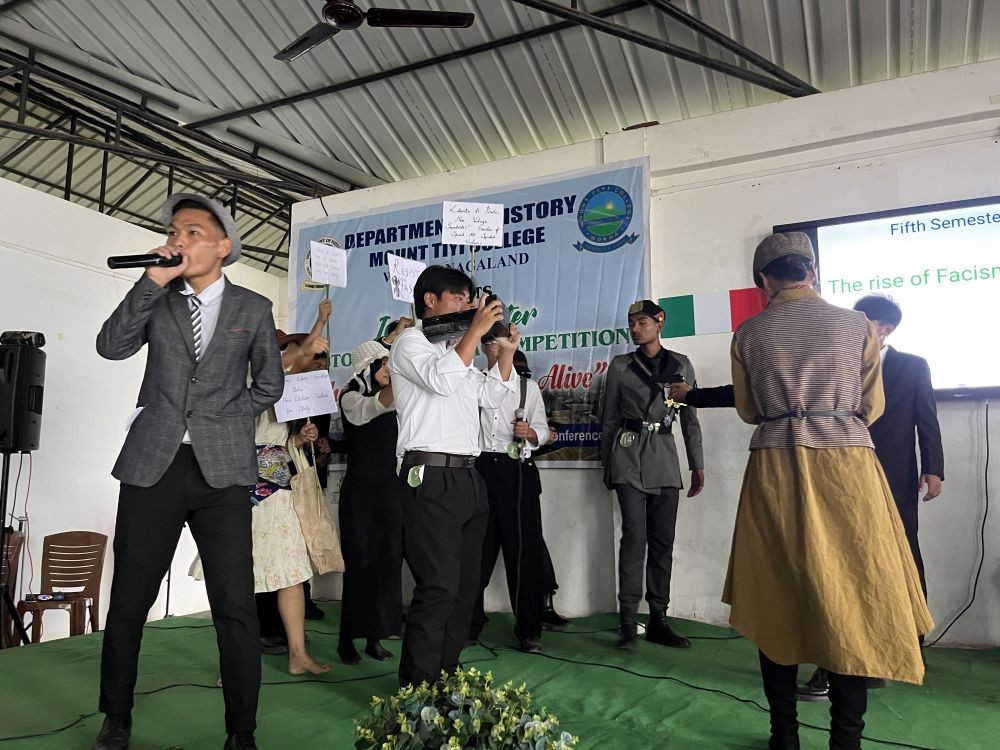
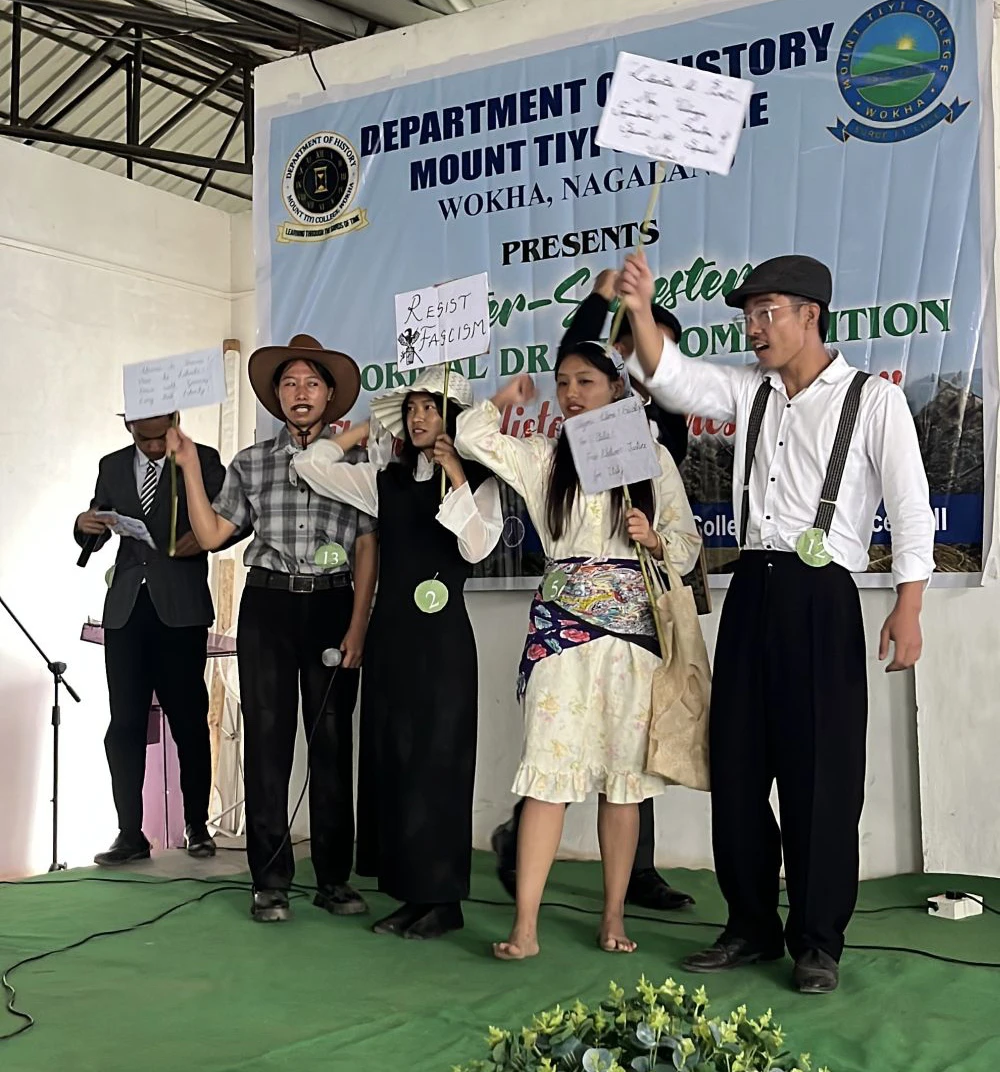
Mount Tiyi College, Wokha 5th semester students presenting ‘The Rise of Fascism in Italy’. (Morung Photo)
Morung Express News
Wokha | October 1
The Department of History, Mount Tiyi College, Wokha, held an inter-semester historical drama competition on October 1 at the College Conference Hall. The event, themed ‘History Comes Alive,’ used drama and creative expression to portray historical events. It formed part of the department’s academic initiative to help students engage with history beyond the classroom and deepen their understanding through performance.
The 5th Semester presented ‘The Rise of Fascism in Italy,’ the 3rd Semester staged ‘France 1789: The Cry for Liberty,’ and the 1st Semester performed ‘Slavery in Ancient Greece.’ Each performance combined storytelling, acting, dialogue, costumes and stage presentation to bring its historical theme to life.
Welcoming the gathering, Dr Libemo Kithan, HoD, Department of History, said the programme reflected the spirit of learning beyond the classroom. He highlighted the importance of presenting historical events, personalities and experiences in a manner that allows students to engage with the past not merely as recorded information, but as stories that can be understood and felt.
Dr Bweyhunle Khing, Principal said active participation in practical activities such as drama and presentations could make learning more effective, helping students understand and remember their lessons more clearly.
He encouraged the faculty to give greater emphasis to such teaching and learning methods and integrate practical activities into classroom learning. He also urged students to actively participate in similar programmes to enhance their understanding through experience.
Dr Khyopenthung Tsopoe, Vice Principal said the performances demonstrated that history could indeed “come alive” when presented creatively.
Giving a brief overview of drama's origins in English literature, Tsopoe explained that medieval drama partly grew from Catholic Church practices, where biblical stories were enacted for congregations who could not understand Latin. He traced the development of miracle, mystery, and morality plays before drama moved from churches to streets and later to purpose-built theatres.
He also cited William Shakespeare's early experience as a supporting actor before becoming one of English literature's most celebrated playwrights, using the example to show how drama evolved into today's theatre, film, and visual productions.
Commending the participants, he noted that unlike professional film productions, where scenes can be repeated and enhanced with technology, the students had only one chance to perform on stage with limited technical support. He praised their confidence, creativity, and acting skills.
Myingthunglo Murry, Assistant Professor, introduced the panel of judges and briefed the participants on the competition rules. The judging criteria included historical content and relevance, historical accuracy, acting and dialogue delivery, direction, costumes, creativity, stage presentation, coordination and overall impact.
A panel of judges comprising Dr N Renthungo Patton (HoD, Economics), Dr I Koktiba (HoD, Political Science), and Dr W Meribeni Patton (HoD, English) evaluated the event. Mhonjan N Odyuo, Assistant Professor, chaired the programme, which opened with a prayer by Dr Kenilo Kath, Assistant Professor.
The 5th Semester won the competition followed by the 3rd Semester as first runner-up and the 1st Semester as second runner-up.
Individual awards went to Chenithung (1st Semester, Best Actor), Hayivani Jami (5th Semester, Best Actress), Oponthung A Murry (5th Semester, Best Costume), and Tumben Erui (5th Semester, Best Narrator).
Amikali Jimo, Assistant Professor, delivered the vote of thanks, and Ekonbeni Tsanglao, Assistant Professor, closed with a prayer.