MLA Dr Tseilhoutuo Rhutso and others during the state-level workshop on Nagaland Food & Feed LINK (N2FL) 2.0 at the Capital Convention Centre, Kohima on May 29. (DIPR Photo)
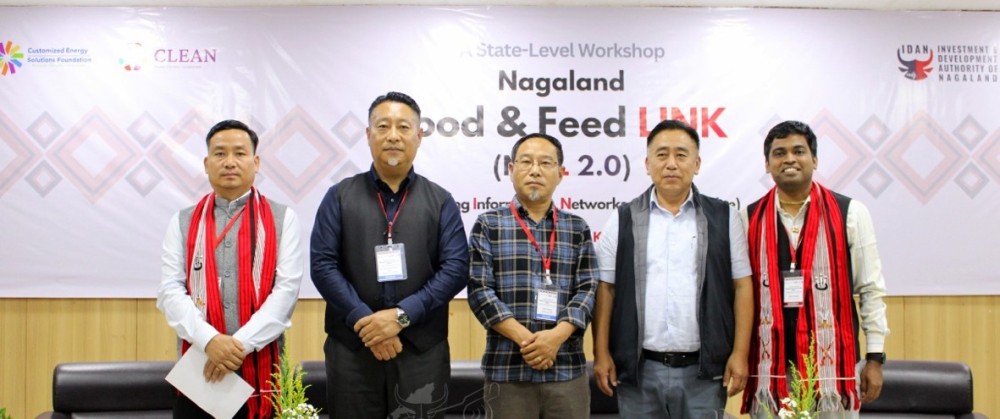
Kohima, May 29 (MExN): Moving beyond dialogue and value-chain mapping, the state-level workshop on Nagaland Food & Feed LINK (N2FL) 2.0 marked a decisive shift toward field-level implementation, enterprise strengthening and scale-up of clean energy-enabled livelihoods across the state.
Organised by the Investment & Development Authority of Nagaland (IDAN) at the Capital Convention Centre, Kohima on May 29, the workshop brought together government departments, development partners, financiers, technology providers, entrepreneurs and community institutions to review progress and chart the next phase of action for energy-enabled food, feed and livelihood enterprises.
Building on the foundation laid during the 2025 state-level workshop, N2FL 2.0 focuses on scaling successful models, strengthening market and credit linkages, building local capacity and creating a practical roadmap for decentralised renewable energy interventions across food processing, feed production, fibre-based livelihoods, aquaculture and coffee processing.
Over the past year, clean energy-enabled interventions have demonstrated how decentralised renewable energy can improve productivity, reduce dependence on external inputs and create income opportunities for rural entrepreneurs and producer groups in Nagaland.
Need to unlock existing potential
Special guest and MLA Dr Tseilhoutuo Rhutso congratulated IDAN, CLEAN, CESF, UNDP and all partner institutions for creating a meaningful platform for “dialogue, collaboration and action.”
“Nagaland is blessed with rich natural resources, hardworking communities, indigenous knowledge systems, and tremendous entrepreneurial potential. However, for decades, many of our rural economies remained disconnected from technology, finance, markets, and infrastructure. The challenge before us is not the absence of potential, the challenge is creating systems that unlock that potential,” Dr Rhutso said.
He emphasised that development must move beyond policy discussions and reach the field level, pointing to real interventions in food processing, local feed production, coffee value addition, aquaculture, stitching hubs and renewable energy-based enterprises that are creating “real impact for real people.”
The MLA said the government under the leadership of the Chief Minister is committed to creating an enabling ecosystem for enterprise development, investment promotion, youth empowerment, and livelihood generation. However, he added, ‘Government alone cannot achieve this transformation. We need partnerships, convergence between government departments, development agencies, financial institutions, technology providers, community organizations and the private sector. Development today requires collaboration, innovation and shared responsibility.’
Credit linkage, youth, women critical
Dr Rhutso stressed the importance of credit linkage and enterprise financing, noting that many talented entrepreneurs and farmers in Nagaland have ideas and determination but lack access to capital and market opportunities. “Our responsibility is to ensure that financial systems become more accessible, responsive and supportive to grassroots enterprises,” he said.
He also highlighted the role of youth and women, stating that young Nagas are talented, creative and aspirational. “We must create opportunities that allow them to build livelihoods within the state instead of forcing migration due to lack of opportunities. Women-led enterprises, self-help groups, and community institutions are already proving that inclusive development is possible when the right support systems are created.”
Asserting that the future of Nagaland cannot depend only on government jobs, Dr Rhutso called for building an entrepreneurial economy driven by innovation, local production, value addition and sustainable enterprises.
“N2FL 2.0 must therefore become more than a project. It should evolve into a long-term movement for rural economic transformation in Nagaland,” he added.
The workshop represents a “larger vision” where villages become centres of productivity, youth become job creators, farmers become entrepreneurs and development reaches the grassroots in a sustainable and inclusive manner, he said.