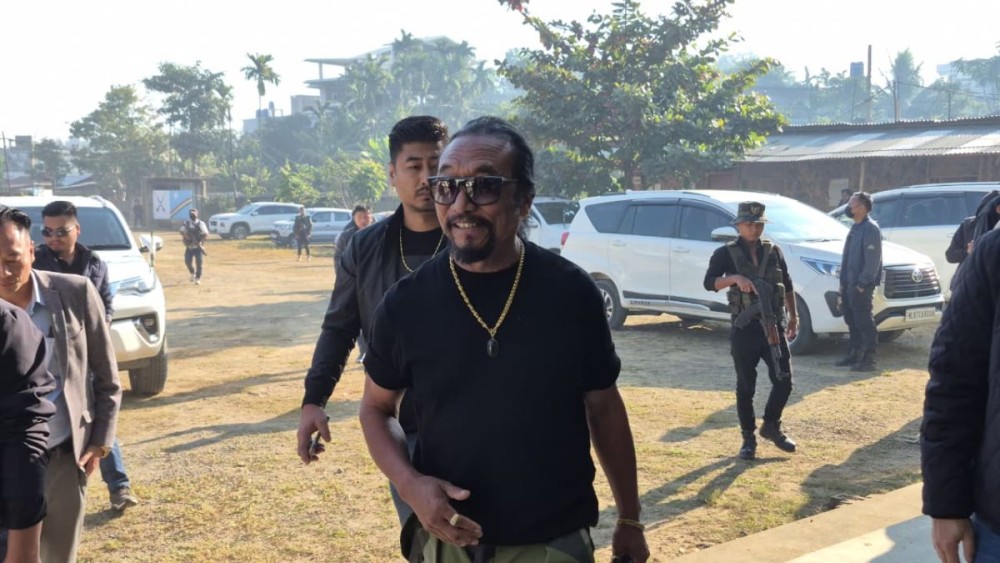
General (retired) Niki Sumi, President of the NSCN-K (Niki) at his groups CFSB office in Dimapur on December 15. (Morung Photo)
Morung Express News
Dimapur | December 15
A fragmented Naga social spectrum does not augur well for an already splintered Naga political movement, according to General (retired) Niki Sumi. He said that not only has the Naga political movement splintered into various groups, even the Naga tribes have herded themselves into blocs further exacerbating a stalemated Indo-Naga political issue.
“We must stop the rhetoric and work towards genuine unity. To unite, Naga leaders transcending the ‘overground and underground’ realms must stop cherry-picking weak points and instead work towards overcoming differences,” Sumi told a press conference at the Ceasefire Supervisory Board (CFSB) office of the NSCN-K (Niki) he leads as the President, in Dimapur on December 15.
Terming the perceived division as a symptom of differences hidden within, he said that the semblance of unity that prevails will further disintegrate if it continues. He added that the trend of Naga tribal leaders individually meeting and lobbying the Government of India (GoI) officials is not helping the situation, rather only problematising it.
According to him, the various tribal blocs cutting across the Naga inhabited areas must first come to terms before any solution. He regretted the Eastern Nagaland People's Organisation (ENPO) allegedly avoiding participating in collective Naga discussions and requested that they reconsider their stance.
Babus & netas
Sumi castigated retired officials, including bureaucrats and former legislators, for what he alleged was crying foul over government policy, having done nothing to improve conditions while holding office. He held that critiquing the state government regarding the Naga political issue is misplaced, as the latter is bound by the Indian Constitution. Per his argument, demands must be directed at the GoI, not local representatives.
AP & FA
He further directed criticism at the Agreed Position and Framework Agreement. The proponents of the former, he said, has had a fallout with two diverging Working Committee, Nagaland National Political Groups (WC, NNPGs) emerging. “Although there is one Agreed Position, there are now effectively two WC, NNPGs,” he said.
While the Agreed Position was originally signed by 7 Naga Political Groups (NPGs), he said that it has now splintered into 17-18 groups. He added that the more they splinter, the more problematic the situation would become.
As far as the Framework Agreement (FA) was concerned, he held that the NSCN (IM) cannot expect the Naga public to cooperate without knowing the content or “competencies”. “They are seeking cooperation without offering transparency,” he said, adding that they have no grounds to feel aggrieved by a lack of support when they themselves are not transparent.
He questioned the logic of demanding ‘flag and constitution’ without sovereignty and integration. Even if it is acceded to, he queried whether its scope will be confined to Nagaland only, or the entire Naga-inhabited area.
On reconciliation
He reiterated that he agreed to a Ceasefire with the GoI on the request of Naga tribal organisations, and with the intention of working towards an inclusive one solution. He disclosed that after the ceasefire deal, he was asked by the GoI to submit a ‘Charter of demands,’ which he declined. He argued that the onus rests with the other Naga Political Groups (NPGs) to build a unified front, and only then will he join.
In the event of a united front, he though maintained that he will not join blindly. While stating that his group has no intention of engaging in separate talks, he said that adding a third agreement would only create more division.
According to him, his course of action will ultimately be guided by the collective will of a united Naga people.
A better deal
Nagaland reportedly got a better deal compared to other states in the north-eastern region. He argued that comparatively, Nagaland has fared better and secured a more favourable deal because of the political movement that predates statehood.
Terming it a unique struggle, he said that the movement has allowed the state to keep illegal immigration in check. While intellectuals may criticise the proliferation of NPGs, he held that it is these groups that have elevated Naga identity within the wider Indian landscape.
He further claimed that these very groups deterred non-Naga businesses from dominating the local economy, while allowing Naga entrepreneurs to get a foothold in business.