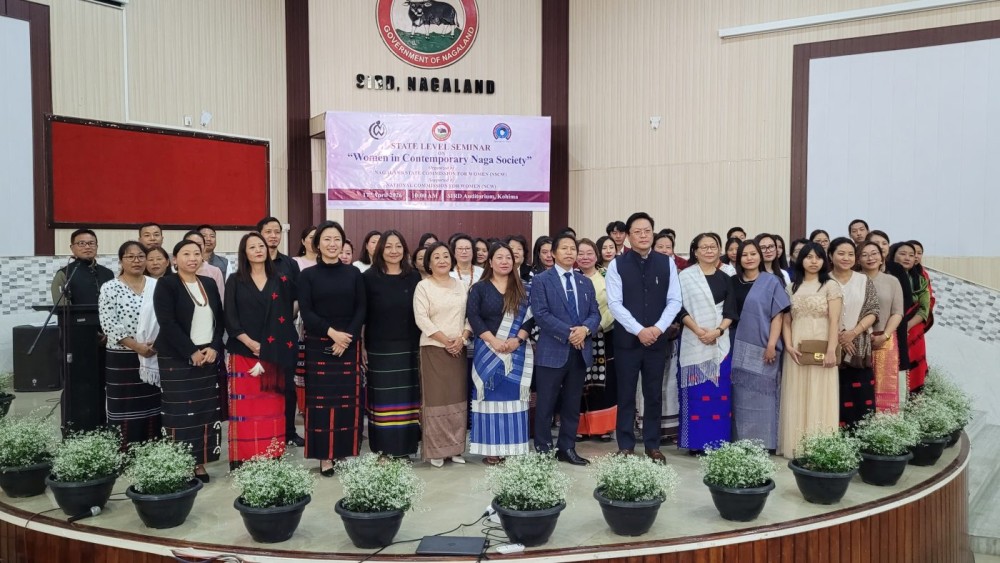
Participants with resource persons, NSCW members and others during the state-level seminar on ‘Women in contemporary Naga society’ at Kohima on April 17. (Morung Photo)
Morung Express News
Kohima | April 17
Secretary, Department of Social Welfare, Limawabang Jamir, IAS today noted that for generations, discussions around Naga tradition largely focused on warriors, village councils and male elders, reflecting the patriarchal nature of society.
While women played vital roles in agriculture, household management and preservation of culture, their participation in decision-making remained limited, he stated at the state level seminar on ‘Women in contemporary Naga society’ on April 17.
The seminar held at the SIRD Auditorium, Kohima was organised by the Nagaland State Commission for Women (NSCW) with support from the National Commission for Women (NCW.
“Today, that reality is changing,” he said, adding that women are no longer confined to traditional roles but are increasingly visible across education, politics, business and social activism.
He highlighted education as a key driver of this shift, pointing out that more Naga women are pursuing higher studies and entering professions as teachers, doctors, administrators and entrepreneurs.
“This shift has not only improved their individual status but also contributed to the overall development of society,” he said.
In the economic sphere, Jamir said women continue to demonstrate resilience and independence, from running local markets to managing small and medium enterprises. He described the familiar sight of women vendors in markets as “not just cultural, but a clear sign of economic strength.”
He also pointed to growing political participation, calling it a significant milestone stating “this shows that women are not just participating, but leading” further adding that ‘we’ stand today at a historic crossroads being rewritten by the hands of its women.
Despite these gains, Jamir acknowledged that challenges remain, including gender inequality, limited representation in traditional institutions, and social expectations that continue to restrict many women.
While observing that balancing modern aspirations with traditional values can also be difficult, he maintained that Naga women continue to show resilience and adaptability. “They are not only preserving culture but also redefining it in the modern context,” he added.
“Women are no longer silent contributors but active participants and leaders. Empowering women is not just about equality but about strengthening society as a whole,” stated Jamir.
During the technical session, Dr Theyiesinuo Keditsu, Assistant Professor, Kohima College, spoke on “Empowering Women through Awareness, Dialogue and Cultural Sensitivity.” Rev Dr Ellen Konyak Jamir, Associate Professor, Oriental Theological Seminary presented on “Navigating the Socio-Cultural Challenges of Women in Nagaland.” Dr A Wati Walling, Associate Professor & Dean (Academic), Department of Science & Humanities, National Institute of Technology, spoke on “Balancing Tradition and Transformation in Naga Society.”