• Say regularisation issue no longer an executive matter
• Delay or obstruction amount to contempt of court
• Urge State Government and NSF to act in accordance with law.
Morung Express News
Kohima | February 8
The Joint Action Committee (JAC) of COVID-era appointed healthcare workers has asserted that the issue of their regularisation is no longer within the discretionary domain of the executive, terming the State Cabinet’s February 3 decision to keep the regularisation order “on hold” as “legally untenable and constitutionally impermissible.”
In a statement issued through its media cell, the JAC stated that the affected health workers have already completed the joining process and that their appointments have “attained legal effect.”
Accordingly, it contended that any subsequent attempt to stall or suspend implementation through an executive “hold order” is arbitrary, ultra vires, and violative of Articles 14 and 21 of the Constitution of India.
“What has attained finality in law cannot be rendered uncertain or infructuous by a subsequent administrative order,” it added.
The JAC further pointed out that it is a settled legal principle that wilful non-implementation or obstruction of a judicially settled issue amounts to contempt of court. It stated that continued delay, inaction, or indirect circumvention through external pressures exposes the authorities concerned to contempt proceedings for deliberate disobedience of binding legal conclusions.
Urging the State Government and the Naga Students’ Federation to resolve the matter strictly in accordance with law and constitutional propriety, the JAC maintained that engagements or negotiations cannot override judicial discipline or dilute settled legal rights.
“Failure to revoke the hold order and implement the lawful decision forthwith will compel the affected healthcare workers to initiate appropriate contempt of court proceedings, in addition to pursuing other legal remedies available under law,” the statement said.
The committee also indicated that it would be constrained to adopt lawful and democratic forms of protest, if necessary, to safeguard the healthcare workers’ constitutional rights, professional dignity, and livelihood.
“This matter has moved beyond policy debate. It is now about respecting the law, upholding the Constitution, and ensuring that the Government acts responsibly,” the JAC asserted.
Background
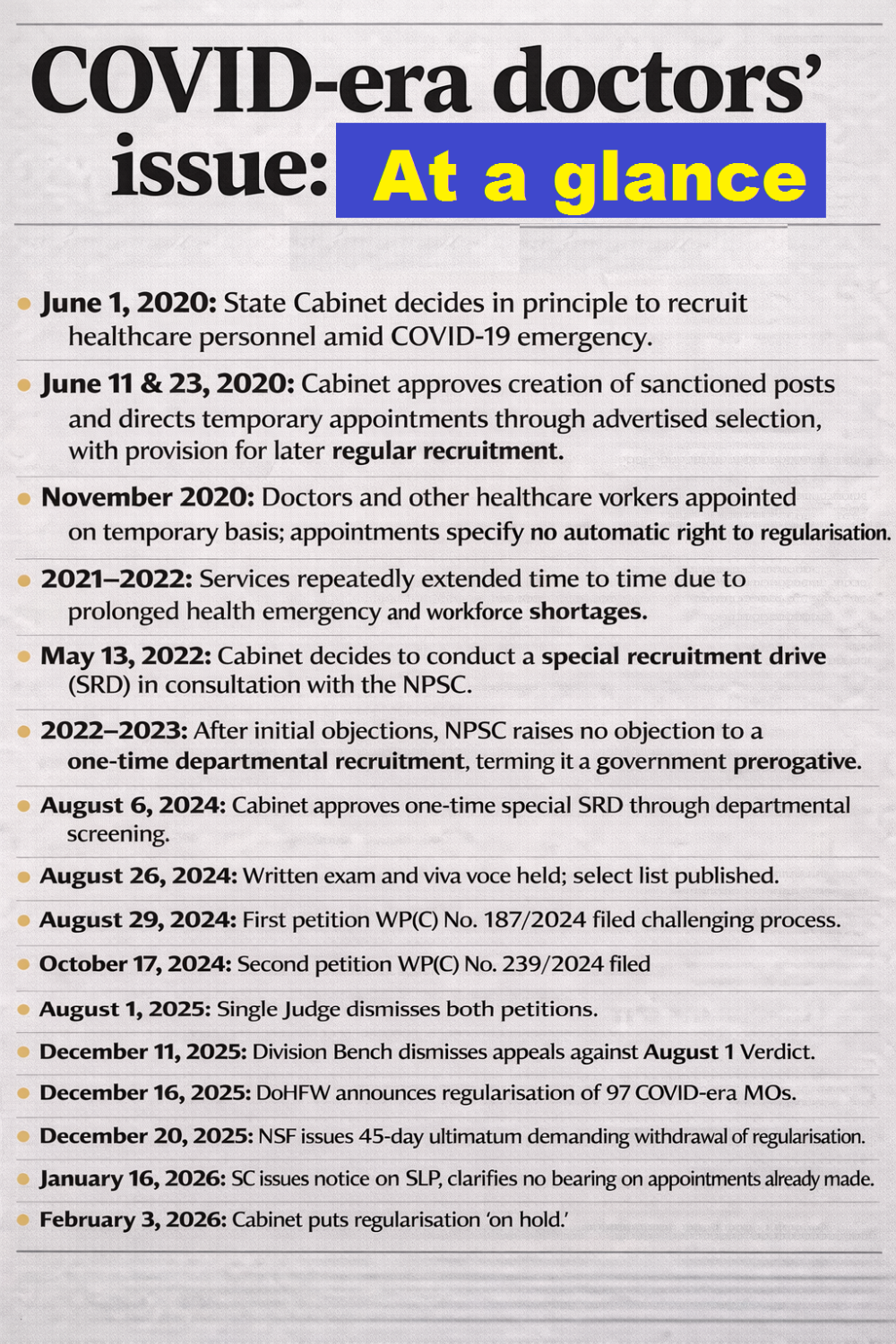
It may be noted that a single-bench judge of the Gauhati High Court, Kohima Bench, on August 1, 2025, dismissed two writ petitions challenging the State Government’s SRD process in a common judgment.
Subsequently, on December 11, a Division Bench of the Court dismissed two writ appeals challenging the single-judge judgment, finding “no infirmity,” and allowed the State to proceed with the regularisation under the SRD, if it had “not already been completed.”
Apart from holding that the a set of petitioners lacked locus standi, the Court upheld the constitutional validity of the State’s policy under Articles 14 and 16 of the Constitution of India.
Following the verdict, the Department of Health and Family Welfare, on December 16, announced the regularisation of 97 medical officers who were engaged on a contractual basis during the COVID-19 pandemic.
However, on December 20, the NSF opposed the Nagaland Government’s decision to regularise the medical officers and served a 45-day ultimatum demanding withdrawal of the regularisation order.
Meanwhile, a Special Leave Petition (Civil) was filed before the Supreme Court against the December 11, 2025 judgment in connection with the issue.
However, the apex court, while issuing notices on January 16, effectively upheld the regularisation stating that pending claims by the petitioners would not affect appointments already made by the State.
“It is made clear that the present claim of the petitioners will have no bearing on the appointments already made by the State,” the order stated.
The Cabinet’s February 3 decision came in the wake of the expiry of the 45-day ultimatum by the NSF.
Incidentally, the NSF had then described the Government’s action as “arbitrary, unconstitutional and legally untenable.”