Morung File Photo
Morung Express News
Kohima | November 3
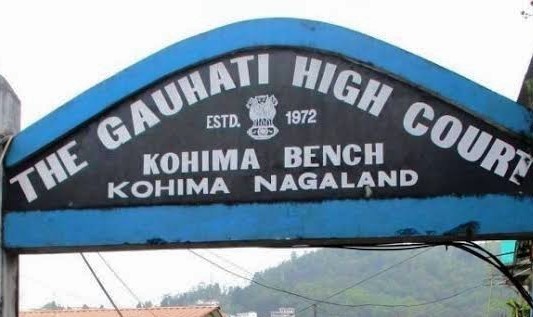
The Gauhati High Court, Kohima Bench, has clarified that the Nagaland Government may acquire land under the Nagaland Land Requisition and Acquisition Act, 1965, but compensation must be determined according to the rates and quantification prescribed under the Right to Fair Compensation and Transparency in Land Acquisition, Rehabilitation and Resettlement Act, 2013 (RFCTLARR Act), which the Court held to be more beneficial to landowners.
The 1965 Act “has not been replaced by the Act of 2013 in the State of Nagaland,” noted the clarification was issued by a Division Bench comprising Justice Susmita Phukan Khaund and Justice Yarenjungla Longkumer on November 3 while disposing of review petitions filed by some landowners from D-Khel Kohima.
However, it added that “the acquisition process may be done in terms of the Act of 1965” while “just and fair compensation has to be made as per rates and quantification as provided under the Act of 2013 as it will be more beneficial to the landowners.”
Case background
The litigation originated from two writ petitions, WP(C) 216/2021 and WP(C) 50/2022, filed by landowners seeking compensation for the acquisition of their lands.
On November 29, 2024, a Single Judge of the High Court held that the petitioners were entitled to just and fair compensation under the 2013 Act. The State challenged the decision through Writ Appeals (7/2025 & 6/2025) but a Division Bench upheld the Single Judge ruling on May 5, 2026.
The landowners subsequently sought a limited review, arguing that certain observations in the appellate judgment were being interpreted by the State to mean that the 1965 Act applied to the exclusion of the 2013 Act.
They contended that the earlier judgment had not considered their submission that the National Highways Act, 1956, and the 2013 land acquisition Act did not require separate adoption by Nagaland, arguing that both were already in force by virtue of Section 26 of the State of Nagaland Act, 1962.
The reliance on an earlier High Court judgment in Repasosang Ao v. State of Nagaland was also challenged by invoking the doctrine of implied repeal, arguing that the 2013 Act had effectively replaced the 1965 Act.
The State opposed the review petitions, submitting that review jurisdiction is limited and cannot be used as an appeal in disguise.
Court clarifies legal position
The Bench agreed that the petitioners had not established grounds warranting a review of the earlier judgment. Citing the Supreme Court’s decision in Kamlesh Verma v. Mayawati, it reiterated that review cannot be used to substitute one judicial view for another. It observed that an error apparent on the face of the record must be self-evident and not one requiring “a long drawn process of reasoning”.
“Not every legal error, omission, or failure to discuss an argument qualifies for review,” it added.
On whether the 2013 Act had rendered Nagaland’s 1965 acquisition law inapplicable, the Court relied on the doctrine of harmonious construction, under which two enactments may coexist where their provisions can be reconciled.
“The principle of implied repeal does not necessarily render the entire earlier act inapplicable,” and the two laws could operate together “where there is no repugnancy,” it held.
Accordingly, the Court clarified that the acquisition process may proceed under the 1965 Act, but compensation must be determined according to the rates and quantification prescribed under the 2013 Act.