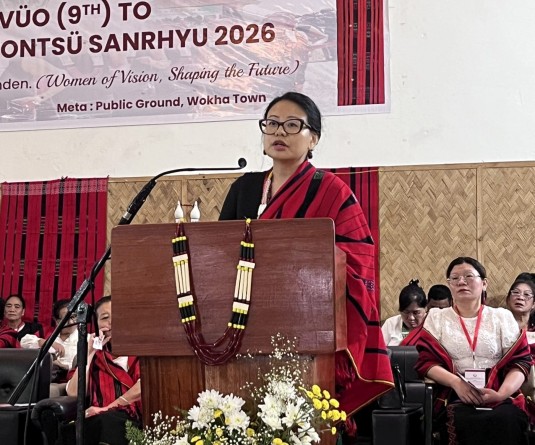
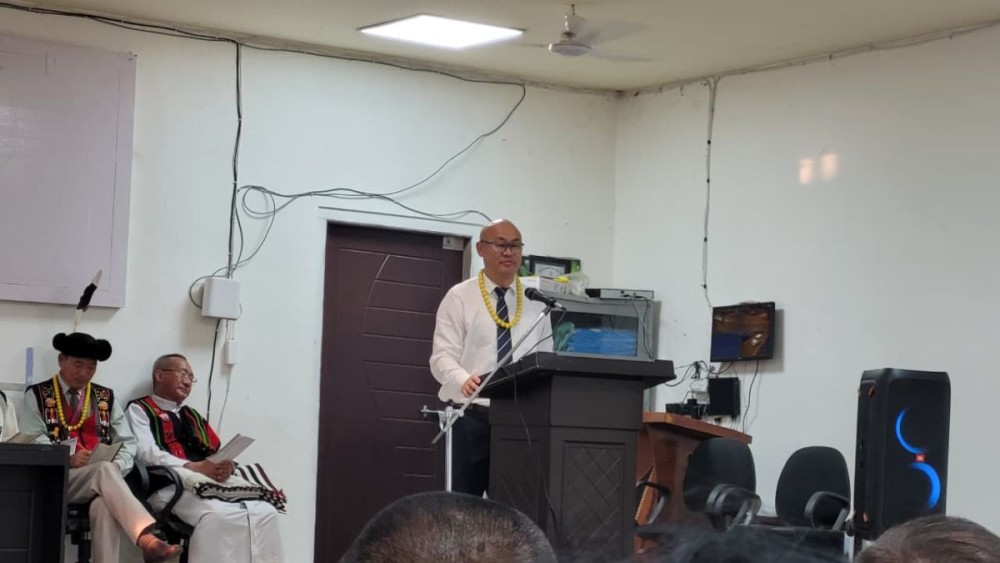
Dr Villo Naleo, Secretary Social Concerns, NBCC addressing the leaders conference in prelude to the Sekrenyi-cum-Mini Hornbill 2026 held at Sovima Village Council ground on February 24. (Morung Photo)
NBCC leader explores on navigating faith and tradition
Morung Express News
Sovima | February 24
Living as a Christian while remaining rooted in one’s culture is never simple, especially in a world shaped by flawed systems and human imperfections. Christians are called to live in the world without surrendering their moral and ethical convictions. Culture, like human society itself, is complex neither entirely good nor entirely evil and constantly evolving with time.
These observations were shared by Dr Villo Naleo, Secretary Social Concerns, Nagaland Baptist Church Council (NBCC) during the leaders conference in prelude to the Sekrenyi-cum-Mini Hornbill 2026 held at Sovima Village Council ground.
Speaking on the topic ‘Christianity and Culture,’ he reflected that if human culture were perfect in itself the coming of Jesus Christ would have been unnecessary. Quoting Matthew 5:17, Dr Naleo noted that Jesus did not abolish the law or traditions but fulfilled them, correcting distortions caused by human convenience, greed and misinterpretation, wherein Jesus confronted the law teachers, scribed and pharisees who were interpreting the law according to their convenience.
Ancestral beliefs and Christian faith
According to Dr Naleo, ancestral beliefs and customary laws share several parallels with biblical teachings, particularly in values such as purity, respect, community harmony, and moral restraint. However, while these traditions guide good living, they cannot offer salvation or righteousness in the Christian sense, he reminded.
He also noted that the Tenyimia ethos is shaped by two core values: shame and taboo that regulate social conduct and religious discipline, emphasising virtue, hospitality, generosity, love, respect for elders, and sensitivity to others.
While pointing out that these cultural values closely resemble the biblical understanding of goodness, Dr Naleo however, reminded that for Christians, goodness is ultimately personified in Christ.
Christianity, culture and context
Culture survives through a dynamic process of adaptation- passing down traditions, language and values across generations while navigating external pressures and modernisation, said Dr Naleo.
“Culture and Christianity must go side by side, complementing each other. The other word for this relationship can be called ‘contextualisation.’ Christianity came out from a certain context and the cultural nuances cannot be dismissed” he maintained.
Rethinking Sekrenyi
Addressing the debate around Sekrenyi festival, Dr Naleo acknowledged its roots in ancestral religion but noted that contemporary celebrations have largely shifted away from ritual practices toward cultural expression. Today, Sekrenyi often highlights traditional attire, community values, purity, and frugality rather than religious rites.
However, he cautioned against celebrations that promote excess, debauchery, discrimination, majoritism, tribalism, or violence, and that cultural pride should never become an excuse for moral compromise or harm.
Dr Naleo challenged the notion that abstaining from cultural festivals automatically leads to holiness. Christian spirituality, he argued, is not about withdrawal but about living a Spirit-led life rooted in relationship with God and expressed through community, mission and daily conduct.
If the church thinks that celebrating Sekrenyi is abhorrent to God and evil in nature, we must let the church have its say on this issue. One must not dictate the other by demonising and stereotyping people who are celebrating or not celebrating” said Dr Naleo.
He calls for mutual respect between the Church and society, stressing that neither can detach itself from each other as long as ‘we’ are here on earth. Rather, he viewed that the Church must continue to act as the moral conscience of society without alienating the people it seeks to guide.
Drawing parallels with Christmas and Easter both of which have absorbed cultural and even pagan elements over centuries, Dr Naleo argued that cultural influence alone does not invalidate faith.
Meanwhile, he suggested that rather than condemning Sekrenyi, Christians should engage with it thoughtfully by imitating Christ.
“Since, the participants are mostly Christians, we must not forget the call for Christians to be the salt and light of this world. We cannot become overnight spiritual giants, by detaching ourselves from such celebrations” said Dr Naleo.
While it may take time to transform Sekrenyi into a full corporate Christian tradition, he suggested that as ‘we’ continue to celebrate, the idea of abandoning harmful elements in the celebration can be mediated.
Sekerenyi is being organised by the Angami Public Organisation, sponsored by the Department of Tourism and hosted by Sovima Village Council.
The celebration on February 25 will be graced by Temjen Imna Along, Minister for Tourism & Higher Education, Zhaleo Rio, Advisor for Urban Development & Municipal Affairs and Zandi Dumta, President, Nagaland Zeliang People’s Organisation.
.png)