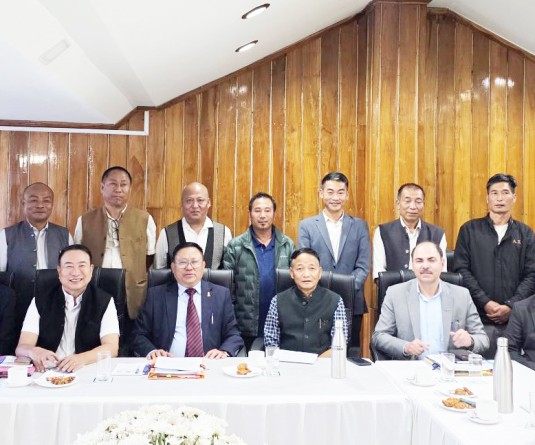
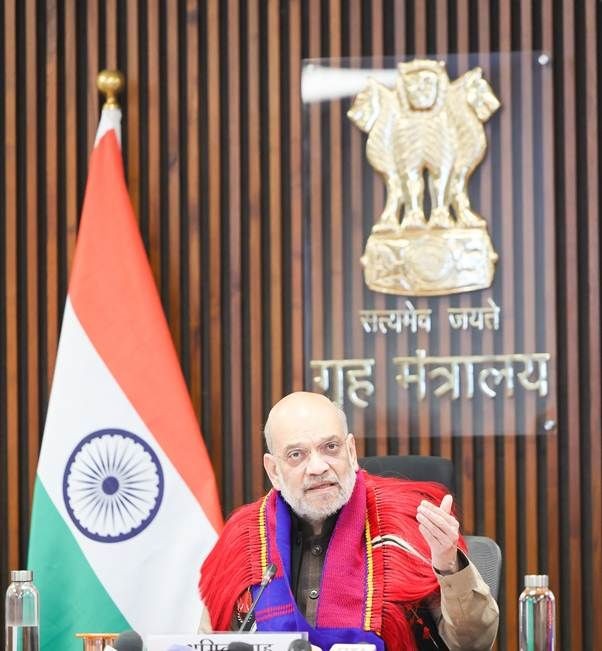
Union Home Minister Amit addresses the signing of the Memorandum of Agreement on the Frontier Nagaland Territorial Authority between the Government of India, the Government of Nagaland and the Eastern Nagaland Peoples’ Organisation in New Delhi on February 5. (PIB Photo)
FNTA MoA: At a glance
• Coverage: Six districts of Eastern Nagaland
• Powers: 46 subjects to be devolved to FNTA
• Administration: Mini-Secretariat headed by ACS/PS-level officer
• Funding: Fixed annual Central allocation; MHA to bear initial setup cost
• Development outlay: Shared based on population and area
• Safeguard: Article 371(A) remains unaffected
• Goal: Faster governance and development delivery
Morung Express News
Dimapur | February 5
Further details of the Memorandum of Agreement (MoA) on the Frontier Nagaland Territorial Authority (FNTA) have outlined key administrative and financial arrangements, including the establishment of a Mini-Secretariat, devolution of powers over 46 subjects, and explicit safeguards for Article 371(A) of the Constitution.
The MoA was signed in New Delhi on February 5 between the Government of India, the Government of Nagaland and the Eastern Nagaland Peoples’ Organisation, paving the way for the formation of the FNTA for six districts of the State.
In a statement, the Union Ministry of Home Affairs informed that the FNTA will be supported by a Mini-Secretariat headed by an Additional Chief Secretary or Principal Secretary-level officer. The arrangement is intended to strengthen decentralised governance and ensure focused implementation of development programmes in Eastern Nagaland.
The agreement provides for the transfer of powers relating to 46 subjects to the FNTA, enabling greater administrative autonomy for the six districts covered under the new authority. Development outlay for Eastern Nagaland will be shared proportionally based on population and area, it said.
On the financial front, the Government of India will extend support through fixed annual allocations, while the Union Ministry of Home Affairs will bear the initial establishment expenditure, including costs associated with setting up the Mini-Secretariat and administrative infrastructure, it added.
The MHA further clarified that the arrangement does not affect the provisions of Article 371(A) of the Constitution of India in any manner, addressing concerns related to Naga customary law, land and ownership.
Speaking at the signing ceremony earlier, Union Home Minister Amit Shah said the agreement reflects the Government’s commitment to resolving long-standing issues through dialogue and assured that there would be no obstacles in the path of development of Eastern Nagaland.
The FNTA framework envisages overall development of Eastern Nagaland through enhanced decision-making, financial autonomy and accelerated infrastructure development, to be jointly taken forward by the Centre and the State Government, the statement added.