Morung Express News
Dimapur | March 1
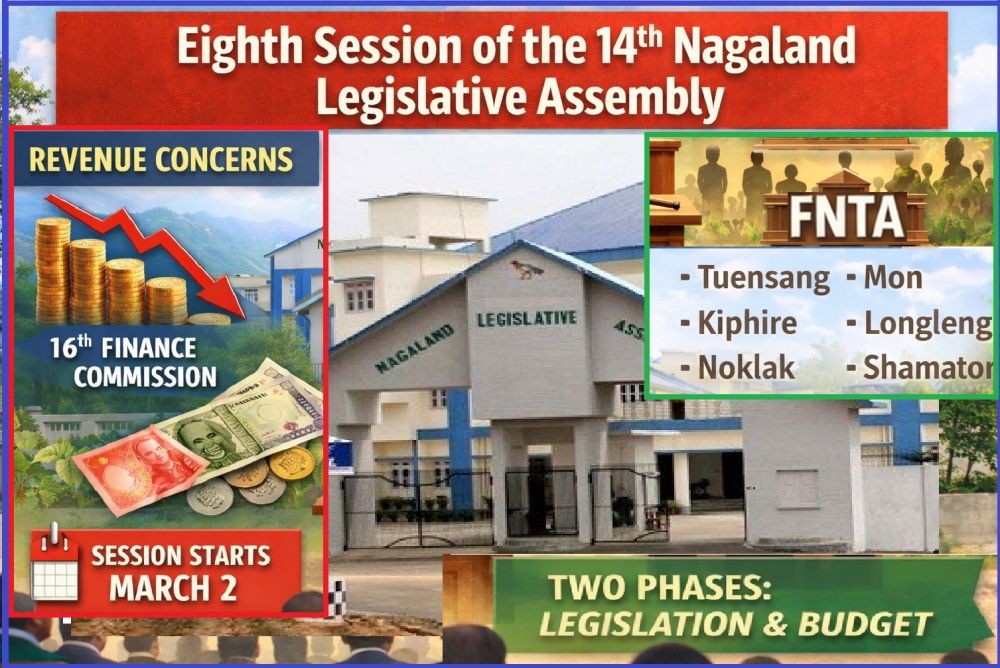
Revenue constraints under the Sixteenth Finance Commission (16th FC) framework and the proposed the Frontier Nagaland Territorial Authority (FNTA) are set to dominate the Eighth Session of the 14th Nagaland Legislative Assembly (NLA), beginning March 2.
Chief Minister Dr Neiphiu Rio had earlier indicated the Assembly would pass a State Act to facilitate the formation of the interim arrangement during the upcoming Budget Session.
“The interim will be for one year. And after that, elections will be held,” he informed media on the sidelines of an event on February 11, clarifying that it would be a State legislation and not a Parliament Act.
The move follows the signing of a Memorandum of Agreement (MoA) in New Delhi on February 5 between the Government of India, the Government of Nagaland and representatives of the Eastern Nagaland Peoples’ Organisation (ENPO), paving the way for the formation of the FNTA “within the State of Nagaland.”
The proposed FNTA will cover six districts - Tuensang, Mon, Kiphire, Longleng, Noklak and Shamator.
Among others, agreement provides for devolution of powers relating to 46 subjects to the Authority, aimed at strengthening decentralised governance and accelerating development in Eastern Nagaland. It also envisages proportional sharing of development outlay for the region based on population and area.
According to a statement issued by the Union Ministry of Home Affairs (MHA) after the singing, the arrangement includes establishment of a mini-Secretariat for the FNTA headed by an Additional Chief Secretary or Principal Secretary. The agreement clarifies that it “does not affect in any manner whatsoever” the provisions of Article 371(A) of the Constitution of India.
The MHA described the agreement as reflective of the Government of India’s commitment to resolving issues in the Northeast through dialogue and negotiation.
Fiscal pressure
Parallel to the FNTA legislative process, the Budget for 2026–27 assumes heightened importance as Nagaland enters the 16th FC award period (2026–31).
Under the 15th Finance Commission (2021–26), Nagaland was awarded Rs 21,249 crore in Post-Devolution Revenue Deficit Grants (RDG), averaging approximately Rs 4,248 crore annually. The State also benefited from Rs 525 crore in state-specific grants during that period.
However, under the 16th FC recommendations tabled officially and tabled the report in Parliament on February 1, 2026, Nagaland’s share in tax devolution has declined from 0.573% to 0.481%.
Further, similar state-specific grants do not feature in the new award cycle, and the continuity of RDG support remains uncertain.
On February 11, the Chief Minister cautioned that the State could face a severe fiscal crisis, including non-payment of salaries, if the RDG is not restored.
He indicated that the potential annual impact could range between Rs 8,000 and Rs 9,000 crore. It was among the “important and pertinent issues” raised by official high-level delegation to New Delhi led by CM Rio led concerning Nagaland with the Government of India (GoI).
The State DIPR then informed that both Union Finance Minister and Home Minister assured to examine the issue, but no concrete outcome had been announced so far.
How the State proposes to mobilise its own sources of revenue to offset the anticipated shortfall will be closely watched, with the Eighth Session of the 14th Assembly expected to offer an early indication of its fiscal strategy.
Session in two phases
Meanwhile, in a notable departure from recent practice, the upcoming session will be conducted in two phases, marking what could be one of the longest sittings in recent years, according to the provisional programme issued by the Nagaland Legislative Assembly Secretariat on February 21.
Phase-I will commence on March 2 with the Governor’s Address, obituary references and the moving of the Motion of Thanks. Subsequent sittings are scheduled for March 3, 9, 10 and 12.
During the sittings, the House is slated to take up questions, matters of urgent public importance, laying of reports, and the introduction and consideration of Government Bills, including the anticipated FNTA legislation.
Phase-II will be devoted to budgetary business and is tentatively set to begin with the presentation of the State Budget for 2026–27.
The detailed programme for this phase will be notified on the last day of Phase-I, the NLA Secretariat informed.
Financial items include presentation of C&AG reports, review of trends in receipts and expenditure, supplementary demand for grants, regularisation of excess expenditure, and passage of the Nagaland Appropriation Bills, 2026.