Moa Jamir
Dimapur | February 4
Nagaland is set to face a significant reduction in assured fiscal support under the Sixteenth Finance Commission (16th FC) award period (2026–31), following a reduction in the State’s share in tax devolution and the possible withdrawal of Post-Devolution Revenue Deficit Grants (RDG).
An analysis of the Arvind Panagariya-led 16th FC report, tabled in Parliament on February 1, 2026, for the five-year period from 2026–27 to 2030–31, indicates that Nagaland has emerged as a net loser compared with the Fifteenth Finance Commission (15th FC), which covered the period from 2021–26.
Reduction in share of central taxes
Among other changes, Nagaland’s share in the divisible pool of central taxes has been reduced under the 16th FC.
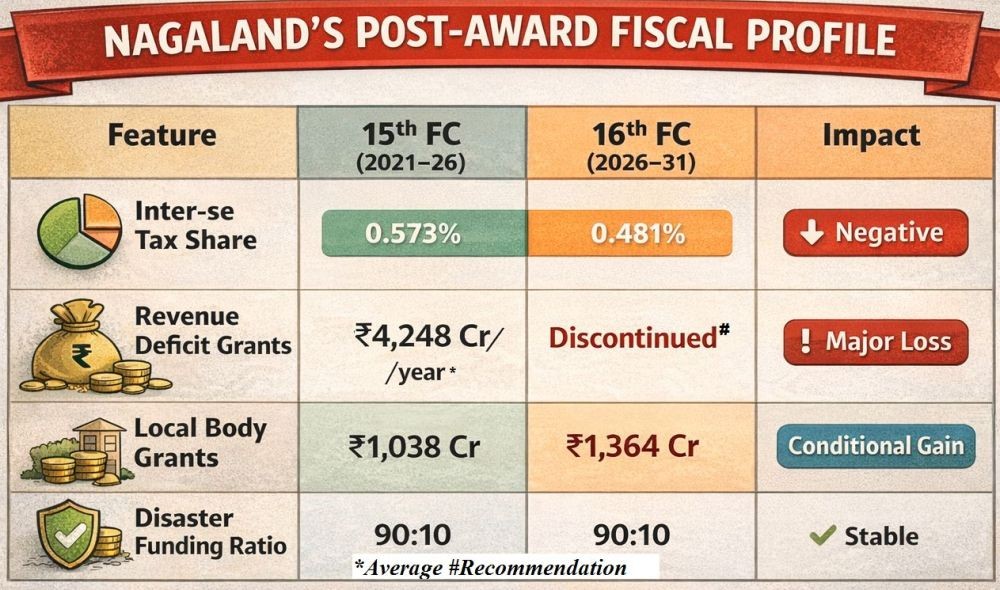
The State’s share has declined from 0.573% under the 15th FC to 0.481% under the 16th FC.
The reduction of nearly 16% in relative terms reflects changes in horizontal devolution criteria that place greater weight on population size and efficiency-related indicators, adversely affecting smaller hill States such as Nagaland.
Under the income distance criterion, defined as the gap between a State’s per capita GSDP and the average per capita GSDP of the three large States with the highest incomes, the weight has been reduced from 45% to 42.5%.
Further, reductions in demographic performance (from 12.5% to 10%) and area (from 15% to 10%), along with the discontinuation of the tax and fiscal effort criterion (2.5%), have also impacted the State’s overall share.
While the weight assigned to population based on the 2011 Census was increased from 15% under the 15th FC to 17.5% under the 16th FC, Nagaland’s population decline in the 2011 Census compared to 2001 may have further affected its allocation.
Possible withdrawal of revenue deficit grants
Perhaps, most significant fiscal pressure would likely to arise from the withdrawal of Revenue Deficit Grants, as the Commission has recommended discontinuing such grants.
According to the 16th FC, the causes of revenue deficits lie in committed and discretionary expenditures, and there is significant scope for States to increase revenues and rationalise spending.
The Commission observed that anticipation of RDG weakens incentives for States to undertake difficult but necessary fiscal reforms, such as rationalising subsidies, improving tax administration, or curbing revenue expenditure.
In continuation of the declining trend of RDG under the 15th FC, which tapered to near-zero levels by 2025–26, the Commission did not recommend RDG for States. It also called for the discontinuation of sector-specific and State-specific grants.
These recommendations could prove to be a major setback for Nagaland, as during the Commission’s visit in November 2024, the State Government had highlighted RDG as critical for maintaining essential services and allocating resources for infrastructure.
Chief Minister Neiphiu Rio had also flagged key pending projects, including the Foothills Road, the proposed airport at Ciethu, Kohima, and the new High Court complex.
To put the impact in perspective, the total Post-Devolution RDG recommended to Nagaland under the 15th FC (2021–26) stood at Rs 21,249 crore, averaging about Rs 4,248 crore annually. In addition, State-specific grants amounting to Rs 525 crore were provided during the same period.
Grants-in-aid to local bodies
Despite reductions in tax devolution and the likely withdrawal of RDG, transfers to rural and urban local bodies will continue under the 16th FC, though the allocations are not sufficient to offset the overall loss.
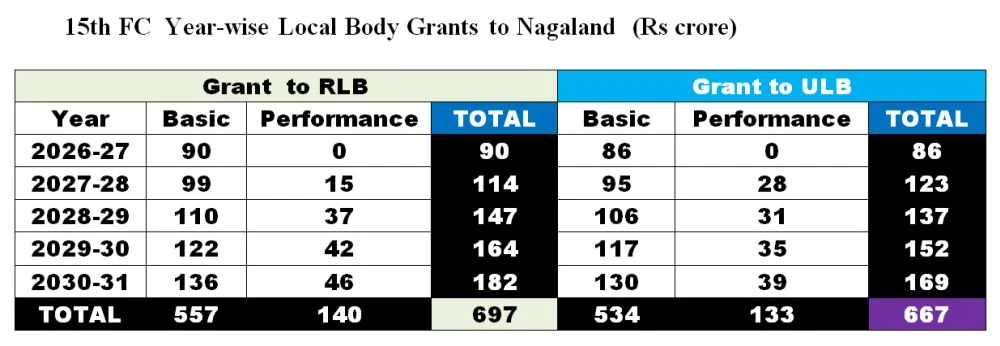
Under the 16th FC award, Nagaland is set to receive Rs 1,364 crore in local body grants over the five-year period from 2026–27 to 2030–31. This includes Rs 697 crore for rural local bodies (RLBs) and Rs 667 crore for urban local bodies (ULBs), marking an increase from Rs 1,038 crore awarded under the 15th FC.
However, while allocations show a gradual annual increase, the 16th FC has introduced tighter performance-linked conditions, particularly for ULBs.
“We recommend that grants for RLBs be classified into basic and performance components, and grants for ULBs into basic, performance, urban infrastructure, and urbanisation premium components,” the Commission stated.
Access to performance grants is contingent on audited accounts, timely data reporting, and compliance with State Finance Commission recommendations.
Unlike the 15th FC, there is no provision for relaxation or transition support for States with limited administrative capacity, raising the risk of delays or partial releases.
Of the Rs 697 crore allocated for RLBs, Rs 140 crore is performance-linked, while Rs 557 crore constitutes basic grants. Similarly, of the Rs 667 crore for ULBs, Rs 133 crore is tied to performance, with Rs 534 crore as basic grants.
Fiscal vulnerability increases
The 16th FC has placed Nagaland among States with a low Own Tax Revenue (OTR) to GSDP ratio, at just 5.5%, the third lowest after Tripura and Manipur.
Conversely, the State’s reliance on devolution and grants for revenue in 2023–24 was the third highest, after Manipur and Arunachal Pradesh.
As a result, the withdrawal of RDG and reduction in tax devolution share are likely to expose Nagaland to greater fiscal stress, even as expenditure pressures persist.
Notably, the 16th FC has not provided any special or transition grants to compensate States that lose RDG or suffer reduced devolution shares. Taken together, the FC-16 award marks a structural weakening of fiscal support for Nagaland.
On a positive note, the 16th FC specifically lauded Nagaland’s parametric insurance solution for extreme rainfall.
.jpg)