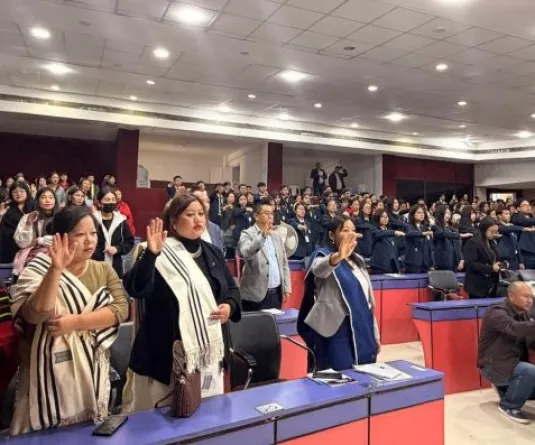
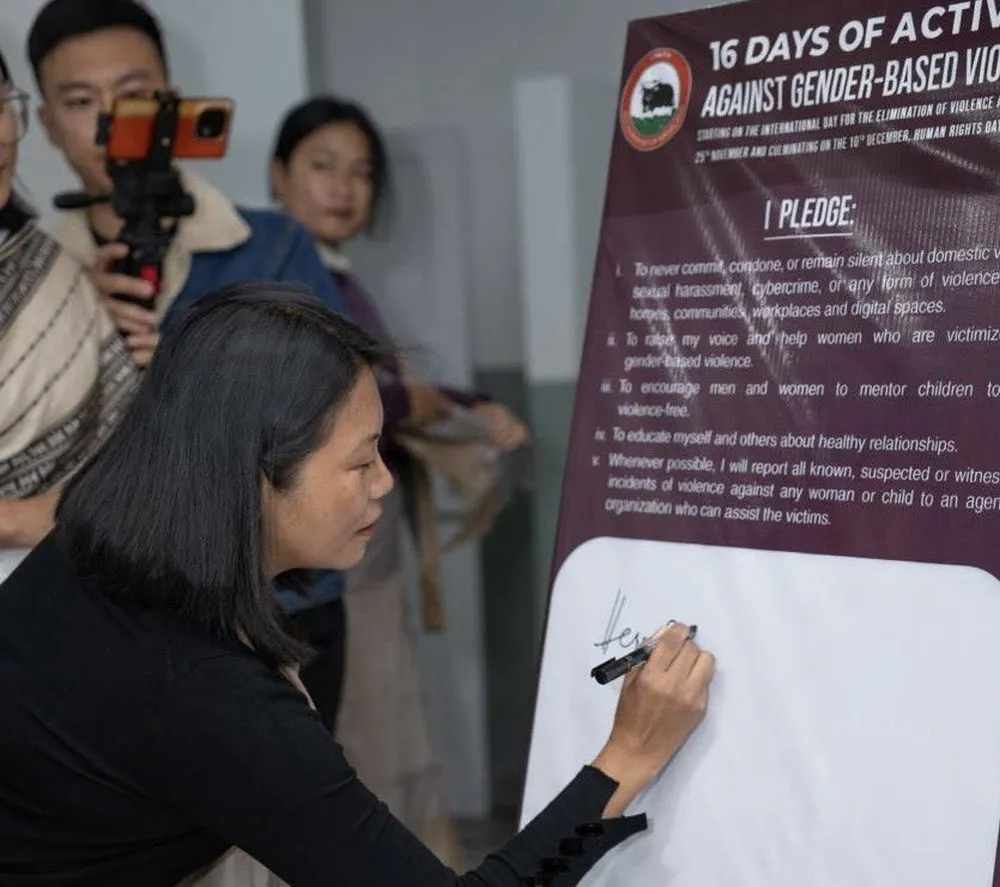
Hekani Jakhalu Kense joins the signature campaign during the International Day for the Elimination of Violence against Women in Kohima on November 25. (Photo Courtesy: X@JakhaluHekani)
Our Correspondent
Kohima | November 25
Nagaland Industries & Commerce Advisor Hekani Jakhalu Kense on Wednesday stressed the need to establish a culture of zero tolerance towards violence against women in the state.
“We need to reinforce the urgent need to break the cycle of abuse before it reaches irreversible ends,” she said at the state-level observation of International Day for the Elimination of Violence against Women in Kohima under the theme “Unite to End Violence against Women and Girls: Ensure Justice, Protect Survivors, End Impunity.”
She emphasised that before discussing how to ensure justice, protect survivors, or end impunity, society must first grasp the true magnitude of the problem.
Citing WHO and UN Women data showing that one in every three women experience some form of violence in their lifetime, she said, “Assuming Nagaland has a population of 20 lakh with women constituting around 10 lakh, this means three lakh of Nagaland’s population is going through problems of negative self-image, anxiety, depression, and other issues.”
She said gender-based violence remains one of the most pervasive human rights violations worldwide, affecting individuals across every country, age group, and socioeconomic background.
She said statistics showing Nagaland as having the lowest rate of violence against women and as one of the safest places for women do not reflect ground reality.
“The idea that Nagaland is a safe haven for women is a confronting myth that does not hold up against reality,” she said.
She said domestic violence remains a silent epidemic, with many cases going unreported due to societal expectations, fear of ostracization, and the deeply entrenched belief that domestic matters should remain private. The consequences of this silence can be fatal, she cautioned.
Call for systematic intervention
The biggest challenge, she said, is the normalization of harassment, violence and abuse, which society has come to treat as ordinary occurrences. “This is the danger facing us today,” she said.
Regarding domestic violence in Nagaland, she said the patriarchal structure escalates the problem, as women are often pressured to endure abuse for the sake of family honor.
Many women remain trapped in toxic relationships due to economic dependence, concern for their children, or fear of social backlash, she observed.
Hekani asserted that without systematic intervention and societal change, countless women will continue to suffer in silence, unable to escape the violence they endure behind closed doors.
Stressing that abuse and trauma have lasting consequences, she said they affect survivors’ emotional well-being, relationships, and sense of self, and can increase the risk of anxiety, depression, self-harm, and even suicide.
While Naga ancestors prided themselves on protecting women and children, today’s Naga society has failed to uphold that legacy, she lamented. The time has come for society and each one of us to confront these issues rather than suppress them under the guise of tradition, morality, and religion. For Nagaland to be truly safe for women, society must first acknowledge the problem and commit to change, she said.
‘Enforce laws strictly’
Emphasising that addressing violence against women is not the government’s responsibility alone, she said the church, civil society organizations, and every individual must also take responsibility.
Urging the church and CSOs to actively advocate for women’s rights and support survivors, she said: “Continuous awareness campaigns should educate women on their legal rights and encourage them to report abuse without fear of stigma.”
As the moral and ethical backbone of the community, the church has the power to shape societal attitudes, she said. Every government department should take the issue of violence against women seriously and jointly push the agenda, she added.
Stating social awareness and street protests alone are not enough once crimes have been committed, she said, “It is the government’s job to enforce laws strictly, set up strong institutions, and establish more women’s shelters, crèche centers, and legal aid services to provide survivors with tangible support systems.”
Without stronger laws and institutional backing, women will continue to suffer in silence despite public activism, she said.
“We have to start a strategic plan involving every type of stakeholder to normalize zero tolerance for violence against women in our state,” she added.