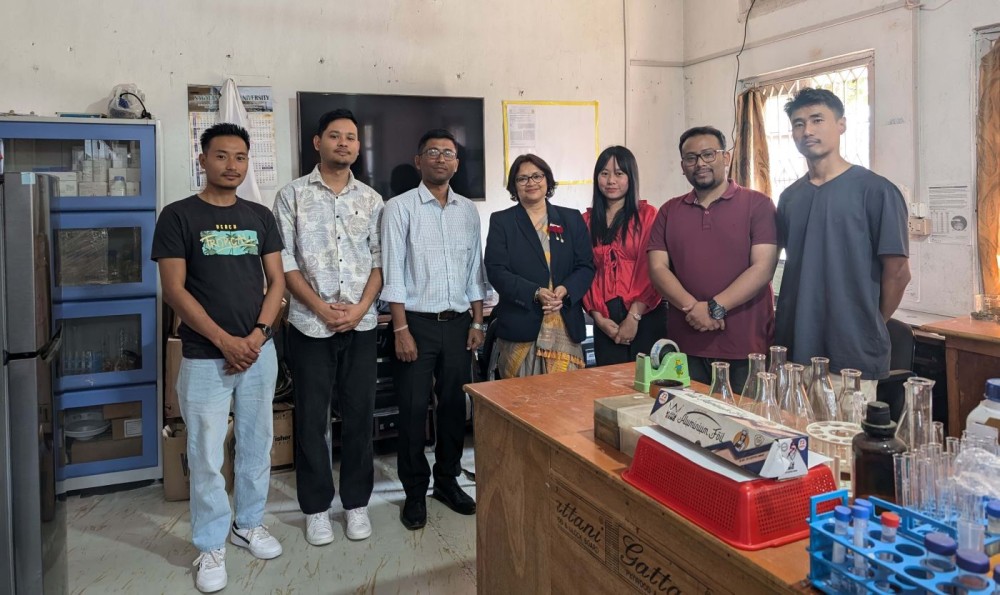
Dr Pranjal Bharali (3rd from left L), Assistant Professor, Department of Environmental Science, with his Research Team at a lab in Nagaland University.
Lumami, March 23 (MExN): A multi-institute research team led by Nagaland University has developed a biodegradable biopolymer that offers a sustainable alternative to conventional plastics, potentially addressing the escalating global crisis of microplastic pollution.
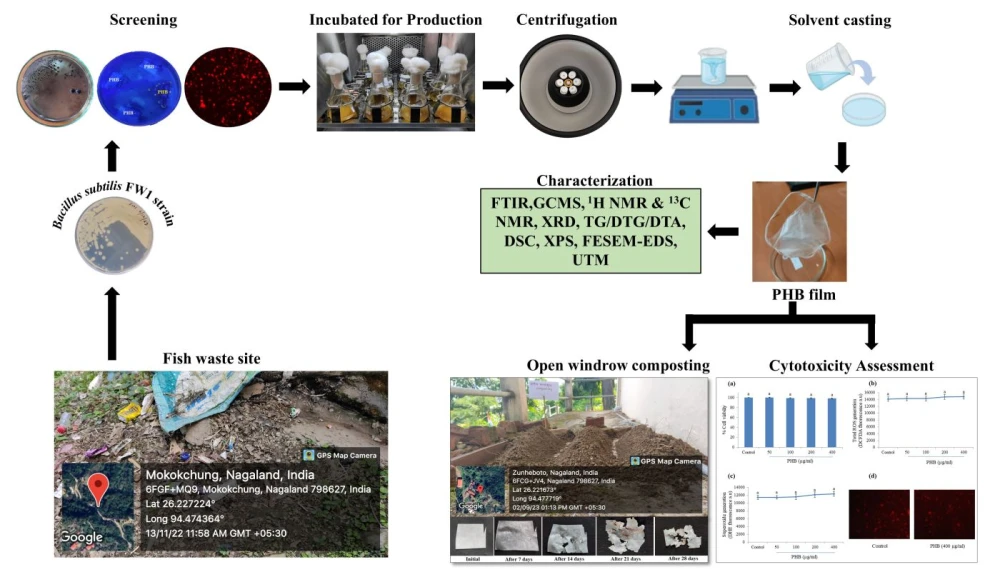
The polymer, known as Polyhydroxybutyrate (PHB), was produced using a bacterial strain called Bacillus subtilis FW1 isolated from fish waste disposal sites in Mokokchung district of Nagaland. PHB is biodegradable, biocompatible, and derived from biological sources, positioning it as a promising replacement for petroleum-based plastics.
Microplastics, tiny plastic particles that accumulate across ecosystems, have emerged as pollutants of global concern. Due to their minute size, they are easily ingested by organisms and gradually accumulate in the food chain. Through biomagnification, the concentration of these particles increases at each trophic level, eventually reaching humans and posing significant risks to both health and ecosystems.
The research, published in the Journal of Polymer Research, a peer-reviewed publication of Springer Nature, was led by Dr Pranjal Bharali, Assistant Professor at Applied Environmental Microbial Biotechnology Laboratory in the Department of Environmental Science, Nagaland University. The team included doctoral scholars Shiva Aley Acharjee, Bhagyudoy Gogoi, Bendangtula Walling, Viphrezolie Sorhie, and Alemtoshi, along with researchers from other institutions.
Collaborating institutions included Sathyabama Institute of Science and Technology, CSIR-North East Institute of Science and Technology, Tezpur University, Bharathiar University, University of Science and Technology Meghalaya, and Galgotias University.
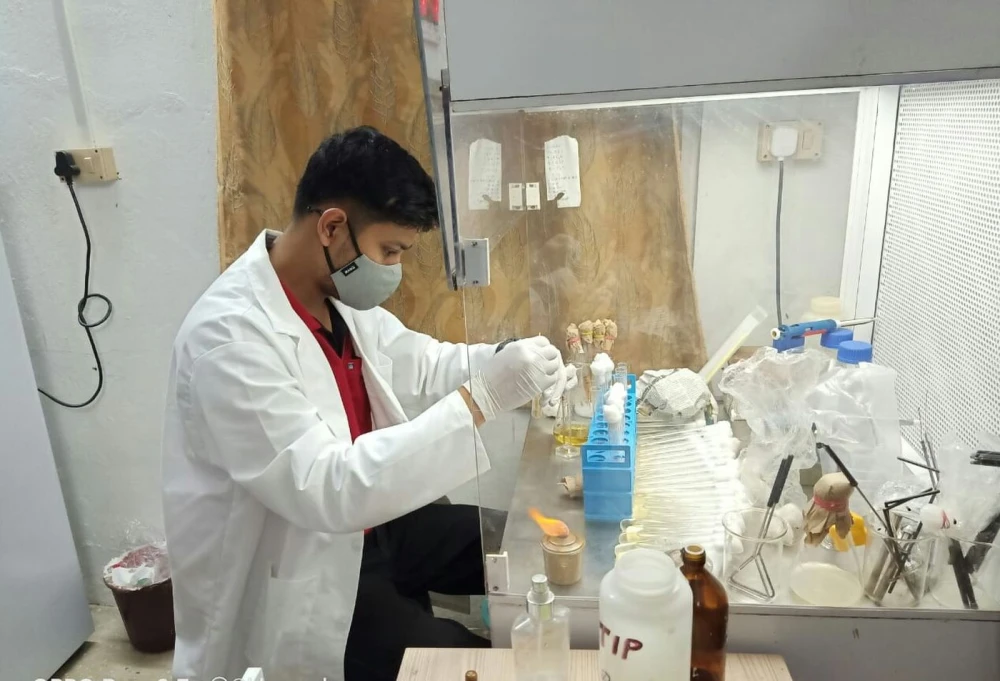
The study demonstrated that the bacterial strain could accumulate up to 69.2% PHB biopolyester, indicating strong production potential. Physico-chemical characterisation revealed high thermostability, while laboratory testing confirmed the material is biocompatible with human liver hepatocellular carcinoma cell lines (HepG2), suggesting its potential safety for biomedical applications.
In soil burial experiments using the open windrow composting method, PHB film degraded by approximately 59.6% within 28 days, underscoring its potential as a sustainable biomaterial.
Nagaland University Vice Chancellor Prof Jagadish K Patnaik hailed the achievement, stating, “This innovative material, produced from bacteria isolated from fish waste disposal sites in Nagaland, represents a significant step forward in addressing the global challenge of microplastic pollution.”
He added, “The development of this eco-friendly and sustainable alternative to conventional plastics highlights the importance of scientific research rooted in local resources and environmental responsibility. Nagaland University remains committed to advancing research that contributes to environmental sustainability, supports green technologies, and benefits society at large.”
Dr Pranjal Bharali said advances in microbial biotechnology could play a critical role in tackling the plastic pollution crisis while creating sustainable materials. “This research highlights how bacterial biopolymers could help reduce dependence on fossil fuel–based plastics while contributing to a circular bioeconomy. Widespread adoption of such biodegradable materials could reduce environmental pollution, mitigate microplastic formation, lower carbon emissions and open new possibilities in sectors such as medicine, agriculture and sustainable packaging.”
He noted that future research would focus on improving bacterial strain efficiency, optimising metabolic pathways, and utilising low-cost waste-based feedstocks to make PHB production economically competitive with conventional plastics.
At present, the researchers have successfully isolated bacteria from fish waste disposal sites in Mokokchung and synthesised PHB using glucose as a carbon source. The extracted polymer has undergone biodegradability and biocompatibility assessments, demonstrating its non-cytotoxic nature and promising environmental performance.
The researchers also emphasised the need to address several scientific and societal challenges moving forward, including scaling up production processes, improving downstream extraction methods, studying biodegradation behaviour in different environmental conditions and enhancing public awareness about sustainable plastic alternatives.