Dr Rumi Dhar, Assistant Professor and Tania Anya, Research Scholar at the Department of Law, Nagaland University, in a new study, have propose Digital Rehabilitation Law, which among others, bats for integrating AI in drug recovery efforts. (Photo Courtesy: NU)
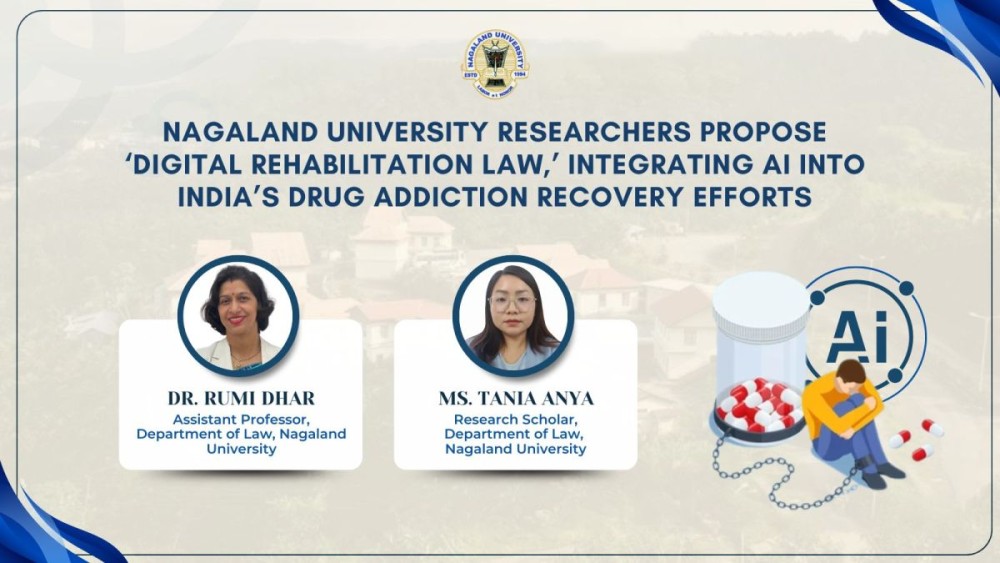
Propose integrating AI in drug recovery efforts
Lumami, December 17 (MExN): Researchers from Nagaland University (NU)’s Department of Law have proposed a Digital Rehabilitation Law, a future-oriented legal framework that integrates Artificial Intelligence (AI), telemedicine, and mobile health technologies into India’s drug addiction recovery system.
In a press release, NU noted that the study offers one of the earliest doctrinal analyses of how India’s legal environment can accommodate technology-driven rehabilitation models. It examines India’s growing drug dependency crisis and argues that traditional rehabilitation systems have remained inaccessible, understaffed, and stigmatized for far too long.
The researchers highlighted the urgent need to strengthen rehabilitation as a central pillar of national public health and drug policy. The study was undertaken by Dr Rumi Dhar and Tania Anya from the Department of Law, Nagaland University.
According to the NU release, the study evaluated the compatibility of existing statutes—including the Digital Personal Data Protection Act (2023), Telemedicine Practice Guidelines (2020), and the Narcotic Drugs and Psychotropic Substances Act (1985)—with emerging digital rehabilitation tools.
It identified critical gaps related to privacy, informed consent, algorithmic transparency, and accountability, especially as AI-driven relapse prediction models and virtual counselling platforms become more prevalent, it said.
Elaborating on the study, Dr Dhar, Assistant Professor at NU’s Department of Law, noted that the proposed legislative model would harmonize India’s current legal provisions to support safe, ethical, and technology-enabled addiction treatment.
Co-researcher Anya added that key recommendations include establishing a National Digital Rehabilitation Regulatory Authority, amending the NDPS Act to formally recognize digital rehabilitation pathways, and launching pilot programs for AI- and telemedicine-based interventions, among others.
Meanwhile, NU Vice Chancellor Prof Jagadish K Patnaik lauded the researchers for proposing what he termed an innovative concept of a Digital Rehabilitation Law. He added that the research reflects NU’s commitment to socially relevant work that upholds patient rights, expands access to care, and supports evidence-based policymaking.
The NU informed that the findings of the study were published in the KDU Law Journal (https://fol.kdu.ac.lk/wp-content/uploads/2025/10/Volume-5-Issue-2.pdf) a peer-reviewed academic journal published by the Faculty of Law, General Sir John Kotelawala Defence University, Sri Lanka.