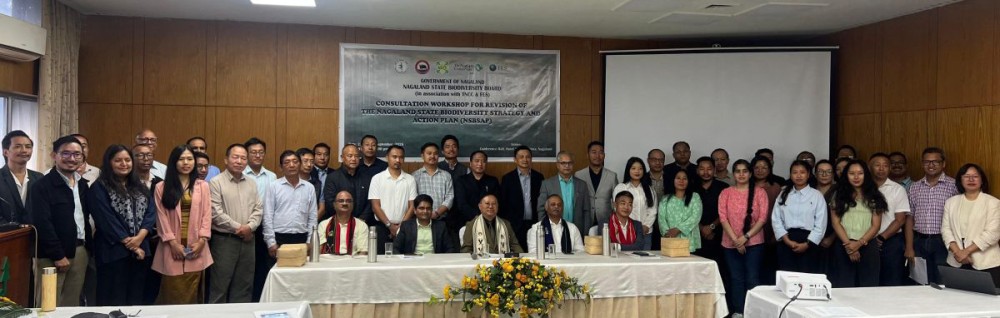
NSBB Chairman Kikheto Sema and other officials with participants at the stakeholder consultation workshop for revision of the NSBSAP in Kohima on September 23. (Morung Photo)
Stakeholder consultation workshop for plan revision held in Kohima
Our Correspondent
Kohima | September 23
The Nagaland State Biodiversity Board (NSBB), in association with The Nature Conservation Centre (TNCC) and Foundation for Ecological Security (FES), conducted a Stakeholder Consultation Workshop for the revision of the Nagaland State Biodiversity Strategy and Action Plan (NSBSAP) on September 23 at Hotel Japfü, Kohima.
The SBSAP is a state-specific policy document to be prepared by State Governments or Union Territories in line with the National Biodiversity Strategy and Action Plan (NBSAP).
The NBSAP serves as the country’s primary roadmap to protect its rich biological diversity and fulfil commitments under the UN Convention on Biological Diversity (CBD).
The proposed revision of the NSBSAP is necessitated by the revision of the national document in compliance with the landmark Kunming-Montreal Global Biodiversity Framework (KMGBF).
Nagaland prepared its first NSBSAP in 2005, in line with NBSAP and later it was revised and formally launched in May 2022, incorporating 12 targets drawn from the national plan and the Aichi Biodiversity Targets.
The inaugural programme of the workshop was addressed by Y Kikheto Sema, Principal Secretary, Department of Environment, Forests & Climate Change, Chairman NSBB and Development Commissioner, Nagaland; Supongnukshi, APCCF (Territorial), O/o PCCF and HoFF, Nagaland; Dr Ishwar Narayanan, Executive Director, TNCC, India; and Sanjay Sharma, General Manager, FES.
The programme was chaired by Sidramappa M Chalkapure, CCF (D&P) and Member Secretary, NSBB, while the vote of thanks was proposed by Savinuo Kikhi, RFO, in-charge, Chiephobozou Range and NSBB.
During the technical session, the workshop discussed India’s updated National Biodiversity Strategy and Action Plan (NBSAP), launched at CBD COP16, which serves as a comprehensive blueprint aligned with the Kunming-Montreal Global Biodiversity Framework (KMGBF) to halt and reverse biodiversity loss.
Biological Diversity Act and its relevance to Nagaland
The Biological Diversity Act, 2002, is a landmark legislation enacted by the Parliament of India to preserve biological diversity, promote sustainable resource use and guarantee fair and equitable benefit-sharing with indigenous communities.
To adapt to modern industrial demands and international updates such as the Nagoya Protocol and Kunming-Montreal Global Biodiversity Framework, the Act was extensively modified under the Biological Diversity (Amendment) Act, 2023, alongside the newly enforced Biological Diversity Rules, 2024.
With the unique land ownership pattern in the State, wherein communities and individuals own land and resources, the Biological Diversity Act is particularly relevant to Nagaland.
Nagaland lies within an ecologically significant region of the Indo-Burma biodiversity hotspot and is rich in forests, wildlife, rivers, medicinal plants, orchids and traditional agro-biodiversity. It also has a cultural relationship between indigenous communities and nature.
Traditional knowledge, community stewardship
The workshop maintained that customary practices and traditional conservation ethics have historically protected forests and water sources in the State.
Village councils and local institutions play an important role in biodiversity conservation. The workshop highlighted the importance of preserving traditional ecological knowledge alongside modern science.
It also highlighted biodiversity challenges, opportunities and State-specific priorities to guide future conservation actions.
The workshop stressed the need to develop a shared vision and actionable strategies by building consensus on integrating biodiversity considerations across sectors, gathering recommendations to strengthen governance frameworks, enhancing capacity building and promoting community participation to enrich the revised SBSAP.
It also stressed the need for comprehensive inputs, insights and data on State-specific biodiversity challenges and strategies; actionable recommendations for practical measures for conservation, restoration and sustainable use; and greater stakeholder ownership and collaboration for successful implementation of the NSBSAP.