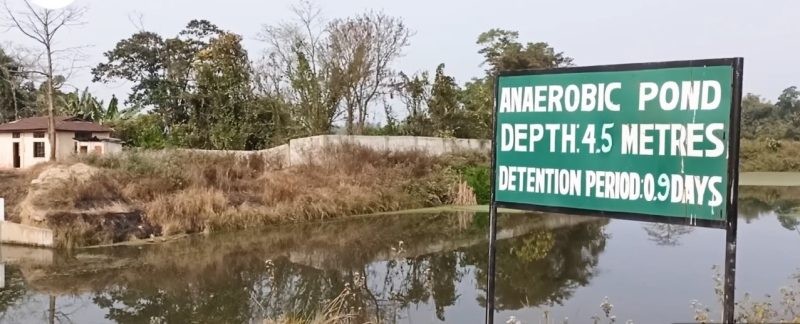
An anaerobic pond, used for the initial treatment of wastewater, at Shozukhu village in Dimapur, a core component of Nagaland’s first Sewage Treatment Plant, seen in this file photo taken on January 14, 2023. The Nagaland Government recently informed the NGT that the plant is only partially operational after suffering damage during the 2025 monsoon. (Morung File Photo)
Moa Jamir
Dimapur | September 27
Nagaland’s 90 KLD Faecal Sludge Treatment Plant (FSTP) at Meriema in Kohima and the Dimapur Sewage Treatment Plant (STP) appear to have run into “operational fouls,” according to the latest State Government submission to the National Green Tribunal (NGT).
The Kohima FSTP remains non-operational, while the Dimapur STP has resumed only partial operations following damage during the 2025 monsoon, according to the State’s compliance submission covering January-June 2026. The submission was filed in connection with OA No. 606/2018 and the NGT’s observations on waste and sewage management in its previous proceedings.
Non-payment of power bill keeps Kohima FSTP shut
Kohima’s FSTP at Meriema has remained non-operational after its power supply was disconnected over non-payment of a Rs 80,000 monthly transformer rental charge, according to a committee report submitted by the State Government to the NGT.
The committee, constituted to examine the functioning of the plant, found that the FSTP was non-functional despite most of its machinery being in good condition, while making some observations regarding the machinery.
The plant has a 400 KVA transformer, for which the monthly rental is Rs 80,000. The committee recommended that the outstanding electricity bills be cleared. It also suggested that the transformer could be replaced with one having adequate voltage requirements, in consultation with electrical engineers.
The committee further found that the plant would require at least five personnel for operation—one technician, one laboratory assistant and three workers.
It also noted that six cesspool vehicles were lying idle at the plant and that 12 personnel comprising drivers and helpers would be required to put the vehicles into operation. The suction pumps installed in the vehicles would also require upgrading.
The State clarified that the facility earlier recorded as a 90 MLD STP in Kohima is actually a 90 KLD FSTP, with no STP in Kohima.
Meanwhile, the State Government informed that it is initiating necessary action to operationalise the FSTP.
It further highlighted that 13 additional FSTPs with a combined treatment capacity of 210 KLD are being implemented by the Public Health Engineering Department (PHED), with completion targeted for November 2026.
Dimapur STP only partially operational
In Dimapur, the STP has also not returned to its full operational capacity after being damaged during the 2025 monsoon.
The NGT had noted that the Dimapur STP had a reported utilisation capacity of 18.4 MLD, while another part of the earlier submission stated that it had been damaged during the monsoon and was non-operational. The Tribunal observed that untreated sewage was being discharged into water bodies, with the Dhansiri River identified as the discharge point for Dimapur.
In response, the State said one sewage pumping station (SPS) has been restored and made operational, allowing the STP to resume partial operations.
The plant is currently treating approximately 6.7 MLD of sewage through the restored SPS, according to the State’s submission.
It further informed that the Nagaland State Disaster Management Authority (NSDMA) has released funds for restoration of the remaining flood-damaged infrastructure, and that the remaining two SPSs and associated interception and diversion (I&D) works will be restored on priority after the monsoon, subject to receding water levels and the availability of safe working conditions.
The restoration of the remaining infrastructure would enable the Dimapur STP to resume operation at its optimum capacity, it added.