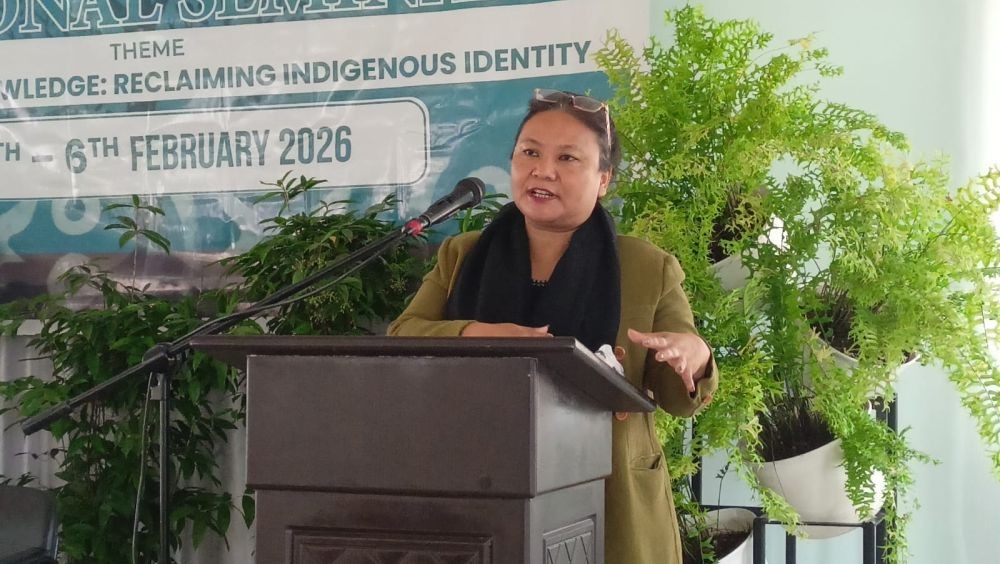
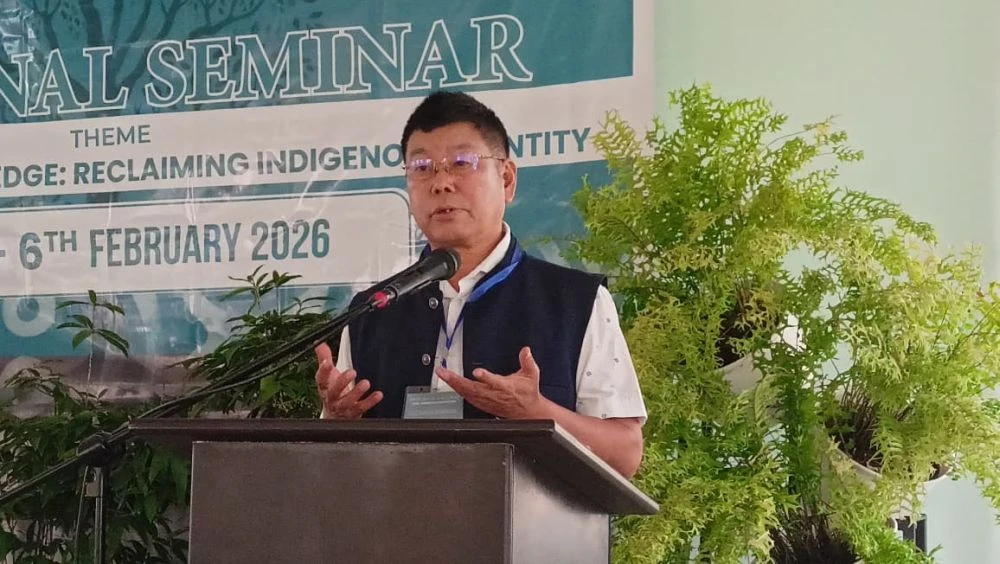
Dr Akatoli Chishi presenting her paperspeaking during the seminar.
Morung Express News
Dimapur | February 5
A two-day National Seminar on ‘Decolonising Knowledge: Reclaiming Indigenous Identity’ began today at Trinity Theological College (TTC) in Thahekhü, Dimapur.
Presenting her paper, Dr Akatoli Chishi highlighted the Naga ‘tiger men/women’ phenomenon as a powerful indigenous framework that challenges colonial surveillance, restores cultural identity and promotes ecological and social harmony.
Dr Chishi, Associate Professor of TTC presented a paper titled ‘Resisting the Panoptic Gaze: The Tiger Men/Women Phenomenon of Naga Intuitive Ecology as Decolonising Praxis.’
She explained that colonial rule imposed rigid hierarchies and surveillance systems that fragmented indigenous knowledge and reduced holistic relationships with land and nature into exploitable units. In contrast, the tiger men/women tradition, rooted in Naga intuitive ecology, subverts these hierarchies through spiritual empathy, relational thinking and interdependence.
A key aspect of the phenomenon, she noted, is the intergenerational transmission of sensory and ecological wisdom, where elders pass on intuitive knowledge to younger generations. This process ensures cultural continuity and resilience despite external policy pressures and administrative interventions.
The paper also highlighted how the tiger men/women phenomenon historically mediated social and political conflicts. Drawing on tiger–human relationships as metaphors for coexistence, communities used these narratives to resolve disputes over land and resources, transforming adversarial situations into cooperative alliances. Such practices, Dr Chishi argued, allowed communities to adapt to change without losing relational integrity or social cohesion.
Using colonial surveillance as an analytical lens, Dr Chishi showed how indigenous intuitive practices resisted being labelled as irrational or superstitious. Instead, non-verbal sensing, emotional connection and adaptive stewardship enabled communities to anticipate environmental threats, protect biodiversity and respond effectively to complex challenges, often with greater success than abstract, data-driven models.
Notably, Dr Chishi said this phenomenon transcends mysticism and offers a globally relevant model of identity restoration. She called for epistemic pluralism, stating that Naga intuitive ecology provides a means of transcending colonial rationality by reclaiming indigenous identity and restoring agency through holistic, relational worldviews.
Co-authors of knowledge
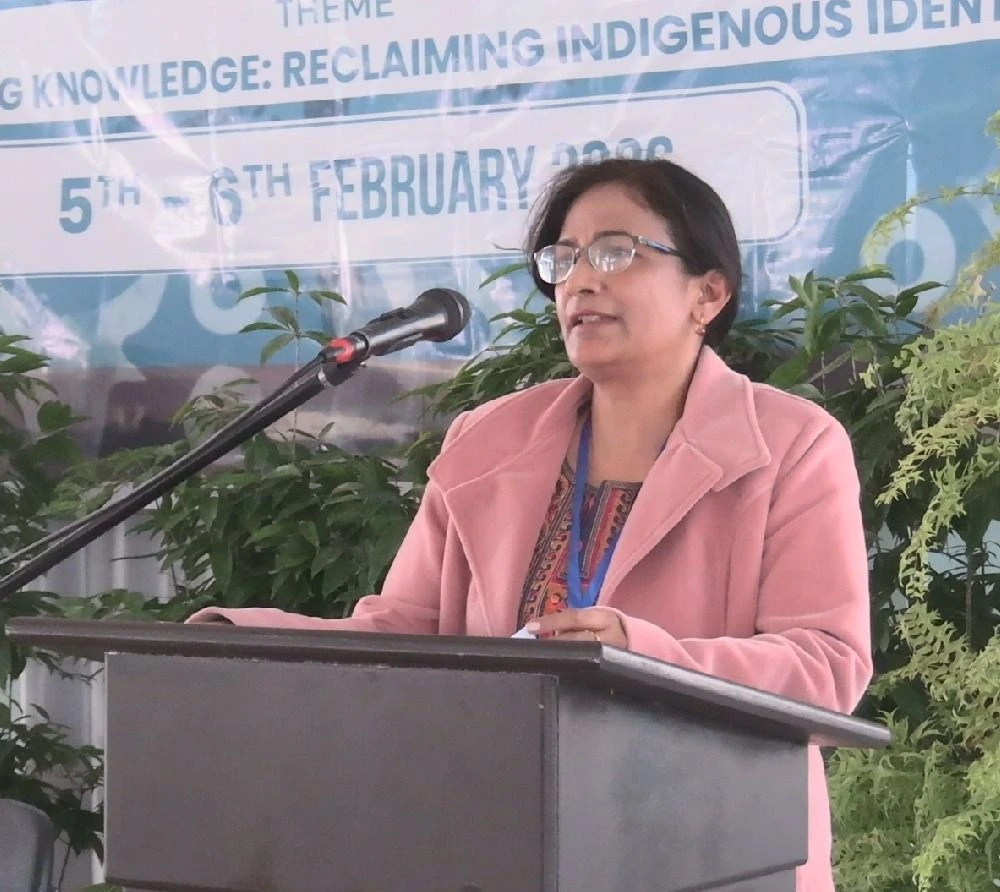
Indigenous communities should be recognised as collaborators and co-authors in knowledge production, rather than being viewed merely as beneficiaries of developmental programmes, said Professor Geetika Ranjan while presenting her working paper on ‘Understanding Indigenous Communities and their Knowledge Systems in Letter and Spirit.’
Prof Ranjan from the Department of Anthropology, North-Eastern Hill University, highlighted that indigenous communities in India have long endured social, economic and intellectual marginalisation. For the country to truly function as a welfare state, she argued, it is essential to acknowledge indigenous peoples as thinkers and knowledge creators whose contributions are central to holistic development.
Her paper examined how colonialism extended beyond political and economic domination to shape systems of knowledge. Eurocentric frameworks, she said, were imposed as universal, leading to the suppression of indigenous and non-Western knowledge traditions. This legacy continues to influence contemporary approaches to education, research and development.
Referring to India’s immense cultural diversity, Prof Ranjan pointed out that indigenous communities possess distinct knowledge systems rooted in their environment, history and lived experiences. She cautioned against the blanket use of the term ‘tribe’, describing it as a colonial construct that overlooks the diversity and uniqueness of individual communities.
A key focus of her presentation was the role of ethnographic research in understanding indigenous knowledge. Prof Ranjan stressed that decolonising knowledge is not a mechanical or hurried process.
Instead, it requires sustained engagement, cultural sensitivity and a decolonised mindset that values ‘insider’s perspective.’ Ethnography, she said, enables a deeper understanding of indigenous worldviews by situating knowledge within its cultural context.
Prof Ranjan said that recognising and nurturing indigenous knowledge systems can enrich not only indigenous communities but mankind at large.
Earlier, Rev Dr Wati Longchar, Consultant, Foundation for Theological Education in Asia and the Pacific, delivered the keynote address. The cultural event had Y Vikheho Swu, former Minister, Government of Nagaland, as the speaker.
.jpg)