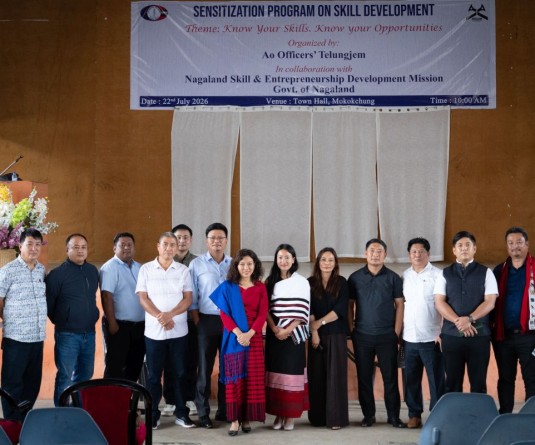
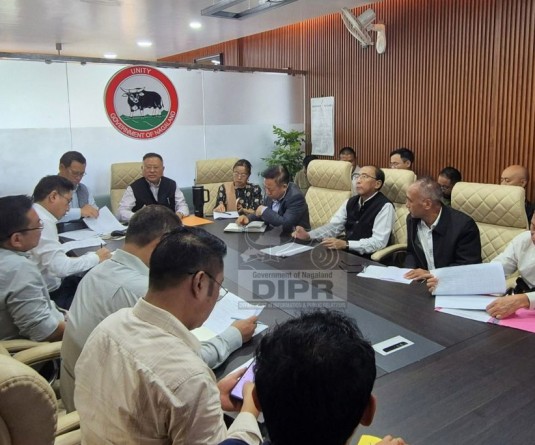
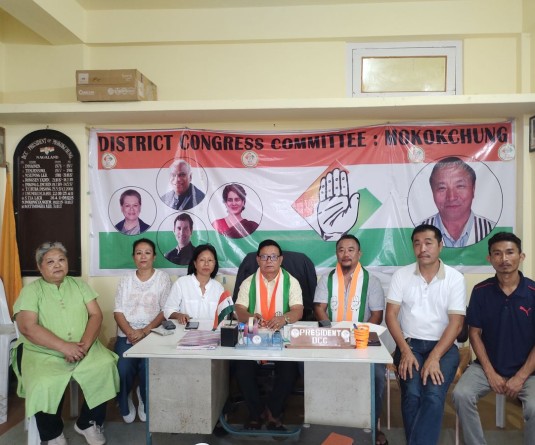
Participants during the one-day orientation for District Level LSC School Related Gender Based Violence Committees at Hotel De Oriental, Kohima on April 14. (Photo Courtesy: NECTAR)
.JPG)
Kohima, April 14 (MExN): The Nagaland Education Project—The Lighthouse (NECTAR), under the Department of School Education (DoSE), launched a Grievance Redressal Mechanism (GRM) portal for Lighthouse School Complexes (LSC) during a one-day orientation for District Level LSC School-Related Gender-Based Violence (SRGBV) Committees at Hotel De Oriental, Kohima, on April 14.
The portal was inaugurated by Alun Hangsing (NCS, Retired), Chairman, Nagaland State Commission for Protection of Child Rights (NSCPCR).
According to an update from NECTAR, the portal will ensure the anonymity of complainants through automated features that directly notify the concerned committee.
In his welcome address, Principal Director of DoSE and Project Director of NECTAR, Shashank Pratap Singh, stated that the creation of a GRM is mandated by court directives as well as by the United Nations and the World Bank.
.webp)
Singh underlined the responsibility of committee members, stating that, as an extension of the home and family, school heads and teacher counsellors must ensure a safe and supportive environment for students.
He also urged committee members to handle juvenile cases of gender-based violence sensitively, with counselling support.
In his keynote address, NSCPCR Chairman Hangsing highlighted that nations which have prioritised child rights have prospered and achieved a high Human Development Index.
He stated that, given the importance of child rights, the Indian Parliament has instituted the National Commission for Protection of Child Rights (NCPCR), followed by the establishment of state commissions.
.webp)
Noting that LSC SRGBV Committee members have immense responsibility, Hangsing exhorted them to effectively implement policies, emphasising that the collective aim is to build a better future and be on par with other nations.
SRGBV committees from all 17 districts attended the orientation. Altogether, 97 members participated, including officials from the Social Welfare Department, Police, Childline, DHEW, Sakhi One Stop Centre, students’ union representatives, school heads, and teacher counsellors.