Participants of the Political Science Programme and Debate Club at the Shokiye Seminar Hall, NECU.
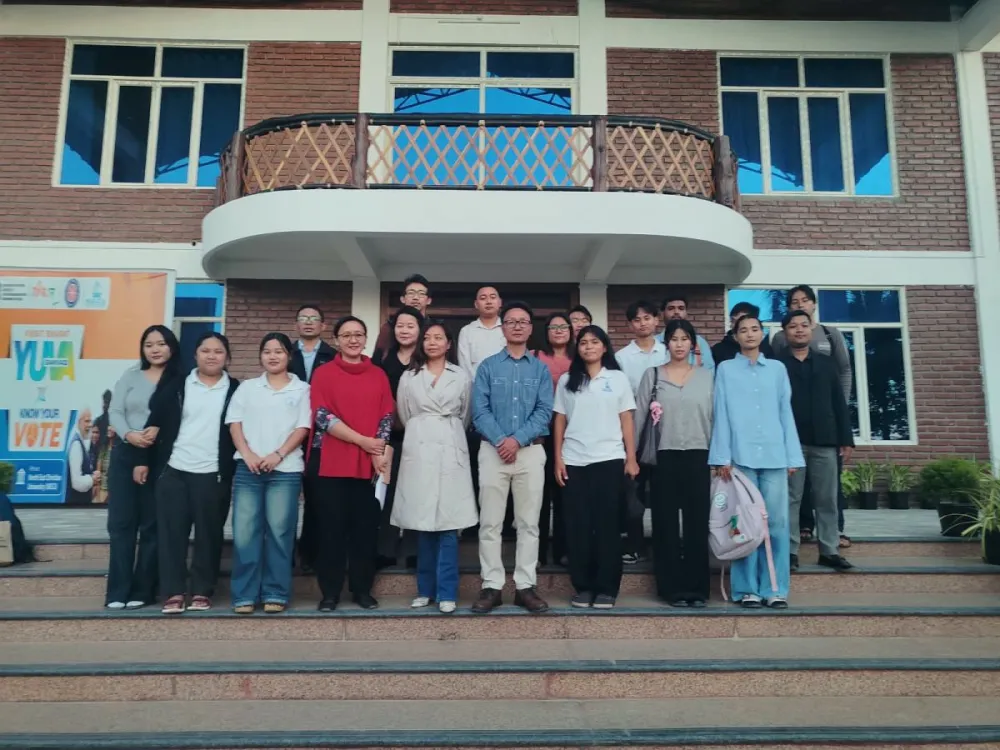
Dimapur, November 29 (MExN): North East Christian University (NECU) observed Constitution Day with a lecture examining the constitutional recognition of Scheduled Tribes, indigeneity and indigenous peoples’ rights in India.
The programme, organised by the Political Science Programme in collaboration with the Debate Club and Internal Quality Assurance Cell (IQAC), was held on the theme, “A Category Without a Definition: Scheduled Tribes, Indigeneity and the Constitution of India.”
Gam A. Shimray, Member of the United Nations Expert Mechanism on the Rights of Indigenous Peoples (EMRIP), was the speaker. Shimray examined the ambiguity and overlapping application of constitutional provisions, including Articles 340, 341, 342 and 244, and questioned who determines the inclusion and exclusion of indigenous peoples in India.
He argued that the categories of tribe, caste and indigeneity should not be understood solely through the lens of backwardness. Instead, he said, they represent communities with distinct social, political and historical circumstances requiring particular constitutional consideration.
He identified non-dominance, redressal of historical oppression and liberation as essential elements in understanding the rights of indigenous peoples. He also linked these principles to the United Nations framework on indigenous rights, particularly the principle of self-determination.
Shimray further noted that the UN Expert Mechanism has consistently linked the right to free, prior and informed consent of indigenous peoples with the broader principle of self-determination.
The session concluded with a question-and-answer discussion on constitutional recognition, indigenous identity and the rights of Scheduled Tribes in India.
The programme was chaired by Dr O. Grace Ngullie, Assistant Professor, Political Science Programme, who highlighted the significance of the Constitution. Khrielhoumenuo Suokhrie, Coordinator of the Political Science Programme, delivered the welcome address, while Suneptula Longkumer, a third-semester student, led the reading of the Preamble.