Students representing various nations during the diplomatic debate simulation on UNSC reform organised by the International Relations Programme at NECU, Dimapur.
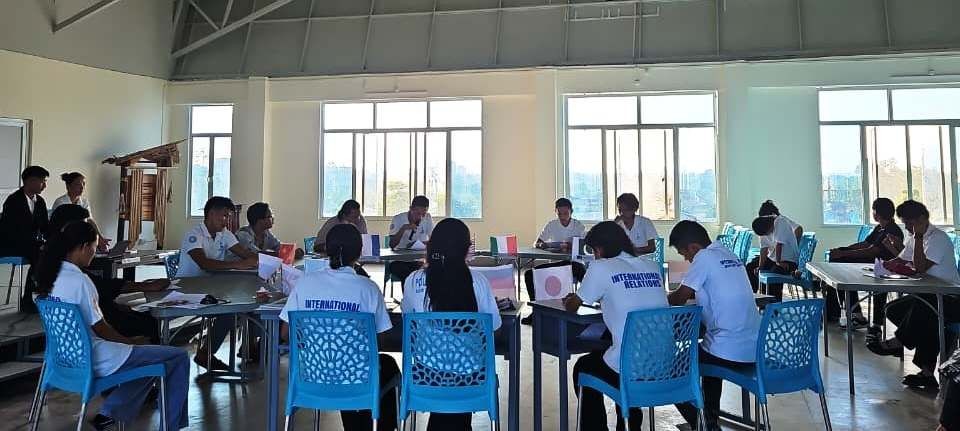
DIMAPUR, OCTOBER 27 (MExN): The International Relations (IR) Programme of North East Christian University (NECU) observed United Nations Day 2026 with a diplomatic debate simulation on India’s bid for permanent membership of the United Nations Security Council (UNSC) on October 23.
Titled ‘The Diplomatic Table’, the simulation was held at the Dr Peter Armacost Hall under the theme ‘India’s Bid for Permanent Membership of the United Nations Security Council: Representation, Power and Reform’. A total of 14 students participated as delegates representing 12 countries and members of the International Press Corps. The debate examined whether India’s population, economic growth, contribution to UN peacekeeping and global role justified permanent membership, alongside questions of regional representation and veto power.
Delegates from India, the United States, the United Kingdom, France, Russia, Japan, Germany, Australia and Brazil supported India’s bid, citing its growing political and economic significance and contributions to UN peacekeeping. Pakistan and Italy opposed the creation of new permanent seats, advocating instead for an expansion of elected membership. China supported Security Council reform but called for greater representation of developing regions, particularly Africa, arguing that reform should extend beyond India’s individual aspiration.
The debate also examined whether the Security Council, whose current structure dates to 1945, adequately reflects contemporary global realities, particularly the underrepresentation of Africa and Latin America. Delegates discussed whether any new permanent members should receive veto power and whether the existing veto system required reform. Following the formal debate, country delegates and the International Press Corps held an informal discussion on national positions and possible areas of agreement. Questions were raised about Pakistan’s opposition to new permanent seats, China’s position on India’s bid and the possible influence of bilateral tensions.
India was also asked how its permanent membership could strengthen representation of the wider Global South, while representatives of the Group of Four (G4), comprising Brazil, Germany, India and Japan, discussed the challenge of reconciling different national interests and overcoming political obstacles to Security Council reform. India and the G4 representatives reiterated their support for reform and broader representation, while Pakistan, Italy and China maintained their respective positions. The simulation concluded without a decisive consensus.
The discussion highlighted differences among countries over regional representation, the expansion of permanent and non-permanent membership, and the veto powers held by the five permanent members (P5) of the UNSC: China, France, Russia, the United Kingdom and the United States.
The programme began with a welcome address and invocation by Dr Keneisenuo Solo, Programme Coordinator. The session was presided over by Haowon C, a third-semester MA student.