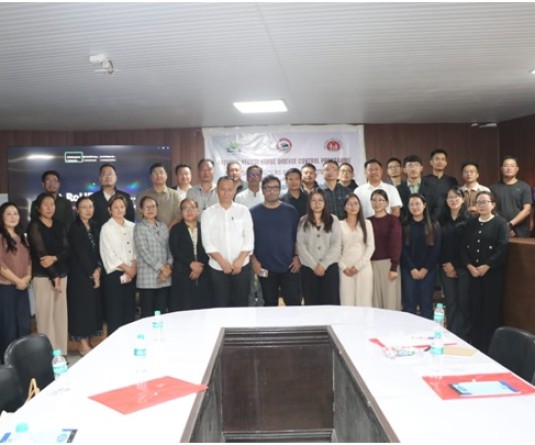
Participants and organizers at the one-day NSA seminar hosted at Zunheboto Government College on October 26.
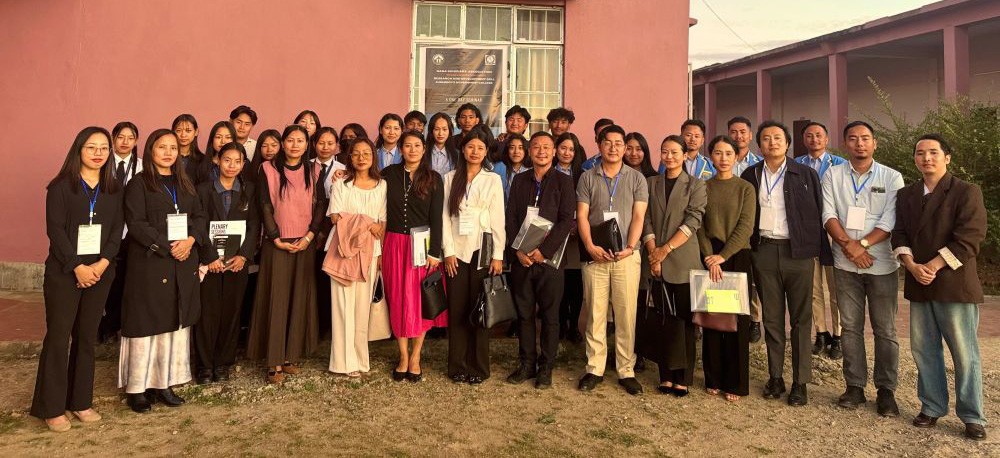
ZUNHEBOTO, OCTOBER 27 (MExN): The Naga Scholars’ Association (NSA), in collaboration with the Research and Development Cell of Zunheboto Government College, organised a one-day seminar on “Materiality, Infrastructure and Local Culture: The Cross-Disciplinary Interaction” in Zunheboto on October 26, bringing together scholars to examine the social, cultural, historical and political realities of Sumi society.
The seminar aimed to create a platform for interdisciplinary scholarship within the Sumi community and Zunheboto town, exploring how local cultures interact with global forces through materiality and infrastructure. Discussions covered textiles, art, gender, literature, public infrastructure, language, the church and other aspects of social and cultural life.
Drawing on the history of Zunheboto and existing scholarship on the Sumi community, the seminar approached the town as an anthropological space for knowledge production. It examined how histories, traditions, everyday practices, material cultures, institutions and infrastructure shape the changing social landscape of the region.
Nine scholars, including faculty members, PhD scholars and postgraduate students, presented their research. They represented institutions including Jamia Millia Islamia, New Delhi; St John College, Dimapur; Serampore University; Aizawl Theological College; St Joseph University; and Nito Theological College.
The presentations critically examined issues such as mass marriage, gender justice, patriarchy, Sutsah, culture, materiality, indigeneity, and human and non-human histories.
Dr Avitoli G. Zhimo, Associate Professor of Anthropology at the University of Delhi, delivered the keynote address. Drawing on her experiences, she offered an anthropological perspective on how materiality and infrastructure shape the functioning of the world, both historically and in the present.
The seminar was chaired by Viboli Kiba, a postgraduate student at Nagaland University. Its three panels were moderated by Newtoli Yeptho and Kileto I. Chishi, faculty members at Zunheboto Government College, and Vilibo K. Yeptho, Dean and faculty member at Nito Theological College.
Conceived exclusively for scholars from Zunheboto, the seminar sought to encourage critical engagement with the region’s social, cultural, historical and political realities. It also foregrounded Zunheboto as a site of knowledge production by and about the Sumi community, bringing questions of locality, identity, modernity, development, culture and globalisation into academic discussion.