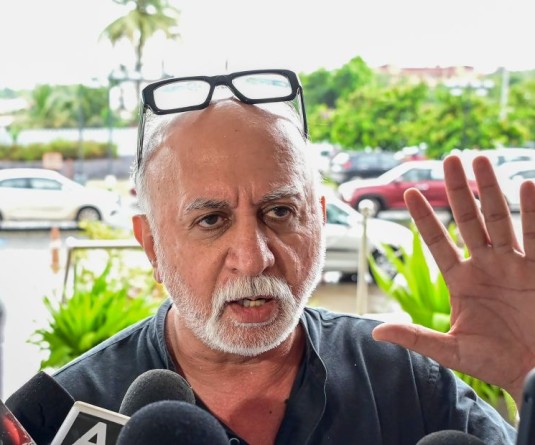
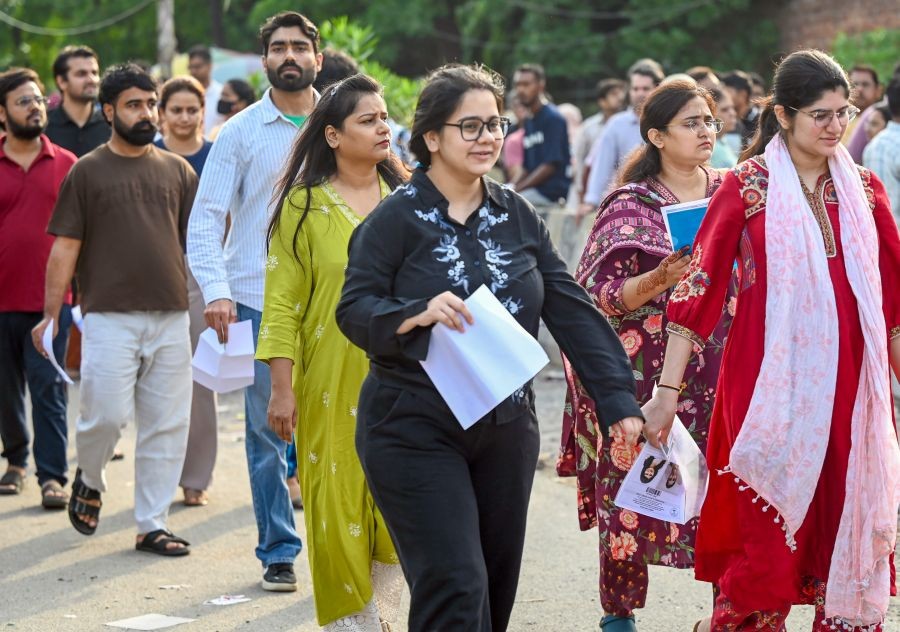
Candidates arrive to appear for the National Eligibility-cum-Entrance Test (NEET-PG) at the Ion Digital Zone in Sector 62, Noida on August 30, 2026. (Photo: IANS)
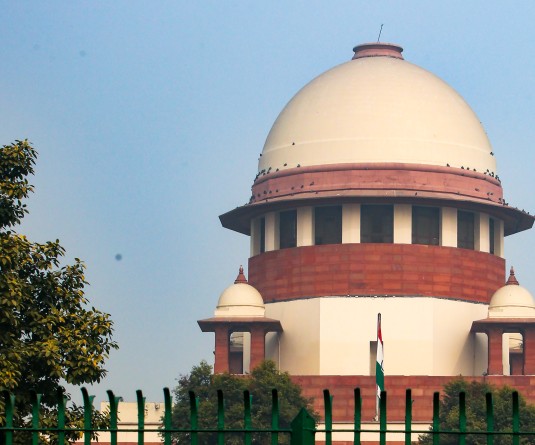
New Delhi, October 15 (IANS): The Supreme Court on Thursday issued notice on a plea filed by the Democratic Medical Association and a group of NEET-PG 2026 aspirants challenging the manner in which the National Board of Examinations in Medical Sciences (NBEMS) disclosed the answer key and candidate responses for the postgraduate medical entrance examination.
A Bench of Justices P.S. Narasimha and Alok Aradhe issued notice to the Union of India, the NBEMS, and the National Medical Commission (NMC), and tagged the matter with pending petitions concerning the NEET-PG examination.
The plea challenges the October 1 notice issued by NBEMS, titled "Scorecard and Answer Key of NEET-PG 2026", under which candidates can access question-wise evaluation details through their individual applicant login.
NEET-PG 2026 was conducted on August 30, while the results were declared on September 24.
Following the declaration of results, several candidates sought access to the actual question paper, official answer key and recorded responses to independently verify their scores.
According to the petition, the existing disclosure mechanism provides the Question ID, response status, numerical correct-answer ID, the option selected by the candidate, and the marks awarded for each question.
However, it does not provide the actual questions or the complete text of the options in the sequence in which they appeared during the examination.
"The candidate is consequently shown a coded numerical matrix, but is not able to correlate such identifiers with what he or she actually saw and answered during the examination," the petition said.
The petitioners have contended that NBEMS adopts candidate-specific shuffling of both the sequence of questions and the order of options, making it difficult for candidates to verify whether the correct answers and recorded responses have been accurately mapped to their examination records.
"Thus, merely informing a candidate that, against a particular Question ID, ‘Option 2’ was correct and ‘Option 3’ was selected does not enable the candidate to ascertain what the underlying question was, what Options 2 and 3 actually contained, or whether the correct question and option sequence have been accurately mapped to that candidate’s examination record," the plea stated.
It further argued that the existing mechanism may allow candidates to reconcile their marks arithmetically but does not enable independent verification of the substantive answer key or the mapping of questions and options to individual candidates.
The petitioners have maintained that, without access to the actual questions and corresponding options, candidates cannot meaningfully challenge ambiguous questions, identify instances where multiple answers may be correct or establish errors in the officially designated answers.
Seeking directions to the NBEMS, the plea has urged the apex court to make available a candidate-wise mapped question paper and response sheet containing the actual questions in the sequence presented during the examination, the complete options, recorded responses, correct answers, and marks awarded.
It has also sought a downloadable and permanent electronic copy of each candidate's examination record, along with a reasonable, time-bound mechanism for raising question-wise objections.
The petitioners have proposed that such objections be examined by a duly constituted subject-expert committee, with consequential correction of scores and ranks wherever errors are established. The plea also refers to previous proceedings concerning transparency and verifiability in NEET-PG examinations and seeks appropriate guidelines or standard operating procedures to govern post-examination transparency in future postgraduate medical entrance examinations.
The matter is likely to be listed next on October 26.
Senior advocate Sidharth Suri, assisted by advocate Satyam Singh Rajput, appeared for the petitioners.