Officials from Northeast Frontier Railway (NFR) and IIT Roorkee during the MoU signing for advanced railway bridge inspection and crack detection.
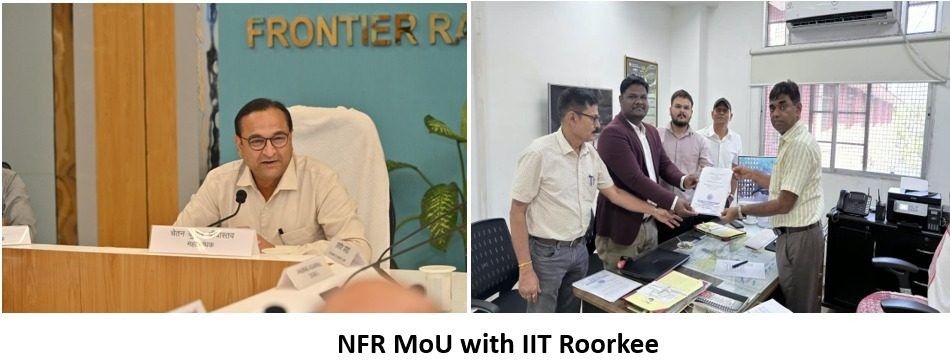
Maligaon, October 30 (MExN): The Northeast Frontier Railway (NFR) has signed a Memorandum of Understanding (MoU) with the Indian Institute of Technology (IIT) Roorkee to develop an advanced methodology for detecting cracks and assessing the remaining fatigue life of ageing railway steel bridges.
The MoU was signed on October 27 for the project titled “Development of Hybrid Crack Detection Methodology including Assessment of Residual Fatigue Life in Railway Steel Bridges.” The initiative assumes significance as several steel bridges across Indian Railways, including those under NFR, have been in service for more than 50 years. Increasing train speeds, heavier loads and repeated movement of trains have made fatigue assessment of ageing bridge structures increasingly important.
Under the project, IIT Roorkee will undertake detailed studies of welded joints, holes and other vulnerable sections of railway bridges. The research will combine conventional inspection techniques with non-destructive evaluation (NDE), artificial intelligence (AI), material testing and advanced structural analysis to improve the detection of cracks and structural defects.
A key component of the project will be the use of InfraDocT, an AI-based tool developed by the project team, to analyse high-resolution images captured during bridge inspections. Images obtained through 4K cameras mounted on drones will also be used to identify cracks and other signs of damage at an early stage. The findings will be supplemented by NDE techniques, which help identify defects without damaging the structure, alongside computer-based modelling and laboratory tests. The study will examine the behaviour of steel truss and girder bridges, including the response of different steel types and welded joints to repeated loading.
Laboratory tests will assess the strength and fatigue behaviour of base steel materials, welded joints and heat-affected areas. The research will also examine how corrosion, temperature variations, humidity and repeated loading contribute to the development and growth of structural flaws. Based on these findings, the project aims to develop scientific models to estimate the residual fatigue life of bridge components, providing an assessment of their remaining service life under repeated loading conditions.
The collaboration also envisages developing a real-time fatigue damage assessment system with an alert-based decision-support mechanism. By integrating inspection findings, laboratory results and data collected from bridges, the system is expected to help railway authorities monitor damage progression, identify vulnerable sections, prioritise inspections and plan maintenance.
According to NFR, the collaboration with IIT Roorkee is expected to supplement existing bridge inspection practices, improve early detection of structural defects and strengthen the scientific assessment of ageing steel bridges, contributing to the long-term safety and reliability of railway infrastructure.