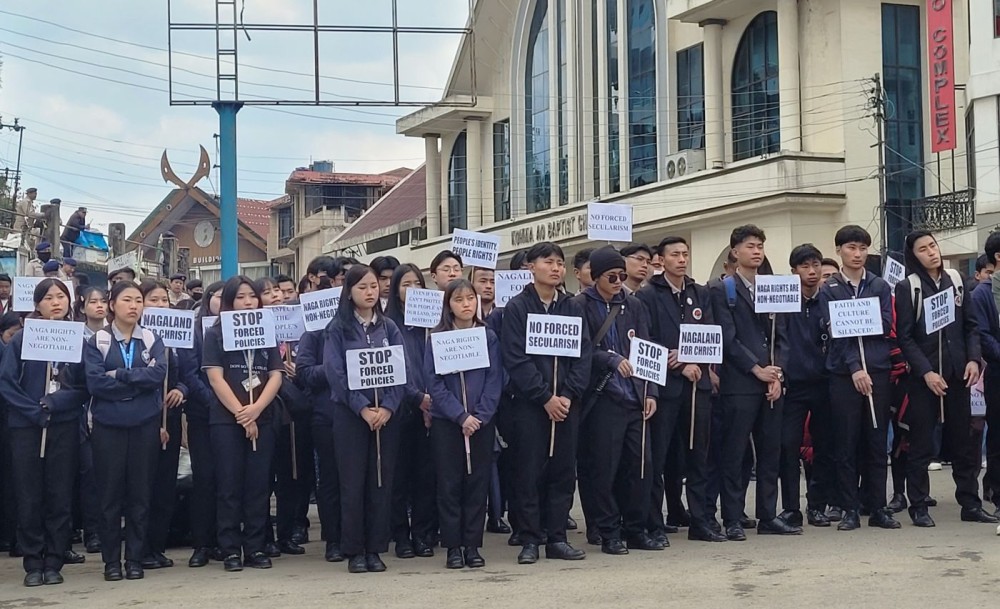
Hundreds of students and citizens of Kohima joined the mass rally on March 16, holding placards to protest the Ministry of Home Affairs’ January 28 directive mandating the singing of Vande Mataram. (Morung Photo)
Submit representation to President; seek withdrawal of Vande Mataram directive
Morung Express News
Kohima | March 16
Hundreds of students and citizens of Kohima came together for a mass rally against the Ministry of Home Affairs’ January 28, 2026 directive mandating the singing of Vande Mataram.
Holding placards that read, “MHA's January 28, 2026 is an assault on secularism,” “Faith and culture cannot be silenced,” “No forced secularism,” “Even if you can protect our people and our land, don't destroy it,” and “People's identity, people's rights,” participants shouted slogans declaring, “We oppose forced imposition.”
Alongside this mass rally in Kohima, similar demonstrations were being observed across educational institutions and by federating units and subordinate bodies of the Federation throughout the Naga homeland.
In his address, NSF President Mteisuding said the rally was necessitated by the notification issued by the MHA on January 18, mandating the playing and compulsory observance of the national song, Vande Mataram, during official functions and in educational institutions.
He clarified that the Naga people bears no hostility toward any national symbols or patriotic expressions of any nation. He emphasised that the rally is not directed against any community or faith, but is a stand to safeguard the principle of secularism. The gathering, he affirmed, serves as a solemn declaration that the identity and beliefs of the Naga people cannot be dictated by administrative directives nor diluted by imposed symbols.
Asserting that Nagas have never judged individuals or communities on the basis of religion, race or gender, he stated that the imposition of Vande Mataram presents a fundamental issue of conscience.
“The song is not merely a patriotic composition,” said Mteisuding. “It carries devotional imagery associated with the worship of a particular deity. For the diverse communities of the Naga homeland, particularly within our administration and educational institutions, the compulsory singing of such a composition represents a violation of personal belief and collective conscience.”
Citing Article 18 of the Universal Declaration of Human Rights and Article 27 of the International Covenant on Civil and Political Rights, he reminded that in any democratic society, the will of the people remains the ultimate law. “No directive, however authoritative, can claim legitimacy if it stands in contradiction to the conscience of the people it seeks to govern,” he asserted.
The Naga people, he stated, are not asking for privilege but are exercising rights already enshrined in international law. He cautioned that any attempt to enforce symbolic conformity without consultation undermines these internationally recognised principles.

Noting that there have been many attempts in the past and present to malign the Federation, Mteisuding addressed the recent effort to intimidate the Naga people by invoking the so-called “wrath of Delhi.” He asserted that the Naga people are not strangers to intimidation.
“Those who believe that the identity of the Naga people can be diluted by financial packages, threatened by military might, or rewritten through ideological propaganda misunderstand the Nagas,” he stated.
Sending a message to those who attempt to distort history for personal recognition, Mteisuding stated, “Our struggle has never been driven by hatred. The Naga people have endured much, but our spirit remains unbroken. Our identity cannot be erased by threats. Our history cannot be rewritten by propaganda. Our conscience cannot be bent by administrative directives. And our identity will never be surrendered.”
Following a programme at the rally site, participants, along with tribal bodies and church representatives, marched to Lok Bhavan to submit a representation to the President of India through the Governor of Nagaland.
Expressing strong opposition to the MHA directive, the representation pointed out that the revised version of Vande Mataram contains devotional imagery associated with the worship of a particular deity.
“For communities such as the Nagas, whose cultural and religious traditions are diverse and whose society places immense importance on freedom of conscience, the compulsory singing or observance of such a composition is viewed as an infringement upon deeply held beliefs and cultural sensitivities” it stated.
Referring to the directive that educational institutions begin the day’s work with the collective singing of Vande Mataram, coupled with instructions to “popularize” the National Song under coercion as ‘deeply troubling’ the representation stated that educational institutions must remain spaces for intellectual freedom, cultural sensitivity and the nurturing of democratic values, not platforms for enforcing symbolic compliance or ideological uniformity.
Raising its concerns citing distinct historical, political identity, cultural and religious beliefs, it has urged the President to ‘nullify or withdraw’ the directive mandating the singing or playing of Vande Mataram during official functions and within educational institutions in the Naga homeland.
The representation signed by NSF President Mteisuding, General Secretary, Kenilo Kent, Secretary General, NPMHR, Neingulo Krome and President, Nagaland Joint Christian Forum, Rev Dr N Paphino also appealed the President to ensure that no policy or directive is implemented in a manner that disregards the cultural, religious and historical sensitivities of the Naga people.
It expressed optimism that the representation will be considered in the spirit of justice, democratic values and respect for diversity.