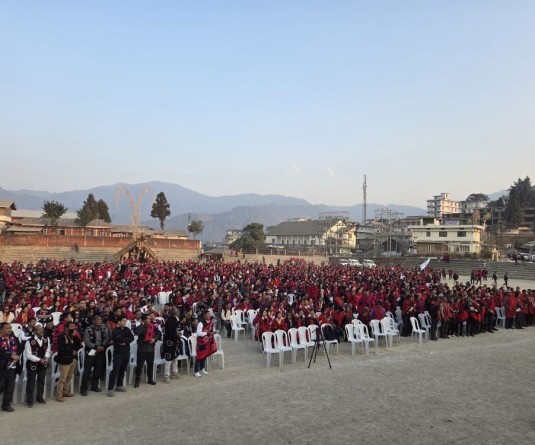
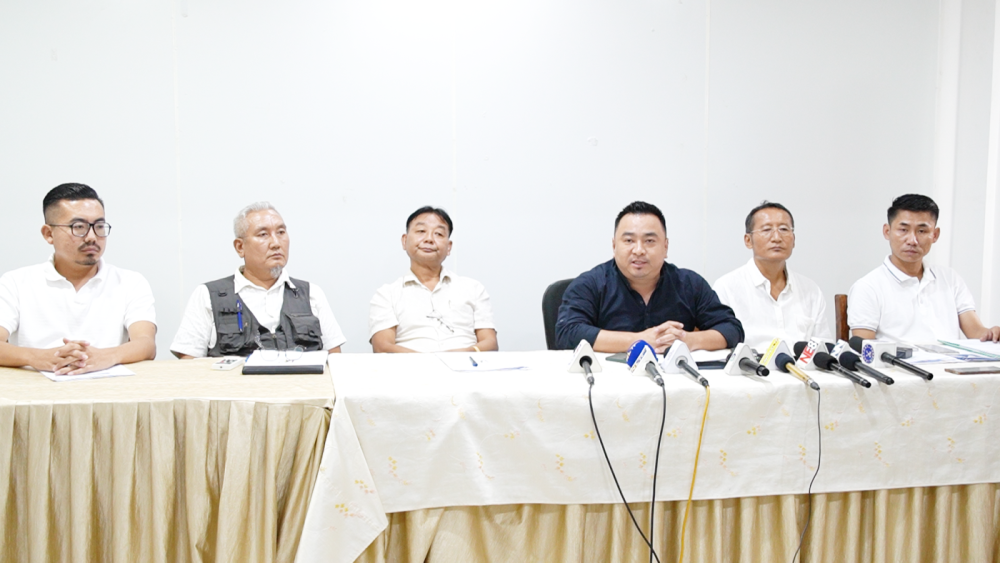
NSF President Mteisuding Heraang (centre) and ILRC-NSF chairperson Senchumo NSN Lotha (right) at a press conference on August 22 announcing a two-day national seminar on the BEFR, held in Dimapur on August 28 and 29. Following the seminar, the NSF-ILRC submitted a series of recommendations to Chief Minister Neiphiu Rio on October 1, aimed at strengthening the administration, monitoring and enforcement of the Inner Line system. (Morung File Photo)
Dimapur, October 1 (MExN): The Naga Students’ Federation (NSF) and its Inner Line Regulation Commission (ILRC) have urged the Nagaland Government to constitute by law an autonomous Nagaland Inner Line Regulation Commission to serve as the single authority for administering and enforcing the Bengal Eastern Frontier Regulation (BEFR), 1873 in the State.
In a representation submitted to Chief Minister Neiphiu Rio on October 1, following a two-day national seminar on the BEFR held at Dimapur on August 28 and 29, the NSF placed a series of recommendations aimed at strengthening the administration, monitoring and enforcement of the Inner Line system.
The Federation said the proposed Commission would address what it described as fragmentation of responsibility among the Home Department, Commissioner, district administrations, Police, municipal and town councils and Land Revenue Department.
It proposed that the Commission be headed by an officer of at least the rank of Commissioner, or a retired Chief Secretary or Judge, with members from the Home, Police, Land Revenue and municipal administration, besides representatives of apex tribal bodies and recognised student organisations.
It also proposed that the Commission maintain a central register of passes, call for district-wise returns and submit an annual report to the Legislative Assembly.
Pending legislation, the NSF has sought notification within 90 days of the representation of the multi-departmental enforcement directorate approved by the State Cabinet in May 2025.
The directorate, it said, should function as an interim enforcement body until the proposed Commission is constituted by law.
Enforcement gaps cited
The representation cited several instances from official records obtained through RTI applications and government files to underline what the Federation described as shortcomings in the existing enforcement mechanism.
According to the NSF, a verification drive in Zunheboto on June 9, 2025 detected 78 persons without valid passes, but recorded no fines, deportations or pending cases.
In Chümoukedima, it said, 146 defaulters were detected but no fines were collected, with those detected released after giving undertakings.
The Federation further cited police checks following the April 2026 elections, during which 644 defaulters were reportedly detected within 48 hours-436 on April 10 and 208 on April 11.
It has sought that the disposal of these cases be called for and published. The representation specifically proposes an end to the practice of releasing defaulters on undertakings to subsequently apply for passes.
Pointing to gaps in physical enforcement infrastructure, the NSF claimed that in Tuensang, Tseminyu, Meluri and Phek had reported no designated check gates, while the State lacked adequate workforce and budgetary arrangements for systematic checking.
It has sought publication of a State-wide list of designated check gates and checking points, along with their jurisdiction, personnel and operating hours.
It also called for pass-issuing and verification counters at Dimapur Airport and Dimapur Railway Station, noting that similar recommendations had been made by earlier committees.
Another instance cited was Phek district’s monthly reporting.
The Federation said 48 consecutive months of returns, from June 2022 to May 2026, contained blank or struck-through columns relating to defaulters, action taken and illegal foreigners.
It has demanded that existing reporting formats be completed in full and that failure to do so be recorded as an official lapse.
The NSF also referred to the records of nine district offices, claiming that only one removal was recorded in the material examined.
The case involved two men transporting live cattle without passes in Tuensang in July 2025, with the cost of removal recovered from the guarantor or employer.
The Federation has proposed establishing a holding facility at Dimapur for persons awaiting removal and recovering removal costs from guarantors or employers.
Central register, stronger checks
A key recommendation is the creation of a real-time central register recording every pass issued in the State, including the holder, purpose, districts covered, guarantor or employer, date of entry, expiry and exit. The NSF identified the absence of exit records as a major gap in the present system.
It has also sought an annual Inner Line return to the Assembly containing district-wise data on passes, expired and extended passes, defaulters, fines, prosecutions, removals, revenue and enforcement expenditure.
The representation further calls for written authorisations under Section 6 of the BEFR empowering designated Police officers to arrest and produce before the competent authority persons found beyond the Inner Line without passes or those violating pass conditions. It also seeks clarity on the competent Magistracy for offences under the Regulation.
Linking ILP with economic activity
The NSF has proposed linking trade licences with valid Inner Line Passes for non-indigenous applicants, including recording pass details on licences and reconciling licensing records with the central pass register. It also sought enforcement of Section 7 concerning acquisition of interests in land or products of land by non-natives beyond the Inner Line.
Other demands include publication and reconciliation of ILP revenue records, enhancement of statutory penalties, greater accountability for guarantors, action on benami businesses, official use of “Inner Line Pass” instead of “Inner Line Permit”, sensitisation of enforcement officials and dedicated district-level Inner Line cells, and a lawful framework for community verification.
The Federation has also sought quarterly publication of district-wise ILP data, including passes issued, defaulters detected, action taken and revenue collected, as well as sensitisation of officials and dedicated Inner Line cells in every district headquarters.
The NSF has asked the Chief Minister to provide a written response within 30 days, indicating whether each recommendation is accepted, partly accepted, under consideration or declined, along with the instrument and timeline for implementation where applicable.
The Federation clarified that its representation does not seek to close Nagaland or deny entry on the basis of origin, language, religion or community. It said its central demand is for the State to maintain an effective record of who enters the Inner Line, under what pass and purpose, for how long, and when they leave.
NSF-ILRC Key Demands from State Govt |
• Constitute the Nagaland Inner Line Regulation Commission by law. Pending legislation, notify Cabinet enforcement • Create a single central register of passes recording both entry and exit. • Lay an annual Inner Line Return before NLA • Direct completion of existing proforma • Publish the State-wide revenue, and reconcile online and offline accounts • Restore and monitor the check gates, and publish list • Issue the authorisations under Section 6 of the Regulation • Settle the question of the Magistracy • End the practice of undertakings in lieu of penalty • Build the machinery of removal • Enhance penalties • Link the trade licence to the pass • Give effect to Section 7 of the Regulation. • Enforce and reconcile the registration of tenants • Act upon the benami question • Make the guarantor answerable • Adopt “Inner Line Pass” officially, in place of “Inner Line Permit”. • Publish the data regularly • Sensitise the officers administering Regulation, and give each district a cell • Give community verification a lawful footing |