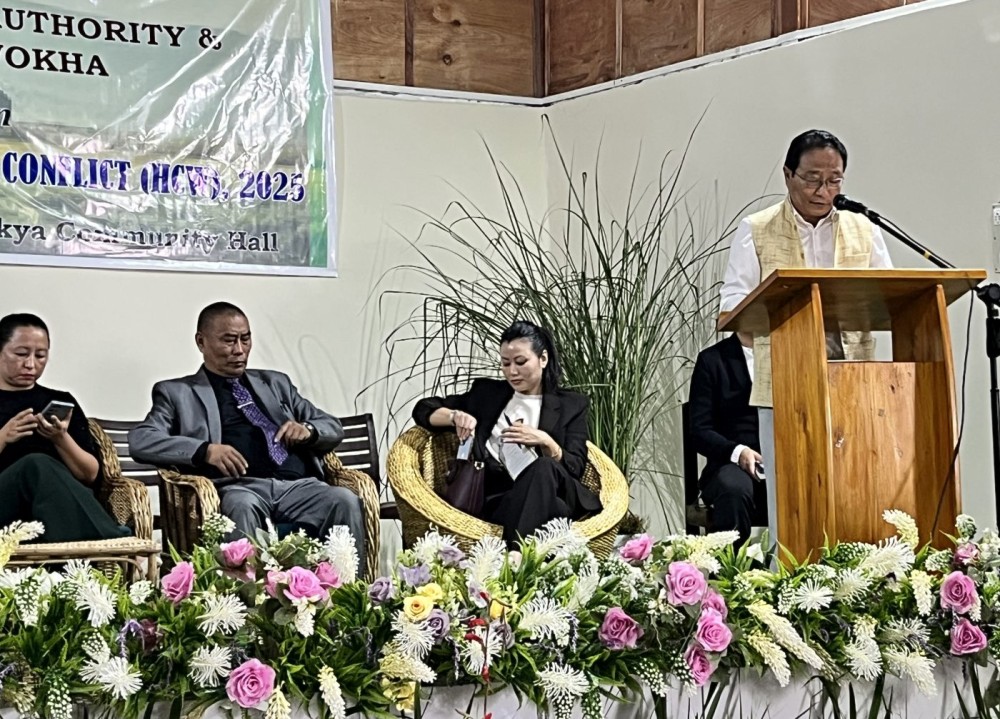
Wokha DC Mhathung Tsanglao addressing the gathering during the one-day seminar on access to justice for victims of Human-Wildlife Conflict at Likya Community Hall, Wokha, on May 30. (Morung Photo)
Morung Express News
Wokha | May 30
The Nagaland State Legal Services Authority (NSLSA), in collaboration with the Wokha District Legal Services Authority (WDLSA) and the District Administration, Wokha, organised a one-day seminar on “Access to justice for victims of Human-Wildlife Conflict (HWC)” at Likya Community Hall, Wokha on May 30.
The seminar was organised to create awareness on legal rights, relief measures, compensation provisions and access to justice for victims affected by incidents of HWC in the district.
Delivering the special address, Mhathung Tsanglao, NCS, Deputy Commissioner, Wokha, highlighted the growing challenge of HWC in the district and stressed the need for awareness, preventive measures, and coordinated intervention. He stated that Wokha has emerged as one of the most affected districts in Nagaland due to increasing incidents of HWC, with elephant presence reported in over 100 villages and nearly 60 villages identified as active conflict zones.
According to Tsanglao, such conflicts have caused severe destruction to paddy fields, areca nut plantations, rubber plantations, farmhouses, and other agricultural properties, resulting in significant livelihood losses for farmers. He also expressed concern over the loss of both human and elephant lives due to such encounters.
“Wokha district has recorded five human fatalities linked to human-elephant conflict since 2018, while around 15 elephant deaths have been reported across Nagaland,” he said.
He further pointed out that inadequate compensation, lack of effective preventive measures, and shrinking wildlife habitats have aggravated the issue, often resulting in direct confrontation between humans and wild animals.
Tsanglao observed that the closure of traditional elephant migratory corridors between Nagaland and Assam due to increasing human activities had displaced elephants into hill areas and upper ranges of the district, intensifying conflicts with human settlements.
“In this day and age, the traditional concept of self-sufficiency is being challenged due to economic compulsions for better education of children and improved standards of living. As rural economic activities remain largely dependent on land and forests, more areas are being cleared for farms and plantations, resulting in the loss of elephant habitats and blockage of migratory corridors, ultimately leading to human-elephant conflict,” he said.
He acknowledged the role of NGOs and four legislators in advocating for balanced solutions and peaceful coexistence between humans and wild elephants. “The coexistence of humans and wild animals has to continue,” Tsanglao stated.
The DC emphasised the need for a proper survey to determine the actual elephant population, habitats, and migratory corridors to better understand elephant movement and minimise future conflict.
“If we go by the projected statistics that we have, the highest concentration of wild elephants in the district and the space they require is really going to result in more conflicts in the years to come because, with the passage of time, more and more economic activities will be undertaken by the people of the district,” he said.
He suggested that authorities may need to explore options such as confining elephants to habitats where foraging resources can be planted or considering relocation measures to reduce pressure on land and minimise conflict.
Tsanglao also acknowledged the establishment of the Doyang Wildlife Division, functional since April 2026 and covering Wokha, Mokokchung and Zunheboto districts.
Referring to relief mechanisms, he said the district administration and the Nagaland State Disaster Management Authority (NSDMA) provide immediate relief to affected persons following reports of loss of life, destruction of property, farms, and plantations.
“We do give out immediate relief to help mitigate the sudden loss faced by affected persons,” he said, adding that relief is provided according to norms based on acreage, structure type, and extent of damages.
A multi-departmental committee has been constituted to tackle the rising human-elephant conflict (HEC) in Nagaland, Wildlife Warden Dr C Zubeni Tsanglao told the gathering. Speaking as a resource person, she acknowledged the complexity of the issue and said the committee would ensure timely assistance and justice for affected victims.
Highlighting that Nagaland falls within a biodiversity hotspot, she invoked Articles 48A and 51A of the Constitution, asserting that conservation is an obligation for all citizens. She added that the Wildlife (Protection) Act, 1972 guides the department’s actions, including mediation processes.
“While Nagaland has community forests, the state faces significant challenges in coexisting with wildlife,” she said, adding that increasing human settlements and the establishment of new villages have encroached upon wildlife habitats and blocked traditional animal corridors. To strengthen rapid response, the Doyang Wildlife Division has been set up, she said, urging the public to report incidents promptly.
Neikho Akami, Member Secretary of Nagaland State Legal Services Authority (NSLSA), stated that the “Access to justice for victims of Human-Wildlife Conflict 2025” scheme has been introduced to provide legal assistance to victims affected by human-wildlife conflict under the Standard Operating Procedure (SOP).
“Whenever incidents involving conflict between humans and wildlife occur, victims can seek legal support through the Legal Services Authority. Whether the conflict results in physical injury, loss of life, damage to property, or destruction of crops, assistance will be provided in documentation, filing claims, and pursuing compensation through the appropriate authorities,” Akami said.
He said one of the key responsibilities of the Legal Services Authority is to ensure that grievances are properly recorded and brought to the attention of competent authorities.
“This is the first seminar of its kind in the state, and Wokha was chosen because the district records the highest incidence of human-elephant conflict in Nagaland,” he said, adding that a dedicated team would be constituted to assist victims with documentation and related procedures.
He further said the initiative was launched with the objective of ensuring that no victim is left behind in accessing justice and support. Victims of human-wildlife conflict can approach the Wokha District Legal Services Authority for legal aid and assistance in filing compensation claims.
During an interactive session, victims and village council members raised grievances over recurring crop destruction, inadequate compensation, delayed relief, and growing HEC challenges in their areas.
During the programme, the DC also distributed relief assistance to victims affected by human-wildlife conflict.