Zasekuolie Chusi along with other officials during the district-level training programme on Census 2027 held at DC’s Conference Hall in Chümoukedima on April 16. (DIPR Photo)
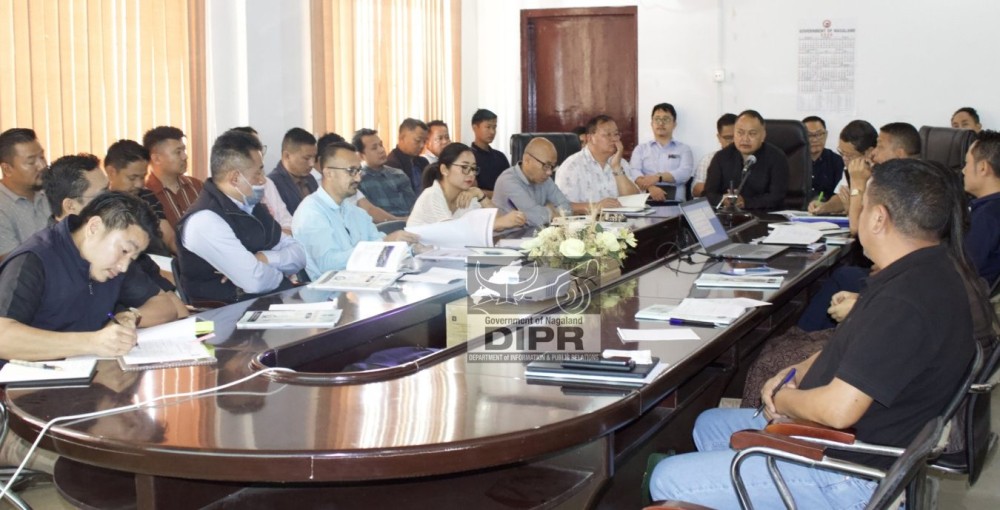
Chümoukedima, April 16 (MExN): A two-day district-level training programme on Census 2027 was conducted at the Deputy Commissioner’s Conference Hall in Chümoukedima on Thursday, with officials highlighting that the upcoming exercise will be a major shift towards digital enumeration.
An update from the DIPR informed that the training was led by Zasekuolie Chusi, Director of Census, Nagaland, and attended by Deputy Commissioners and officials from various departments of Dimapur, Chümoukedima and Niuland districts.
Officials said the forthcoming Census, last conducted in 2011, would be the largest administrative exercise in the country and would be carried out in two phases.
The first phase — House Listing and Housing Census (HLO) — will include a self-enumeration period from June 16 to June 30, 2026, followed by house-to-house enumeration from July 1 to July 30, 2026. The second phase — Population Enumeration (PE) — is scheduled for February 2027.
The training highlighted that the Census will adopt a digital mode of data collection, with enumerators using mobile applications on smartphones. A self-enumeration facility will also be provided to households, with data to be subsequently verified by field functionaries. The process will be monitored through an online system to ensure efficiency and transparency.
Officials emphasised that enumeration will follow the concept of “usual residents” to ensure accurate counting, while cautioning that data must be collected carefully and only once to avoid duplication or inflated figures.
More than 7,000 personnel, including around 5,100 enumerators and over 500 supervisors, along with charge officers and district census officials, will be engaged in the exercise. It was noted that the district level would be the most critical stage for successful implementation.
The training also stressed the importance of real-time data entry, strict adherence to guidelines and regular field verification. Officials warned that negligence or non-compliance would invite action as per the law.
Issues such as difficult terrain, connectivity challenges, special administrative conditions, and migration-related concerns were also discussed, with emphasis on coordinated planning to address them effectively.
All officers and census functionaries were urged to remain prepared and carry out their responsibilities with accuracy and integrity.
A second round of training is scheduled to be held on April 18 at the Deputy Commissioner’s Conference Hall in Chümoukedima.