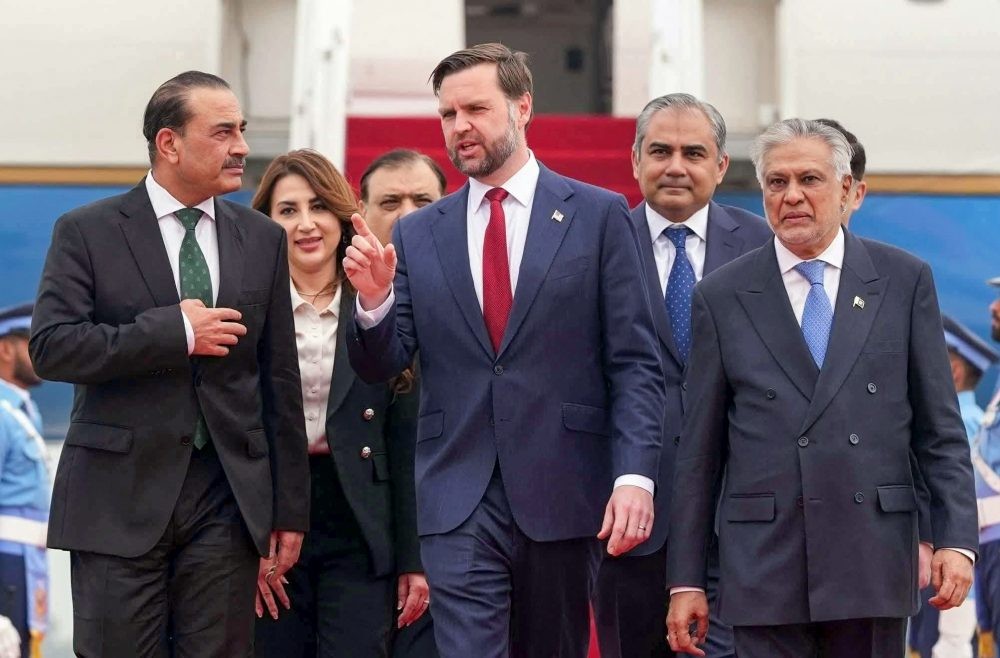
Islamabad: United States Vice President JD Vance arrives with a negotiating delegation and is received by Pakistan Army Chief Field Marshal Asim Munir, Deputy Prime Minister Ishaq Dar, and Interior Minister Mohsin Naqvi, in Islamabad district of Pakistan on Saturday, April 11, 2026. (IANS/X/@MOIofficialGoP)
Islamabad, October 22 (IANS) Pakistan is the wrong country to entrust with converting Washington’s sustained pressure on Tehran into practical next steps, as Islamabad needs a workable relationship with Iran to protect its own economic and security interests, while Tehran has several ways to make any deterioration in ties painful for Pakistan, a report has stated.
Renewed US sanctions, restrictions on Iranian financial and commercial networks, pressure on oil revenues and the cumulative economic costs of war have narrowed Iran’s room for manoeuvre after months of negotiations failed to produce the desired results, a report in 'Real Clear Defense' stated.
“American sanctions obstruct Pakistani plans for Iranian energy and expanded trade. Confrontation threatens Balochistan and could force Islamabad to divert security resources toward an already unstable frontier. Pakistan’s Mecca defence commitments to Saudi Arabia at least theoretically expose it to Iranian support for the Houthis, making Iranian restraint valuable to Islamabad regardless of what Tehran gives Washington,” the report detailed.
“China, Pakistan’s indispensable strategic partner, purchases Iranian petroleum and wants reliable Gulf energy flows. Pakistan’s military leadership has also used mediation to rebuild its political relevance in Washington by presenting access to Tehran as a valuable diplomatic asset. These interests have consistently pushed Islamabad toward de-escalation at precisely the point when sustained pressure had the potential to force Iran into harder choices,” it stated.
The report argued that Pakistan is hardly a neutral party, given its own interest in easing US economic pressure on Iran. It highlighted that the Iran-Pakistan gas pipeline has remained stalled for years, caught between Islamabad’s need for Iranian energy and the constraints imposed by American sanctions.
While Iran has built substantial infrastructure on its side of the border, the report said, Pakistan has repeatedly postponed work on its section.
It added that Tehran has since pressed Islamabad to honour its contractual commitments and warned of potential penalties, while Pakistan’s persistent energy shortages continue to make Iranian gas an attractive option.
Easing sanctions on Tehran could thus help clear a major hurdle for Pakistan’s own energy ambitions. Yet Pakistani officials advising Washington on the economic concessions needed for an agreement are discussing restrictions that directly affect their government’s ability to buy Iranian energy, the report noted.
“Iranian petrol and diesel already enter Pakistan through entrenched smuggling networks across Balochistan. Price differences and Pakistani demand support drivers, traders, storage operators, retailers, and communities that derive income from the traffic. Pakistani authorities occasionally seize fuel and conduct enforcement operations while leaving the commercial networks largely intact. Stronger restrictions on Iranian petroleum reach beyond Tehran’s revenues into a Pakistani border economy whose disruption creates problems for Islamabad,” the report in 'Real Clear Defense' mentioned.
“Iranian authorities can also tighten fuel flows, customs procedures, or border commerce from their side. Parts of Pakistani Balochistan rely on Iranian electricity, including areas around the Makran coast, giving Tehran additional means of creating economic pressure in a province where Islamabad already faces separatist violence and weak development,” it added.