Volunteers segregate waste during The Himalayan Cleanup 2026 in Dimapur on May 30. (Photo Courtesy: The Himalayan Cleanup)
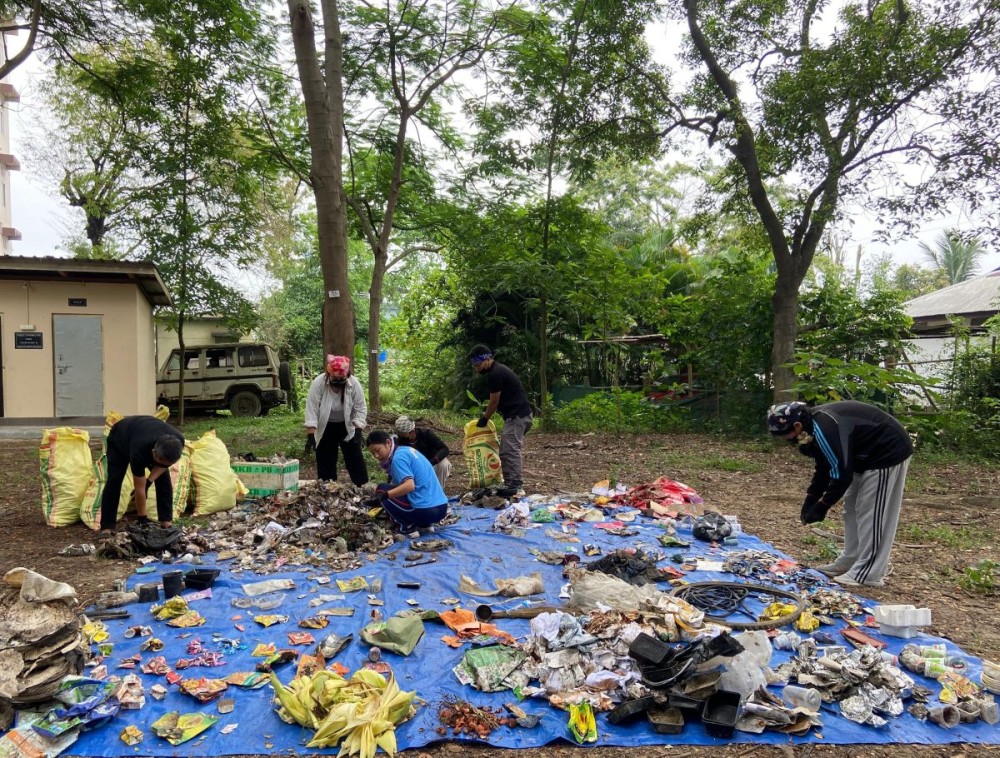
Dimapur, May 30 (MExN): A targeted waste audit conducted during The Himalayan Cleanup (THC) 2026 in Dimapur on Saturday laid bare the depth of the region’s plastic pollution crisis, with pan masala and alcohol brands emerging as the most prolific corporate contributors to litter.
Organised by the State Representative, Living For Environment (LiFE) in partnership with the Department of Environment, Forest and Climate Change, Dimapur Division and supported by the Swachh Bharat Mission-Urban (SBM-U), Nagaland, the drive reclaimed an open dumpsite at the Forest Office Complex ground, stated a press release received here.
Of the 261.521 kgs of waste cleared across 23 sacks from the dumpsite, a detailed brand and waste audit was conducted on six select sacks totalling 50.886 kgs. The audit, which ran until 4:00 PM, found that single-use disposable plastics constituted the overwhelming bulk of tracked litter, accounting for nearly 400 individual items.
Disposable plates led the count: 107 BioGlobal-brand plates alone weighed 5.720 kgs. This was followed by 183 plastic spoons and forks weighing 0.435 kgs, and 106 disposable food containers at 1.91 kgs.
On corporate accountability, the audit singled out Shikar Pan Masala with 76 wrappers as the most prevalent offending brand, followed closely by Signature with 60 packets. Alcohol packaging was also conspicuous: 20 plastic quarter-bottles of Magic Moments vodka were recovered, weighing 750 grams, along with 12 plastic quarter-bottles of AC Black whisky, weighing 485 grams.
Ironically, the persistence of disposable items remained an uphill battle; an outside breakfast arrangement for the team inadvertently generated an additional 25 pieces of sugarcane‑based compostable waste weighing 325 grams.
The drive was also marked by a health emergency when a volunteer was prick by a discarded syringe needle while sorting through the dumpsite waste. The individual was immediately taken to hospital for a tetanus shot and precautionary tests, it stated.
The cleanup was carried out by 24 participants, six team members from LiFE and 18 volunteers drawn from the North East Institute of Social Sciences and Research (NEISSR), Salesian College of Higher Education, Pro-Rural, Forest Department and independent individuals.
Chu thuzhu ni Chache (Zheni), Project Coordinator at LiFE, said the audit findings were a call to rethink everyday convenience. “The sheer volume of single-use items, even those brought in externally, highlights how deeply entrenched disposable culture is in our daily routines,” she said. While the surface of the dumpsite had been cleared, layers of legacy waste embedded deep in the ground posed a longer-term remediation challenge for the area, she cautioned.
Conceived in 2018, The Himalayan Cleanup has grown into one of the “largest collective actions against plastic pollution across Himalayan states.” Its distinguishing feature is the brand audit component, which goes beyond waste collection to establish explicit corporate accountability for plastic pollution.