Faculty, students, and presenters during the interdepartmental science talk on emerging scientific developments held at Patkai Christian College (Autonomous).
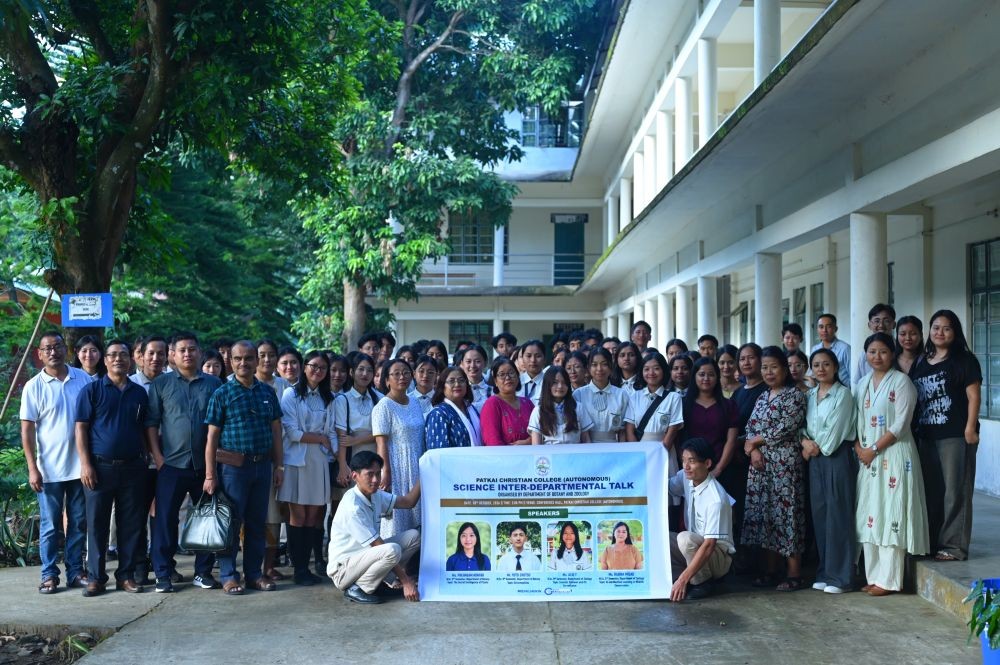
Chümoukedima, October 30 (MExN): Patkai Christian College (Autonomous) organised an interdepartmental science talk on emerging scientific developments at its College Conference Hall on October 30, bringing together students and scholars to discuss research in plant intelligence, extremophiles, zoonotic diseases and artificial intelligence in wildlife conservation.
Jointly organised by the Departments of Botany and Zoology, the programme aimed to promote interdisciplinary learning and provide students a platform to share scientific knowledge and explore emerging areas of research. The programme began with a welcome address by Dean of Sciences, Dr. Th. Devala Devi, who greeted the speakers and participants.
Four students presented papers on different scientific themes. Phehngam Konyak, a fifth-semester BSc student of the Department of Botany, spoke on “The Secret Intelligence of Plants”, examining how plants perceive and respond to environmental stimuli such as light, gravity, touch, temperature, water and chemical signals. She also discussed chemical communication, plant defence mechanisms, adaptation, plant memory and the prey-capturing mechanisms of carnivorous plants.
Yoto Chotso, a third-semester MSc student of the Department of Botany, presented on “Extremophiles”, focusing on microorganisms capable of surviving extreme environmental conditions, including high and low temperatures, pressure, varying pH levels and salinity. His presentation covered their adaptations and survival mechanisms, including thermostable proteins, stable cell membranes and antifreeze proteins. He also discussed the potential applications of extremophiles in sustainable technologies and their relevance to the search for extraterrestrial life.
From the Department of Zoology, Aliu T, a third-semester BSc student, presented on “Zoonotic Spillover and Its Surveillance”. She discussed the transmission of diseases between animals and humans, factors contributing to disease spillover, and surveillance mechanisms, citing Nipah, rabies and avian influenza as examples. Her presentation also covered the One Health approach, ethical considerations and challenges in disease surveillance, highlighting the importance of monitoring and preparedness in preventing disease transmission.
Rabina Misao, a third-semester MSc student of the Department of Zoology, spoke on “AI and Machine Learning in Wildlife Conservation”. She examined how artificial intelligence and machine learning can help process large volumes of data collected through camera traps, drones and acoustic sensors, enabling more efficient wildlife monitoring and strengthening conservation efforts. The presentations highlighted the application of scientific research across disciplines and its potential to address contemporary challenges.
The programme concluded with closing remarks, followed by the distribution of certificates to speakers and participants. Dr. Reingamla Tetso, Head of Department, presented the certificates.