New Delhi: Chief Justice of India, Justice D.Y. Chandrachud, speaks during his farewell function organised by the Supreme Court Bar Association in New Delhi on Friday, November 8, 2024. (Photo: IANS)
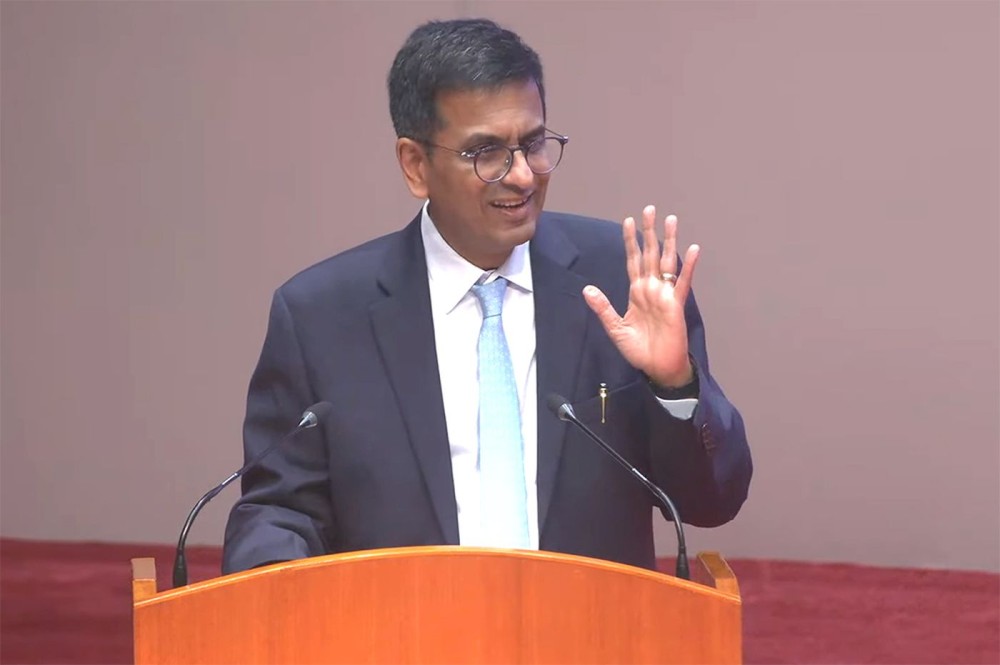
Jaipur, January 18 (IANS) Former Chief Justice of India Justice D.Y. Chandrachud on Sunday shared frank and wide-ranging reflections on law, democracy, the bail system and the functioning of the judiciary during a session at the Jaipur Literature Festival, offering rare personal and institutional insights drawn from his years on the Bench.
Speaking candidly, Chandrachud said that although he belongs to the Baby Boomer generation, his two daughters are from Generation Z and have special needs. “If I want to remain connected to their lives, I must understand how Gen Z thinks and works,” he said, underlining the importance of empathy and adaptation across generations.
Referring to his recent book, he clarified that it is not a conventional legal text but a compilation of his speeches. As a result, it naturally draws from diverse sources, including judgments of the Indian and American Supreme Courts and the ideas of thinkers such as John Stuart Mill and Immanuel Kant.
Recalling the landmark judgment decriminalising homosexuality, he said he had drawn inspiration from a line by poet-singer Leonard Cohen, reflecting both the fragility of democracy and the hope that sustains it. “Some judgments are simple, while others require a flourish of thought and sensitivity,” he observed.
Responding to a question on the Umar Khalid case, Chandrachud emphasised that he was speaking as a citizen, not as a judge. He reiterated that the foundation of Indian criminal law is the presumption of innocence and that pre-trial detention cannot be treated as punishment.
He questioned how the state could compensate someone who spends five to seven years in jail as an undertrial and is later acquitted. He explained that bail may be denied only in limited circumstances -- if the accused poses a serious threat to society, is likely to abscond or may tamper with evidence. Absent these conditions, “bail should be the rule,” he said.
Expressing concern over national security laws, he noted that courts must carefully assess whether detention is necessary and proportionate, warning that prolonged trials violate the right to a speedy trial under Article 21.
Former CJI Chandrachud also voiced concern about a growing culture of fear in district and High Courts, where judges hesitate to grant bail due to apprehensions about scrutiny and career repercussions. This, he said, shifts an excessive burden to higher courts, with the Supreme Court alone handling nearly 70,000 cases annually.
On corruption, he stressed the need for strong accountability mechanisms, cautioning against the tendency to label every adverse decision as corrupt. Strengthening institutions, he concluded, is the real path to justice.