• 81 UCs added to backlog in 2024-25
• AC bills worth Rs 448.17 Cr await adjustment
• CAG flags weak monitoring and accountability
Morung Express News
Dimapur | September 3
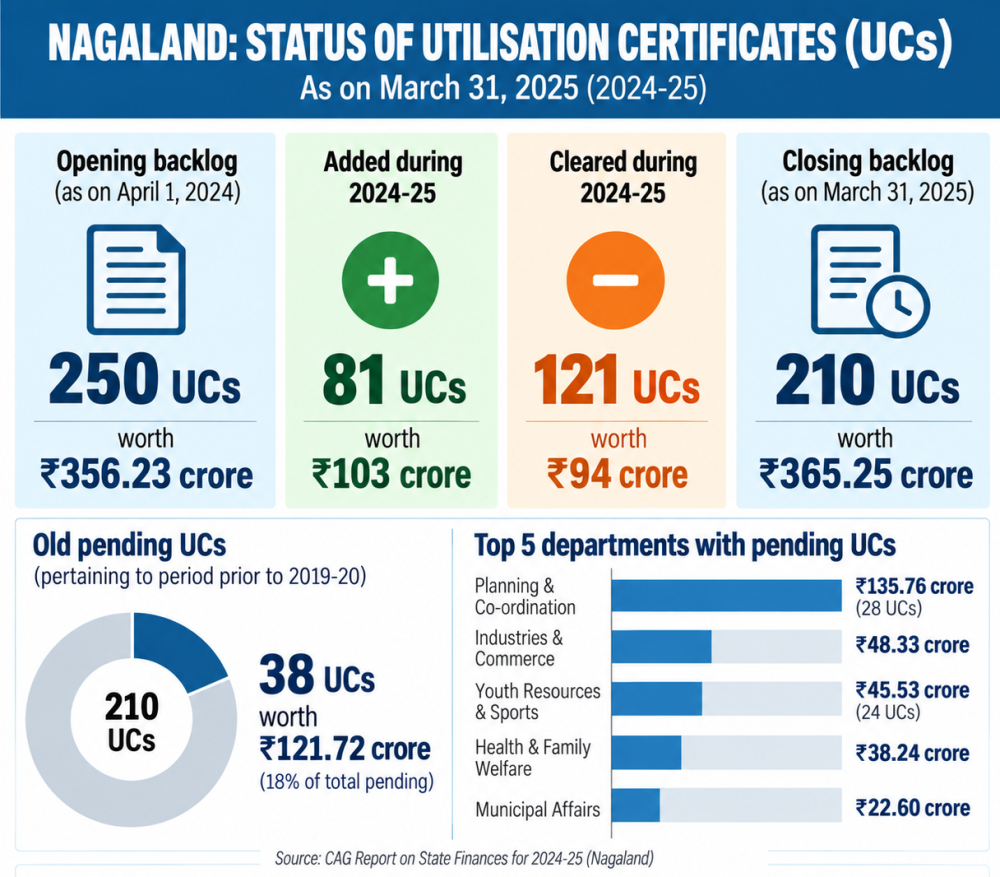
Nagaland government departments continue to delay submission of Utilisation Certificates (UCs), with 210 UCs involving Rs 365.25 crore outstanding as of March 31, 2025, the latest Report of the Comptroller and Auditor General of India (CAG) on State Finances for 2024-25 has revealed.
During 2024-25, 81 UCs amounting to Rs 103 crore were added, while 121 UCs involving Rs 94 crore were cleared, leaving 210 UCs worth Rs 365.25 crore pending, the report, tabled in the Nagaland Legislative Assembly on September 3, highlighted.
Of the 210 pending UCs, 38 worth Rs 121.72 crore pertained to the period prior to 2019-20, indicating a recurring delay.
Planning tops defaulter
Planning & Co-ordination remained the top defaulter, with Rs 135.76 crore across 28 UCs, or nearly 38% of the total. Industries & Commerce followed with Rs 48.33 crore, Youth Resources & Sports (YRS) Rs 45.53 crore, Health & Family Welfare Rs 38.24 crore and Municipal Affairs Rs 22.60 crore.
The CAG’s review of YRS found particularly serious lapses.
Of its 24 pending UCs worth Rs 45.53 crore, the oldest, involving Rs 1 crore, dated back to 2011-12.
Despite old UCs remaining pending, the department continued releasing fresh grants to several defaulting grantees without ensuring submission of earlier UCs, the CAG noted.
The audit also found no structured mechanism for regular review or follow-up, while conditions requiring timely submission of UCs were not effectively enforced.
Under Rule 238(1) of the General Financial Rules, UCs are to be furnished within 12 months of receiving a grant, or before applying for another grant for the same purpose, whichever is earlier.
The CAG cautioned that non-submission carries the risk of misutilisation and called for closer monitoring and accountability.
Rs 187 crore drawn through AC bills in one year
Meanwhile, the CAG report highlighted that, as of March 31, 2025, a total of 307 Abstract Contingent (AC) bills worth Rs 448.17 crore were pending for adjustment.
Of these, 126 AC bills worth Rs 189.09 crore pertained to the period prior to 2019-20, indicating a recurring pattern.
The CAG observed that 111 AC bills amounting to Rs 186.96 crore were drawn during 2024-25. Of these, 26 bills involving Rs 13.56 crore were drawn in March 2025 alone, representing 23.42% of the bills drawn during the year. None of these 26 bills had been adjusted by March 31, 2025.
The Home Department led the pending AC bills with Rs 156.05 crore, followed by the Civil Election Department (Rs 154.74 crore), Election Department (Rs 55.85 crore), Youth Resources & Sports (Rs 40.71 crore), and Planning & Coordination (Rs 12.02 crore).
However, the overall total marked a decline from 333 AC bills worth Rs 613.29 crore pending for adjustment as of March 31, 2024.
Abstract Contingent (AC) bills allow Drawing and Disbursing Officers (DDOs), in emergent circumstances or where the exact requirement cannot be calculated, to draw money without supporting documents. The subsequent adjustment is required through detailed bills.
The audit cautioned that prolonged non-adjustment of advances carries the risk of misappropriation and requires close monitoring by DDOs to ensure submission of Detailed Contingent (DC) bills.
It further observed that, in the absence of DC bills, the expenditure reflected in the Finance Accounts cannot be asserted as correct or final.
The CAG recommended strict adherence to the rules, quarterly reviews of pending AC bills and restrictions on further drawals until earlier advances are adjusted. Departments with high pendency, it said, should face focused scrutiny and suitable accountability measures for delays.
Same problem, same assurance
The latest findings point to a recurring pattern. The 2023-24 State Finances report had recorded 250 pending UCs worth Rs 356.23 crore as of March 2024.
More tellingly, the government’s response appears remarkably similar. During the December 16, 2024 Exit Conference, the Finance Department assured the CAG it would “initiate steps to minimise the outstanding UCs.”
Yet during the February 17, 2026 Exit Conference, the Finance Commissioner again assured the CAG that “more proactive steps” would be initiated to minimise the backlog.
The same pattern is evident in the handling of AC bills. During the Exit Conference on December 16, 2024, the Finance Department assured the CAG that it would “initiate steps to minimise the outstanding AC bills.”
In the latest report, following the February 17, 2026 Exit Conference, the Finance Commissioner, Government of Nagaland, again assured that “more proactive steps” would be initiated to minimise the outstanding DC bills.
In both cases, however, the CAG noted that “the details of the steps to be taken up were not highlighted.”