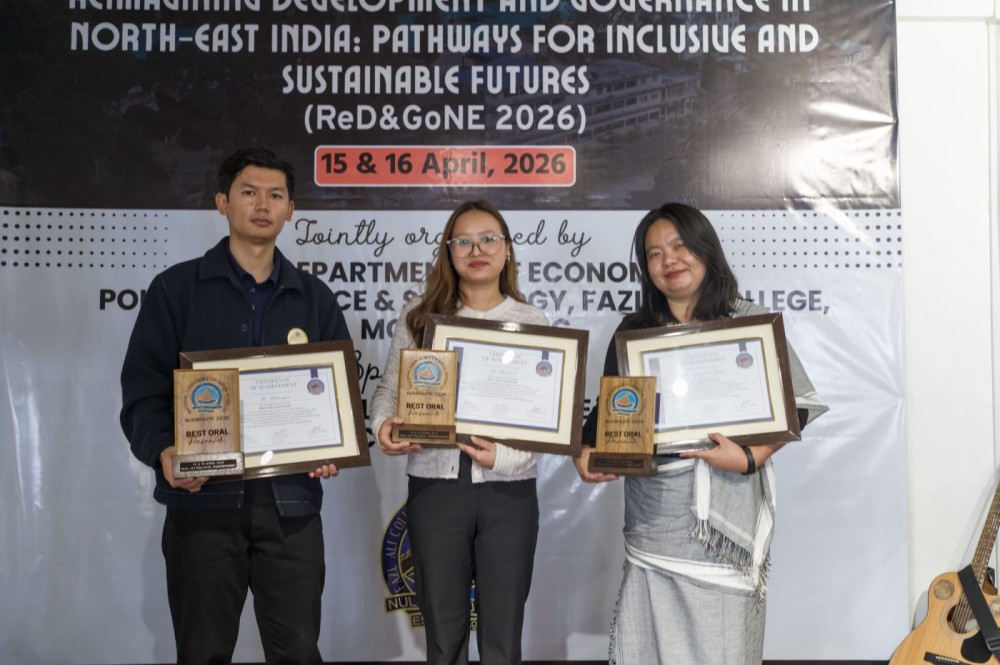
Best Oral Presenters, Dr Watitemjen, Cheme S and Dr Limasenla Jamir with their awards at the two-day national conference organised by the Departments of Economics, Political Science, and Sociology, Fazl Ali College, on April 16.
Morung Express News
Mokokchung | April 16
The two-day national conference on “Reimagining Development and Governance in North-East India: Pathways for Inclusive and Sustainable Futures” (ReD&GoNE 2026), organised by the Departments of Economics, Political Science, and Sociology, Fazl Ali College, concluded on April 16 with a valedictory session held at the College Conference Hall.
The valedictory programme was graced by Neidihou Keditsu, Director, Directorate of Economics & Statistics, Government of Nagaland, as the valedictory guest. In his address, he appreciated the relevance of the conference theme, noting its alignment with the vision of Viksit Bharat 2047.
He encouraged participants to engage in data-driven, in-depth research that can contribute meaningfully towards the goal of Aatmanirbhar Bharat. He also expressed the Department’s willingness to collaborate with academic institutions and research bodies in promoting evidence-based policy formulation for effective governance.
The session featured the presentation of awards to the three Best Oral Paper Presenters. The awardees included Cheme S, Research Scholar, Department of Political Science, Nagaland University, Lumami, Dr Watitemjen, Assistant Professor, Dept of Botany, FAC and Dr Limasenla Jamir, Assistant Professor, Dept of Sociology, FAC.
A total of 22 paper presenters participated in the two-day event, representing institutions from across the region including Wokha, Zunheboto, Kohima, Dimapur, Phek and Shillong, Meghalaya.
The valedictory session also included feedback from selected paper presenters, who reflected on their experiences and highlighted the importance of such academic platforms in fostering dialogue and collaboration.
The conference concluded with words of appreciation from Dr E Benrithung Patton, Co-convenor, marking the culmination of ReD&GoNE 2026 and reaffirming the importance of sustained academic engagement in shaping inclusive and sustainable futures for the region.
Earlier in the technical sessions held in the morning, Prof TT Haokip, Professor, Dept of Political Science, North-Eastern Hill University, Shillong TT Haokip delivered a talk on “Federalism and the Crisis of Governance in Northeast India: The case of Manipur and Meghalaya,” introducing the concept of “ambiguous federalism.” He explained how overlapping authorities among traditional institutions, Autonomous District Councils, and state governments create administrative confusion and inefficiencies.
He said that the resulting lack of clear boundaries weakens accountability, delays decision-making, and leads to governance challenges. Drawing on examples from Manipur and Meghalaya, he called for clearer institutional roles, better coordination, and more inclusive governance frameworks.
Dr Limakumba Walling, Assistant Professor, School of Economics, University of Hyderabad examined Nagaland’s development trajectory, in his paper titled “Overcoming the ‘Permanent Trasition” trap: Reimagining Development in Nagaland’ arguing that the post-1963 state-led model has led to a “permanent transition” marked by institutional stagnation and economic dependency. He highlighted how factionalism, informal taxation and over-reliance on central grants have deepened inequality, weakened infrastructure, and increased unemployment.
He said that the tension between modern governance and traditional tribal structures has further enabled elite capture and eroded public trust. He proposed a consensus-based, community-driven approach through decentralization and communitization.
Emphasizing the role of civil society and the Church, he called for greater accountability and ethical governance to achieve inclusive and sustainable development.