Morung Express News
Dimapur | August 30
“The colonial administration originally used the Inner Line to divide communities. We must not let modern undemocratic forces use these same lines to cut the Northeast off from the rest of the country.”
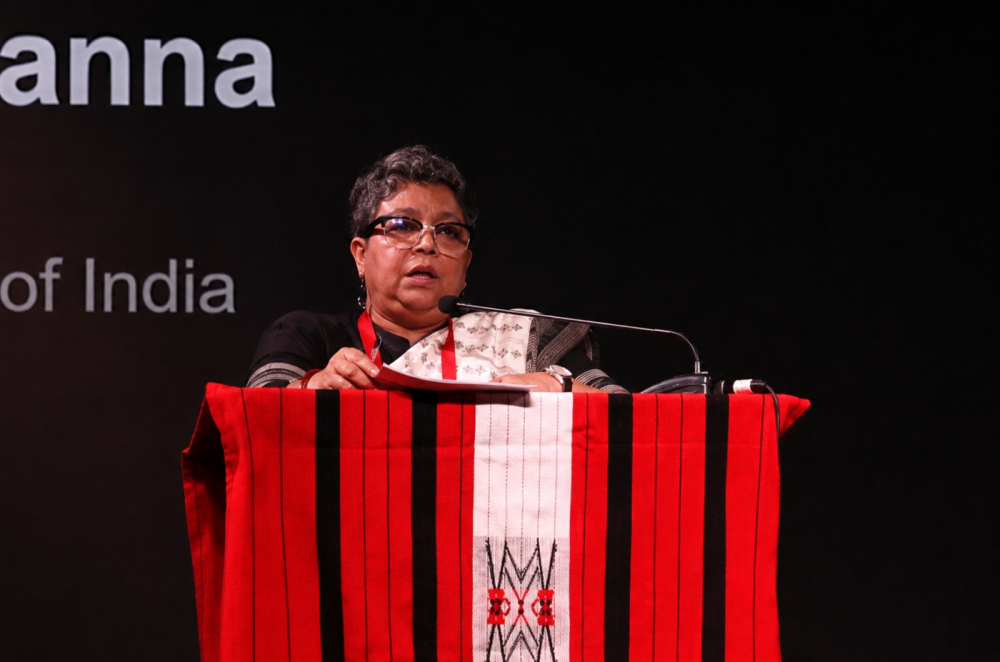
Senior Advocate of the Supreme Court of India Shomona Khanna addressed the audience at the two-day national seminar on the Bengal Eastern Frontier Regulation (BEFR), 1873, organised by the Inner Line Regulation Commission-Naga Students’ Federation (ILRC-NSF), which concluded on August 29.
She called for vigilance in strengthening the Inner Line Permit (ILP) regime while ensuring that it does not become a tool for xenophobia or isolation.
Speaking on "The BEFR, 1873: Protection and Safeguarding the Rights of the Hill Tribes", Khanna said the regulation must be understood in the larger context of protecting the rights, autonomy and identity of the hill tribes.
She noted that colonial records had described the Nagas through a highly paternalistic lens as “innocent groups of people,” “semi-savages” and “wanderers” who supposedly needed protection from plains-dwellers. At the same time, colonial counter-narratives portrayed Nagas as “semi-savage tribes” and “uncivilised hillmen” who were daring and warlike.
Against this backdrop, the British administration introduced the BEFR, 1873, establishing an “Inner Line” beyond which non-Nagas and British subjects could not pass without prior permission. Khanna said the measure was intended to minimise friction between the hill areas and the plains at that historical juncture. She also pointed out that the continuation of the Regulation was explicitly recognised under the 16-Point Agreement of 1960, representing an assertion of autonomy by the people of Nagaland.
Highlighting three key provisions of the BEFR, Khanna said Section 3 provides the legal basis for establishing and maintaining the Inner Line. Section 5 provides for confiscation of forest produce and other goods found in the possession of persons violating the Inner Line; while Section 7 prohibits a British subject or non-native of the district from acquiring an interest in land, or the product of land, within the Inner Line without prior government sanction.
Placing the BEFR within the constitutional framework, Khanna described India as an example of “asymmetrical federalism”, where different regions have distinct constitutional relationships with the Union. In Nagaland, this protective relationship is embodied in Article 371A, which safeguards Naga religious and social practices, customary law and procedure, administration of justice according to customary law, and the ownership and transfer of land and its resources.
On challenges to the ILP under Article 19, Khanna said the freedom of movement and residence are not absolute. Article 19(5) permits reasonable restrictions in the interest of the general public or for protecting the interests of Scheduled Tribes. The ILP, she said, is therefore constitutionally defensible as a reasonable restriction intended to protect tribal populations, identity and resources.
Khanna also cautioned against executive overreach in determining who qualifies for such protection, particularly through the Indigenous Inhabitant Certificate (IIC), and noted the vulnerability of land and natural resource protections under Article 371A.
She underscored that the challenges facing the Naga people are not unique. The struggle is a shared one, with Adivasi and other marginalised communities across the country fighting to protect their customary rights, lands and forests. In light of this, Khanna called on the Nagas to forge stronger alliances of solidarity with them to collectively defend their rights.
She urged a future rooted in shared traditions of community, genuine democracy, and ecological stewardship, rather than surrendering to the forces of extractive capitalism.
.jpg)