Prof Shantanu Chakravarty of Girijananda Chowdhury University, Assam addresses the concluding day of the the two-day national seminar on the BEFR, 1873 organised by ILRC-NSF in Dimapur on August 29. (Morung Photo)
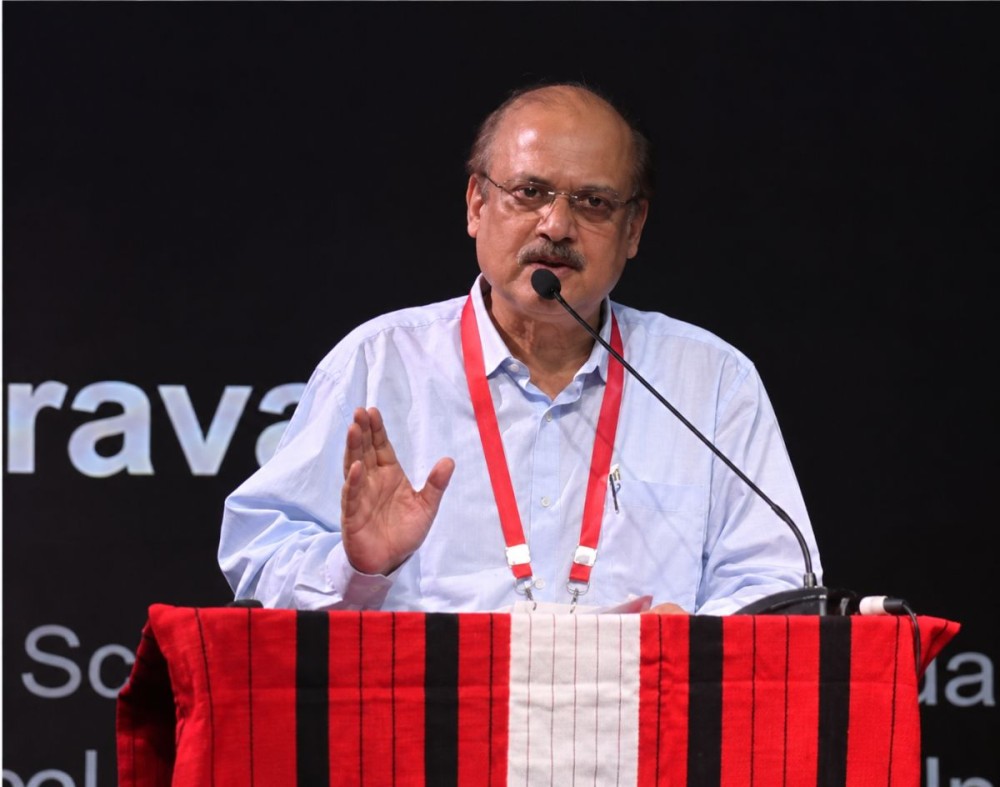
From a ‘mainland’ perspective, Prof Chakravarty argues the ILP system preserves India’s pluralism, not a ‘constitutional anomaly’
Morung Express News
Dimapur | August 30
The debate over the Bengal Eastern Frontier Regulation (BEFR), 1873, should not be framed as a choice between national integration and regional isolation but as part of India’s constitutional commitment to protecting indigenous communities and preserving its pluralistic character, stated Prof Shantanu Chakravarty of Girijananda Chowdhury University, Assam.
Presenting his paper, “The BEFR, 1873: A Mainland Indian Perspective vis-à-vis the Constitutional Safeguards of Indigenous Peoples, with Special Reference to Nagaland,” at the two-day national seminar on the BEFR, 1873, organised by the Inner Line Regulation Commission-Naga Students’ Federation (ILRC-NSF) in Dimapur on August 28 and 29, he offered his reading from a ‘mainland’ perspective.
He clarified, however, that despite the paper’s theme, he was “not originally from what is typically termed the mainland,” being from Assam.
This, he said, initially made it challenging to understand how mainland Indians viewed the regulation, particularly whether they supported it or harboured significant objections.
The task was further complicated by the limited literature directly authored by mainland scholars on the BEFR, with most available commentary coming from the North-East, he added.
Two competing perspectives
Nevertheless, Chakravarty broadly categorised the mainland perspective into two competing positions.
The first is the integrationist view, which sees the ILP as potentially inconsistent with fundamental rights and an impediment to economic integration.
The other, the protective and indigenous rights perspective, sees unrestricted migration, land acquisition and commercial penetration as undermining indigenous land rights, customary institutions, cultural identity and demographic stability.
“This demographic and cultural vulnerability is not theoretical; it is an active reality experienced across the North-East, including in my home state of Assam,” he maintained.
Chakravarty said the tension between national integration and protecting regional and cultural diversity remains central to the BEFR debate.
While requiring a permit to enter a part of one’s own country may appear contrary to the spirit of a single nation, he said the question must also be viewed against Article 19(5), which permits reasonable restrictions on movement and residence for the protection of Scheduled Tribes.
Constitutional continuity and legal validity
He also addressed the BEFR’s colonial origins, acknowledging that the British introduced it primarily for commercial, administrative and revenue interests, while the Inner Line also helped keep hill tribes isolated from the broader Indian national movement.
However, its colonial origin does not by itself invalidate the regulation in the constitutional era, he argued. Referring to Article 372, he said pre-existing laws continued after the Constitution came into force until altered, repealed or amended by a competent legislature.
“Therefore, the BEFR has clear constitutional continuity and legal validity,” he added.
Chakravarty stressed that the constitutional core of Nagaland’s protection lies in Article 371A. While the BEFR functions as a regulatory gatekeeper, Article 371A provides a constitutional shield over Naga religion and social practices, customary law, and the ownership and transfer of land and its resources.
“Land is not merely a commodity or an economic asset,” he said, contending that in tribal societies it is intrinsically linked to community identity, social structure and survival.
Balancing demographic anxieties
Citing demographic concerns across the North-East, including Tripura and Assam, Chakravarty said the free flow of capital and people must be balanced against the possibility of indigenous populations being marginalised.
Demands for an ILP regime in Assam, he noted, have also emerged from such anxieties.
In his closing remarks, Chakravarty said the ILP should be understood not as an “isolationist barrier” or “constitutional anomaly” but as a “vital constitutional asset” preserving India’s federal and pluralistic character.
He proposed a balanced model of Inner Line governance based on three pillars: protection of indigenous land, customary laws, cultural identity and demographic stability; accessibility, with a simple and transparent permit process for legitimate visitors and businesses; and accountability, with transparent administration and judicial oversight.
Such a framework, he said, can protect the distinct rights and identities of frontier states while maintaining “healthy, open, and constructive integration” with the rest of the nation.
.jpg)