Chief Secretary Sentiyanger Imchen with DGP Rupin Sharma and others during the Capacity Building Programme for Village Level Functionaries in Kohima on September 29. (Morung Photo)
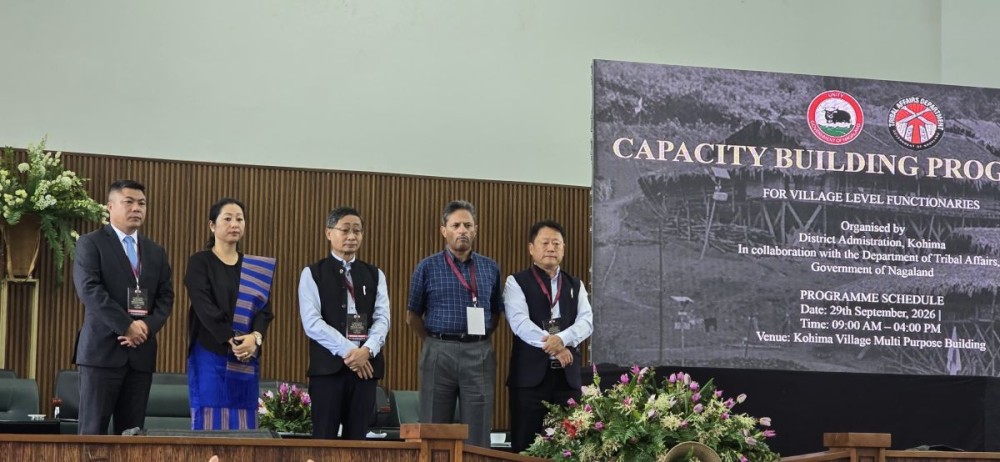
Capacity Building Programme for Village Level Functionaries held in Kohima
Our Correspondent
Kohima | September 29
Nagaland Director General of Police (DGP) Rupin Sharma on Monday said village councils are important and empowered institutions at the grassroots, but the absence of structured induction and training can sometimes lead to functionaries exceeding their prescribed powers.
He stressed the need for village-level functionaries to understand where village councils can act independently and where they must seek assistance from the police, district administration or other authorities.
Sharma was addressing a Capacity Building Programme for Village Level Functionaries in Kohima district, organised by the District Administration, Kohima, in collaboration with the Department of Tribal Affairs, Government of Nagaland, at the Kohima Village Multi Purpose Building, Kohima on September 29.
Speaking from the perspective of law and order, the DGP said serious offences and important criminal matters must be reported to the police.
He emphasised that village councils do not have the authority to arrest people for offences and cautioned against taking the law into their own hands.
Referring to the amended provisions governing village councils and administration of justice, Sharma said the jurisdiction of village councils is limited to their respective areas and urged functionaries to operate strictly within the legal framework.
The DGP also cautioned against imposing inappropriate punishments for serious offences, citing an instance where a village-level body had reportedly dealt with a rape case by imposing a fine. He said such practices were unacceptable and underscored the importance of referring serious criminal matters to the police.
Addressing as the special guest, Nagaland Chief Secretary Sentiyanger Imchen urged village-level functionaries to uphold transparency, accountability, fairness and public interest in discharging their responsibilities. He said governance is experienced by people through basic services and development related to water, sanitation, roads, livelihoods, healthcare, education, social welfare and law and order. Village institutions must exercise their powers responsibly and ensure development is just and equitable, he added.
Call for proper utilization of fund
Nagaland Commissioner Gregory Thejawelie, referring to the Nagaland Village and Area Councils Act, 1978, said village councils have an established legal framework and urged functionaries to familiarize themselves with the relevant dos and don'ts and work towards decentralising governance.
He stressed the need for a clear understanding of government funding, particularly funds provided through the Village Development Board (VDB), and their proper utilization.
He also highlighted the role of village institutions in areas such as communitisation, school management, electricity metering and healthcare.
On certification, Thejawelie emphasised the importance of properly understanding the rules governing Indigenous Inhabitant Certificates and cautioned village authorities against issuing certificates beyond their legal mandate. He also referred to the responsibilities entrusted to village councils in connection with Inner Line Permit (ILP) requirements.
Good community governance
Kohima Deputy Commissioner B Henok Buchem, said the programme was organised following the recent constitution of new Village Councils across the district, with the objective of familiarising village functionaries with important laws, rules, schemes and guidelines relevant to their responsibilities.
Describing Kohima as the first district of Nagaland, he urged village leaders to lead by example through responsible leadership, good community governance and effective implementation of development programmes.
He said that effective governance begins at the grassroots, adding that development becomes meaningful when the community participate in it and takes ownership of the process.
The programme covered the Nagaland Village Council Act, 1978 and Rules, 1979; Rules for the Administration of Justice and Police, 1937; regulations and code of ethics for Gaon Buras; verification of ST, Indigenous Inhabitant and Permanent Residential Certificates; and illegal immigration and enforcement of ILP under the BEFR, 1873.
Other topics included the Nagaland VDB Model Rules, 1980; Communitization Act, 2005 covering village schools, health and power utilities; financial management and statutory audits; Chief Minister’s Micro Finance Initiative, CMHIS, Ayushman Bharat-PMJAY and CMLIS; digitisation of birth and death certificates and infant Aadhaar enrolment.
The programme also covered Solid Waste Management Rules, 2026, Swachh Bharat Mission (Grameen), liquid waste and plastic recovery facilities, and land holding systems under Article 371A vis-à-vis land acquisition and government land.