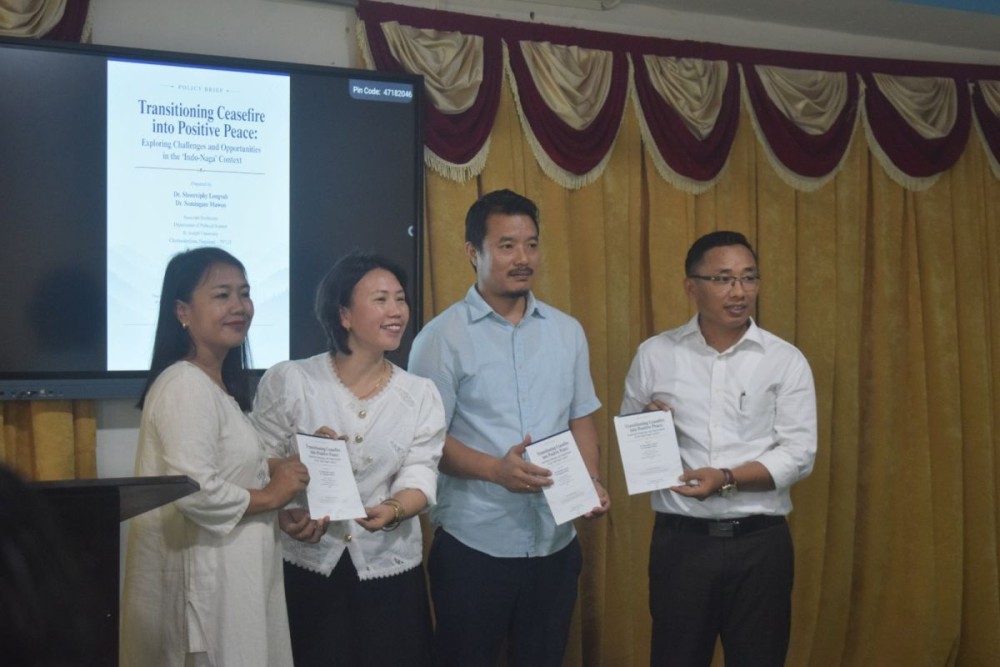
Resource persons pose for a photo during the release of a policy brief on transitioning the Indo-Naga ceasefire at St Joseph University, Chümoukedima on July 27. (Photo Courtesy: SJU)
Chümoukedima, July 27 (MExN): St. Joseph University, Chümoukedima, on July 27 organised a one-day workshop and released a policy brief on transitioning the Indo-Naga ceasefire into positive peace, with participants highlighting the need for inclusive dialogue, institutional reforms and community participation to achieve lasting peace.
The workshop, titled "Transitioning Ceasefire into Positive Peace: Exploring Challenges and Opportunities in the Indo-Naga Context," was organised by the Department of Political Science under a research project funded by the Peace Research Program of the International Peace Research Association Foundation (USA).
Coordinated by Associate Professors Dr Shonreiphy Longvah and Dr Somingam Mawon, the programme brought together academics, students and researchers to examine the challenges of transforming a prolonged ceasefire into a sustainable and inclusive peace process.
Delivering the keynote address, Longvah said peace should be viewed not merely as the absence of violence but as a process that addresses the structural, political and social causes of conflict.
Drawing on field-based research and comparative peace studies, she said positive peace requires institutional reforms, reconciliation and meaningful participation of communities, particularly women and youth, whose voices have often remained underrepresented in formal peace processes.
She observed that while ceasefire arrangements have reduced armed confrontation, they have often evolved into mechanisms for managing conflict rather than transforming it, contributing to a prolonged situation described as "no war, no peace", marked by unresolved grievances, political uncertainty and social divisions.
Participants distinguished between maintaining a ceasefire and building sustainable peace, noting that while ceasefires are important confidence-building measures, they cannot by themselves resolve deep-rooted political and societal issues.
They stressed that without sustained trust-building, inclusive dialogue and institutional reforms, ceasefire arrangements risk becoming permanent transitional arrangements instead of pathways to lasting peace.
The discussions also highlighted the need for evidence-based policymaking that incorporates local perspectives alongside broader peacebuilding frameworks and emphasised justice, reconciliation, responsive governance and equitable development as key elements of positive peace.
A policy brief summarising the findings of the research project and recommending participatory and inclusive approaches to peacebuilding in the Naga context was released by Dr Kinitoli H Yeptho, Director of the Internal Quality Assurance Cell (IQAC), St. Joseph University.