Officials along with the participants during the commencement of the three-day palliative care training held at the Conference Hall of DHFW in Kohima on June 25.
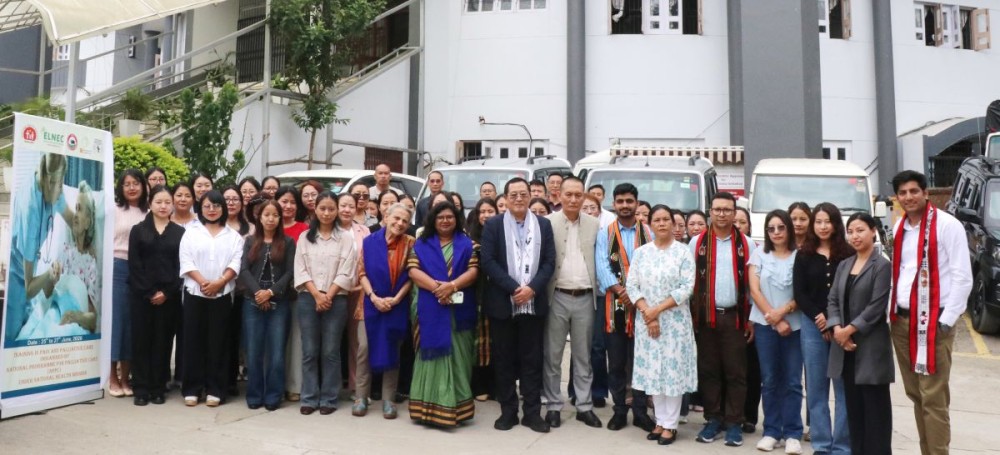
Kohima, June 25 (MExN): A three-day state-level training programme on Pain and Palliative Care for nurses and physiotherapists commenced in Kohima on June 25 under the National Programme for Palliative Care (NPPC), with health officials emphasising the need to strengthen services amid a growing elderly population and rising burden of chronic diseases.
The training, being held from June 25 to 27 at the Conference Hall of the Department of Health and Family Welfare (DHFW), is being attended by 47 nurses and physiotherapists from across the state. The programme is being conducted by Hospice and Palliative Care specialists from AIIMS Delhi and AIIMS Jodhpur.
Addressing the inaugural session, National Health Mission (NHM) Mission Director Dr Keveduyi Theyo said the need for palliative care continues to grow due to an increase in the elderly population and the rising burden of non-communicable diseases as well as certain communicable diseases.
“These realities demand that we not only treat disease but also relieve suffering, uphold dignity and support families,” he said.
Dr Theyo said the National Programme for Palliative Care, launched in 2012 and now integrated with the NHM, aims to strengthen infrastructure, capacity building, drug availability and awareness generation. Nagaland initiated its palliative care programme in 2017.
He noted that the inclusion of palliative care in the Comprehensive Primary Health Care (CPHC) extended package of services marked a major milestone by expanding access to services through Community Health Centres (CHCs), Primary Health Centres (PHCs), Health and Wellness Centres (HWCs) and Sub-Centres (SCs).
Highlighting the importance of workforce development, the Mission Director said capacity building remains the backbone of a strong palliative care system.
“Without a well-trained workforce, quality service delivery cannot be achieved,” he said, adding that caregivers, including family members, ASHAs, ANMs, community health workers and trained volunteers, serve as the primary link between patients and healthcare professionals.
He stressed the need for structured training programmes for caregivers and greater engagement of religious institutions, social groups and civil society organisations to build a sustainable community-based palliative care model.
Dr Theyo also called for prioritising implementation of NPPC across all districts, strengthening pain and symptom management services, and conducting district-level training programmes to enhance the capacity of healthcare providers.
Speaking on the occasion, Hospice and Palliative Care Nurse Specialist Hanife F Macgamwell thanked the Nagaland government for facilitating her visit to the state and said the participants would play a crucial role in expanding palliative care services.
She said some trainees would eventually become state trainers responsible for pain management, symptom management and grief management.
“Palliative caregivers have an endless responsibility and will be useful for a long time in improving the quality of life of patients,” she said.
The inaugural programme was chaired by Joint Director, State Programme Office (NPPC), Dr Imnapokim, who also felicitated the guest trainers. He welcomed the dignitaries, experts and participants and urged district representatives to actively participate in the training and work towards strengthening implementation of palliative care services under NPPC.
Officials said the palliative care programme in Nagaland has faced several challenges, including inadequate training of dedicated staff, frequent changes in programme officers, shortage of manpower and space constraints for setting up palliative care units in district hospitals.
During 2018-19 and 2019-20, financial assistance was provided to palliative care units at Naga Hospital Authority Kohima (NHAK) and the Christian Institute of Health Sciences and Research (CIHSR), Dimapur, to meet operational expenses and procure medicines.
Under the programme, four districts - Tuensang, Kiphire, Zunheboto and Wokha - were approved during 2024-25, while five more districts - Mokokchung, Peren, Longleng, Phek and Mon - were approved during 2025-26.
As part of capacity-building efforts, Pallium India’s TIPS Education and Skill Building Department organised free online training programmes for doctors and nurses, enabling healthcare providers to enhance their skills in palliative care. Several doctors and nurses from the state have completed the training and are eligible for certification.