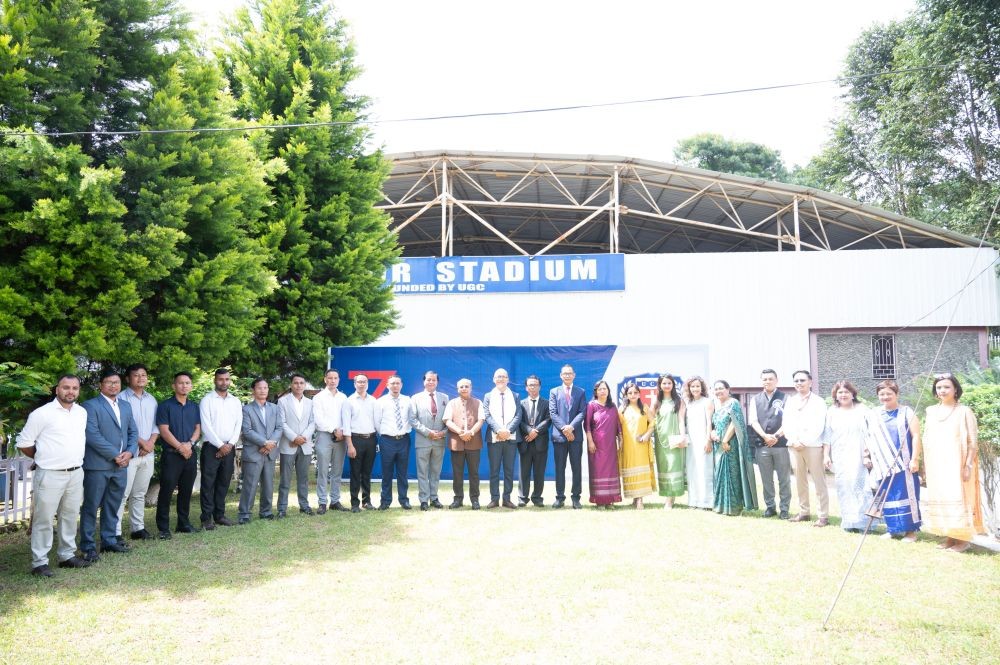
With Prestone Tynsong, Deputy Chief Minister of Meghalaya and Dr Celestine Lyngdoh, MLA of the 11-Umsning Assembly Constituency and Dr R M Manih, the Principal of Union Christian College.
Meyu Changkiri
Seventy-five years ago, in the quiet surroundings of Barapani, a small college began with one student. What began as a modest educational venture would gradually become a meeting place for generations of young people from across the North East and beyond.
Today, Union Christian College (UCC) stands as part of the educational history of Meghalaya and the wider North East. Its story is one of vision, perseverance and, above all, people coming together across communities and places to build something that would outlast them.
On 14 August 2026, UCC began its Platinum Jubilee celebrations, launching a year-long journey that will culminate on 14 August 2027. The inaugural programme was graced by Shri Prestone Tynsong, Hon’ble Deputy Chief Minister of Meghalaya, as the Chief Guest, and Shri Dr. Celestine Lyngdoh, Hon’ble MLA of the 11-Umsning Assembly Constituency, as the Guest of Honour.
For those gathered at Barapani, it was an occasion to celebrate an institution. For me, and for the North East India Christian Council (NEICC), it was also an opportunity to remember the wider story behind its creation - a story that began long before the first class entered a UCC classroom.
The Platinum Jubilee is therefore more than a milestone. It is an opportunity to remember where UCC came from, the people and partnerships that shaped it, and the possibilities that lie ahead.
A Vision That Began Before 1952
The story of UCC did not begin in 1952. Its roots go back to 22 September 1936, when representatives of various missions in undivided Assam met in Shillong to consider the organisation of a Council of Churches in Assam. The meeting reflected a growing recognition that the region’s churches and communities could benefit from greater cooperation. This eventually led to the formation of the Assam Christian Council (ACC).
On 23 November 1937, members of the Council constituted a committee to work towards establishing a college. It included Rev. T. E. Pugh, J. M. Forbes, Rev. J. J. M. Nicholas Roy, Rai Bahadur D. Ropmay and Dr. Victor Hugo Sword, who was appointed Chairman and Treasurer.
The significance of these beginnings lies in their collective nature. UCC was not conceived by one person, one organisation or one state. It emerged from cooperation among different missions and churches around a common educational purpose.
In 1941, Rev. J. W. Roberts, Secretary of the Council, appealed to affiliated bodies and churches for support. A contribution of four annas per member was pledged, while the search for a suitable site continued.
A proposal to use the Baptist Church compound in Guwahati did not materialise. There was also a proposal from the Naga Baptist Church to make 500 acres available at Kohima. At the same time, the then Syiem of Mylliem offered 900 acres on lease at Barapani. In 1950, the ACC decided in favour of Barapani.
Although the College found its home in Meghalaya, its beginnings were wider. Its vision was shared, its founding effort was collective, and its early support came from different parts of the region and beyond.
In 1962, the Assam Christian Council was renamed the North East India Christian Council (NEICC), reflecting the wider scope of its work. The NEICC is therefore an integral part of UCC’s history - not simply an organisation associated with the College later, but part of the regional initiative from which the College emerged.
From Vision to Reality
Turning an idea into a functioning college required persistence, resources and partnership. In July 1951, the American Baptist Board came forward with substantial support. A letter from its Secretary in New York to Dr. Victor Hugo Sword expressed appreciation for the work taking shape at Barapani and acknowledged Dr. Sword’s determination in bringing the College into being.
The first academic session began on Friday, 14 August 1952. There was one student at the beginning. The number gradually grew to eleven, including one young woman. The early students came from West Khasi Hills, Garo Hills, Assam, Nagaland and Manipur.
The College itself was built through remarkable cooperation. An ecumenical work camp brought together people to clear the land and construct the first buildings. Volunteers from different parts of the world also participated. Churches, governments, educational bodies and organisations in India and abroad contributed in various ways.
From the beginning, therefore, UCC was more than a campus. It was an undertaking built through the efforts of many people.
The Strength of Diversity
One of the most distinctive features of UCC over the decades has been the diversity of its student community. Young people from different parts of the North East came to Barapani, bringing with them different languages, cultures, traditions and experiences. In classrooms, hostels, playgrounds and everyday campus life, they learned not only from teachers and books but also from one another.
The presence of students from Nagaland, Manipur, Mizoram, Assam, Arunachal Pradesh, Tripura, Meghalaya and elsewhere gave the College a character that extended beyond its geographical location. It became a place where young people from communities that might otherwise have had limited opportunities to meet could form friendships, exchange ideas and grow together.
For many people in the region, community is an important source of identity and strength. Family, village, clan and community relationships have long played a significant role in social life. Diversity, therefore, need not mean distance; it can also be a source of connection.
That was one of the quiet strengths of UCC.
A Personal Connection
The history of UCC also has a personal connection for me. Among its early students were Tekachang Ao Changki and Sangmonger Ao Changki, both from my own village and belonging to my paternal grandmother’s clan. Tekachang later served as the Joint Chief Election Commissioner of Nagaland, while Sangmonger retired as a Deputy Secretary. Tekachang’s son, Shri Temjenmenba Pongen, is a Member of the Legislative Assembly of Nagaland and serves as Advisor for Transport and Technical Education in the Government of Nagaland.
Their story is a small but meaningful illustration of how the influence of UCC has travelled across generations and into different spheres of public life.
It is also a reminder that the history of an institution is ultimately made up of individual lives. Behind the dates, buildings and official records are families, friendships, teachers, students and communities whose stories have become part of the College’s journey.
There are undoubtedly many such stories.
The Regional Character of UCC
One of the things that made UCC distinctive in its earlier years was the way students from different parts of the North East came together at Barapani. They arrived with different languages, cultures and experiences, but over time the College became a shared space in which friendships were formed and horizons widened.
That experience remains relevant. The North East has always been a region of remarkable diversity, and there is something valuable about having institutions where that diversity can meet naturally. UCC has been one such place.
As the College enters its 75th year, the opportunity is to carry that spirit forward in ways that speak to a new generation. The region has changed considerably since 1952, but the value of bringing young people together, allowing them to learn from one another and giving them a sense of connection beyond their immediate communities remains as important as ever.
That, perhaps, is one of the most enduring parts of UCC’s story.
From Lease to Permanent Ownership
Another important chapter in UCC’s journey came in 2014.
The College had begun on land offered on lease by the Syiem of Hima Mylliem. On 2 July 2014, after more than six decades, UCC gained full and permanent ownership of 170.2 acres of land at Barapani. The land gift deed was signed through the generosity of Latho Manik Syiem, the Syiem of Hima Mylliem. On 14 August 2014, he unveiled a monument commemorating the gift near the Chapel.
The journey from land made available on lease to permanent ownership more than six decades later is a remarkable part of UCC’s history, and a reminder of the generosity and goodwill that have accompanied the College from its beginnings.
Looking Ahead
Today, UCC serves more than 1,000 students across the Arts, Commerce and Science streams in a co-educational and residential setting. Its campus overlooking Umiam Lake has become an established part of the educational landscape of Meghalaya and the wider North East.
Yet the worth of an institution is ultimately measured not by its buildings or its age, but by the lives it shapes and the contribution it makes to society. In a rapidly changing world, UCC has an important role in preparing young people not only for work, but for responsible citizenship, leadership, creativity and service.
Its Christian origins remain an important part of its history, while its educational contribution has extended far beyond its original constituency. Generations of students have passed through its gates and gone on to serve society in many fields. The legacy of UCC has been built and sustained by generations of principals, teachers, staff, students and well-wishers. Their contributions deserve our gratitude as the College enters its next chapter.
At 75, UCC has an opportunity to build on that legacy with confidence, while remaining open to new generations, new ideas and new aspirations. And the best way to honour the past is to give the future something worthy to inherit.