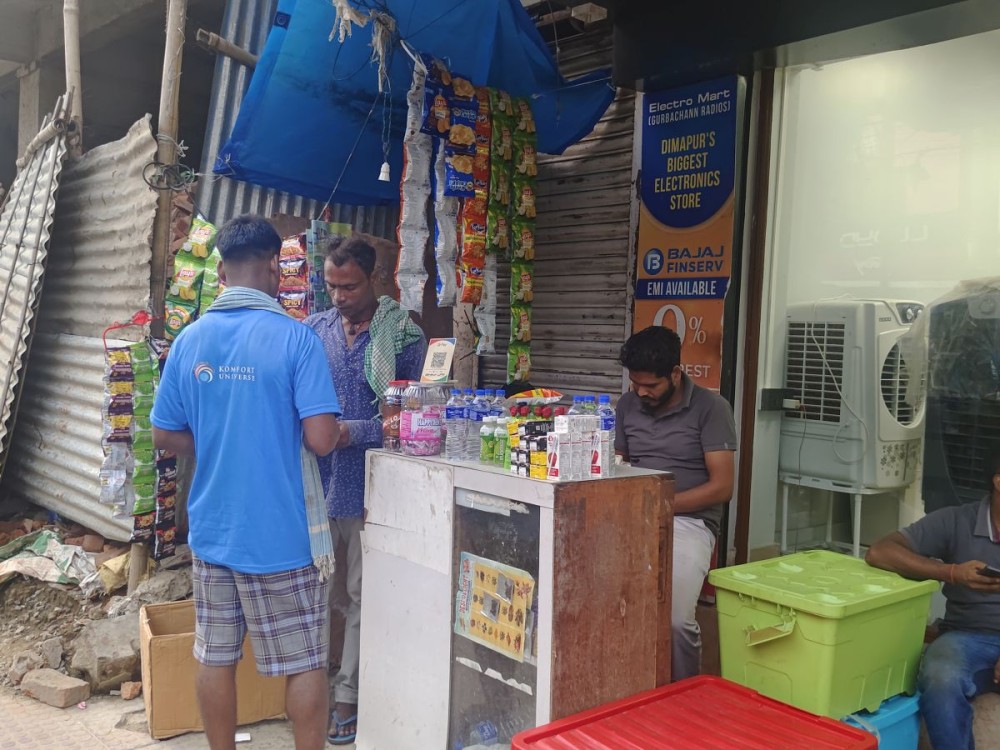
Customers stand by a commercial shop in Dimapur. (Morung File Photo, for representational purpose only)
Surotsa Anar
Dimapur | June 22
While the Nagaland government’s recent one-year ban on all tobacco and nicotine products has been welcomed by some for its public health objectives, many shopkeepers in Dimapur have expressed concerns over its sudden implementation and lack of clarity. Business owners fear significant financial losses. At the same time, consumers and citizens have shared mixed opinions, acknowledging both the potential benefits of the ban and the challenges it may create.
There have been mixed reactions and confusion over the recent one-year ban among citizens, especially business people in Dimapur. While some have acknowledged its positive intentions, many are still confused due to the notice’s sudden and unclear instructions.
The Confederation of Nagaland Chambers of Commerce and Industry (CNCCI) held a press conference in Dimapur on June 15, highlighting confusion regarding the ban. CNCCI Chairperson Dr Khekugha Muru said that the primary source of confusion was the clause stating that any food product containing nicotine and tobacco is banned. He clarified that paan masala, as a product category, falls under the purview of the Food Safety Authority and carries an FSSAI licence.
Following this, an order was issued on June 17, where the Government of Nagaland issued a clarification. Commissioner of Food Safety and Commissioner & Secretary to the Government of Nagaland, Anoop Khinchi, IAS, said the enforcement period of the notification issued on June 2, 2026, shall be till June 1, 2027.
One shopkeeper in Purana Bazar ‘B’ stated, “it will be nice if the government is strict about this ban; if not, then the public will be at loss as other shops will sell them at a higher rate.” A customer expressed concern about the seriousness of the ban imposed by the government.
Another customer pointed to the possibility of illegal businesses increasing, stating, “People who consume it on a daily basis would go and buy it in bulks from the neighbouring states if it is not available here,” adding that this could lead to bulk purchases from neighbouring states either for personal consumption or to sell in black at a higher rate, affecting public finances.
A citizen stated, “The government should have imposed a 3-year ban instead of 1 year along with stricter rules for a better result.”
“Yes, but even this 1 year ban is an opportunity and could benefit the public, even if many may not stop consuming there will be a portion of people who does stop,” another cited stating the ban could bring positive change to society.
However, many shopkeepers said they remained confused due to lack of clarity and sudden implementation, as it would affect their business. One shopkeeper in Dimapur main town stated, “Just watch by winter many of the small pan shops here will close down due to this ban,” adding, “This ban will hamper my business as most of my profits came from these products.”
Another shopkeeper in Purana Bazar ‘B’ stated, “Yes, it will affect my business because of the sudden implementation but the market will adapt to it and the effects will be lessened as time goes on.”
The writer is currently a B.Mass IV semester student in the Department of Mass Communication at Patkai Christian College (Autonomous), Chümoukedima. This report is part of his one-month internship at The Morung Express.