Moa Jamir
Dimapur | October 25
The Juvenile Justice (Care and Protection of Children) Act, 2015 is not merely a legal framework for dealing with children who come into contact with the law. It establishes a system of care, protection, rehabilitation and reintegration, supported by specialised institutions and child-friendly procedures. The effectiveness of these protections, however, depends on how these institutions function in practice.
The Part-Ion JJ Act examined its two-fold mandate covering Children in Conflict with Law (CCL) and Children in Need of Care and Protection (CNCP), and the principles that place the child’s best interests at the centre of the juvenile justice system.
This second part examines these institutions and safeguards, including the law’s treatment of children accused of offences, privacy and confidentiality requirements, and the role of communities and stakeholders in Nagaland in complementing the statutory child protection system.
At its core, the question remains the same: how does the law translate its promise of care, protection and rehabilitation into practice?
Institutional frameworks: Who protects children?
To implement its child protection framework, the Act establishes two specialised quasi-judicial bodies in every district, supported by a network of statutory agencies and other child protection institutions.
Juvenile Justice Board (JJB): To deal with CCL, the JJ Act mandates must constitution of at least one or more JJBs in every district, comprising of Principal Magistrate accompanied by two qualified social workers, including a woman. The primary goal of the JJB is to evaluate the circumstances surrounding an alleged offense and implement reformative measures such as counseling, education, or community service, rather than punitive incarceration.
Child Welfare Committee (CWC): The Child Welfare Committee (CWC) is the statutory authority for children in need of care and protection (CNCPs), constituted in every district. It functions as a Bench and has the powers conferred on a Metropolitan Magistrate or, as applicable, a Judicial Magistrate of the First Class. Its responsibilities include taking suo motu cognisance of cases involving CNCPs, conducting inquiries, placing children in appropriate care and protection, facilitating foster care, declaring eligible children legally free for adoption, and overseeing their restoration and rehabilitation.
Other institutions: The Act also provides for a State Child Protection Society and a District Child Protection Unit (DCPU) in every district. The DCPU supports the implementation of the district child protection plan, monitors child care institutions and coordinates child protection measures with relevant agencies.
The DCPU supports the implementation of the district child protection plan, monitors child care institutions, and coordinates child protection measures with relevant agencies. The network now also integrates the Child Helpline (formerly known as Childline under Section 2(25) of the Act), which plays a vital frontline coordination role updated under the new Mission Vatsalya Standard Operating Procedure (SoP) .
The National Commission for Protection of Child Rights (NCPCR) and State Commissions for Protection of Child Rights (SCPCRs) are empowered to monitor implementation of the Act and inquire into violations of its provisions.
The right to be heard: Under the Principle of Participation in Section 3, every child has the right to be heard and to participate in processes and decisions affecting their interests, with their views considered according to their age and maturity.
Child-friendly policing & an exception
When dealing with children in conflict with law, the JJ Act provides for procedures distinct from those applicable to adults. The Act uses the term “apprehension” for taking a child into custody and prescribes child-friendly safeguards governing the process.
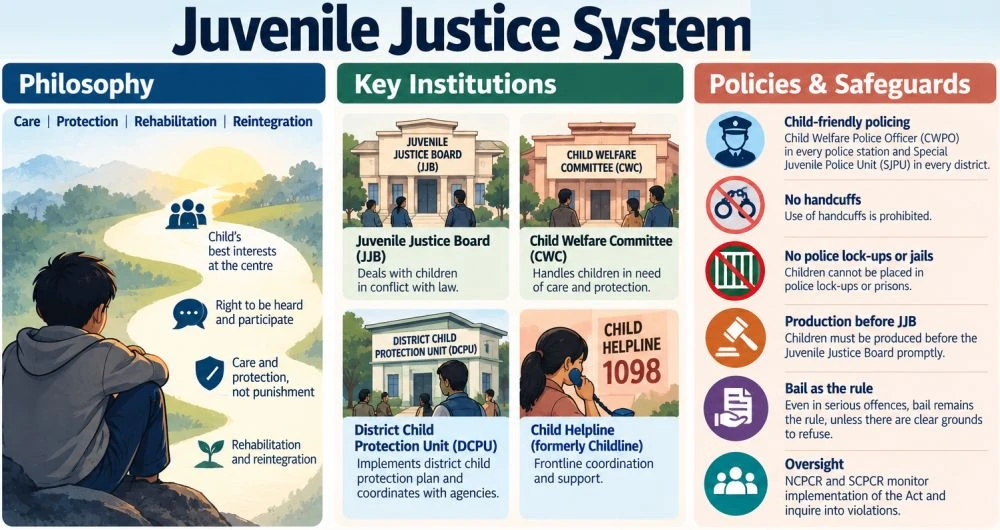
These include restrictions on the use of handcuffs and on placing children in police lock-ups or jails, along with requirements for their prompt production before the Juvenile Justice Board.
Among others, every police station must designate a Child Welfare Police Officer (CWPO), and every district must operate a Special Juvenile Police Unit (SJPU) led by a senior officer to handle minor-related cases.
The law strictly prohibits the use of handcuffs and forbids placing minors in adult police lock-ups or prisons.
Even in serious offences, bail remains the overarching rule, unless there are clear grounds to believe that release would expose the child to moral danger or defeat the ends of justice.
A provision that often draws public debate concerns children aged 16 to 18 accused of a “heinous offence” or one carrying a minimum punishment of seven years or more. They are not automatically transferred to adult courts.
Instead, Section 15 requires the JJB to conduct a preliminary assessment of their physical and mental capacity, ability to understand the consequences, and the circumstances of the alleged offence. The Supreme Court has clarified the assessment is not a trial to determine guilt but rather gauging maturity. Where appropriate, the matter may then be transferred to the Children’s Court for determination.
Where a child is ultimately dealt with under these special provisions, the Act provides for a “place of safety” rather than an adult prison, with care, education, vocational training, counselling and other rehabilitative services, and separation from adult offenders. The child may remain there until attaining 21 years of age, subject to the orders of the Children’s Court
Privacy & confidentially mandate
The most critical compliance requirement for the Naga public and media is the confidentiality and privacy.
Section 74 of the JJ Act places a general prohibition on the disclosure of the name, address, school, photograph, or any other identifying detail of a child, subject to the limited exception provided under the Act.
This restriction applies whether the minor is a CCL, a CNCP, a victim, or a witness, and covers all platforms, including print media, television, websites, and social media networks.
The Supreme Court of India has consistently protected this provision to prevent lifelong stigmatisation and clarified the legislative intent stating:”The purpose is to avoid public scrutiny of the proceedings in which a juvenile is tried, to insulate and protect the juvenile from stigma and emotional trauma…”
This is reinforced by the NCPCR’s Understanding Child Rights: Handbook for Media Professionals, which reminds the media that reportage involving children should be guided by a rights-based perspective rather than sensationalism, with the child’s dignity, privacy and future kept paramount.
Violating this confidentiality requirement is a direct, cognisable criminal offence under Section 74(3), carrying penalties of up to six months of imprisonment, a fine extending to two lakh rupees, or both.
Police are also barred from sharing a child’s record for “character certificates” after a case is closed, reflecting the Principle of Fresh Start under Section 3, which seeks to prevent a child’s past conduct from becoming a permanent stigmato rehabilitation, social reintegration and life beyond childhood.
The Nagaland context
In Nagaland, tribal bodies, student unions, faith-based organisations and other civil society groups often intervene in local matters out of a sense of community responsibility. Cases involving children are no exception.
While organic community support is invaluable, such interventions operate within the statutory framework of the JJ Act as even a well-intentioned intervention may inadvertently violate law and harm a child’s future.
This is particularly significant in an era where information spreads rapidly through social media and digital platforms, often leaving a permanent online footprint.
In this context, informal processes must not replace or bypass the statutory protection system, but complement it by safeguarding children’s rights and supporting their care and rehabilitation.
Incidentally, while the JJA Act was notified in Nagaland on March 22, 2018, the State’s own rules were notified only on December 2, 2025. The Nagaland Juvenile Justice (Care and Protection of Children) Rules, 2024 were framed to provide a state-specific framework for implementing the Act.
Towards rehabilitation
The JJ Act places rehabilitation and social reintegration at the heart of child protection, treating rehabilitation as a continuous process from a child’s entry into the system until reintegration into society.
Depending on best interests’ principle,the rehabilitation may take the form of restoration to the family, adoption, foster care, sponsorship, or aftercare support, with institutional measure as the ‘last resort.’
A key component of this process is the Individual Care Plan (ICP), which must be prepared for every child by the Child Welfare Officer, Probation Officer, Case Worker, or Social Worker of the Child Care Institution (CCI) or District Child Protection Unit (DCPU) under the direction of the CWC or JJB.
Rather than a one-size-fits-all approach, the ICP provides a personalised roadmap for the child’s rehabilitation, covering education, vocational training, healthcare, mental health and psychosocial support, protection from further abuse, family restoration, and overall social reintegration.
Adoption under Section 56 is one of the permanent rehabilitation measures under the Act for children declared legally free for adoption, with the 2021 Amendment transferring the authority to issue adoption orders from civil courts to District Magistrates.
Securing ‘best interest’
Ultimately, the overarching objective is to ensure that every child is able to recover from adversity, realise their full potential and be restored wherever possible, as a “responsible and productive member of society.”
On paper, the JJ Act provides a comprehensive framework to achieve these objectives.
The greater challenge, however, lies in its effective implementation. Ensuring that the best interests of every child remain paramount requires not only robust State institutions but also informed, responsible and child-sensitive communities.
Disclaimer: This report is part of the ‘Media Fellowship Initiative on Child Protection Awareness and Ethical Public Discourse’ series, supported by DKA Austria and implemented by Prodigals’ Home. The content is intended for public legal literacy and preventive awareness.