(Photo Source: UN)
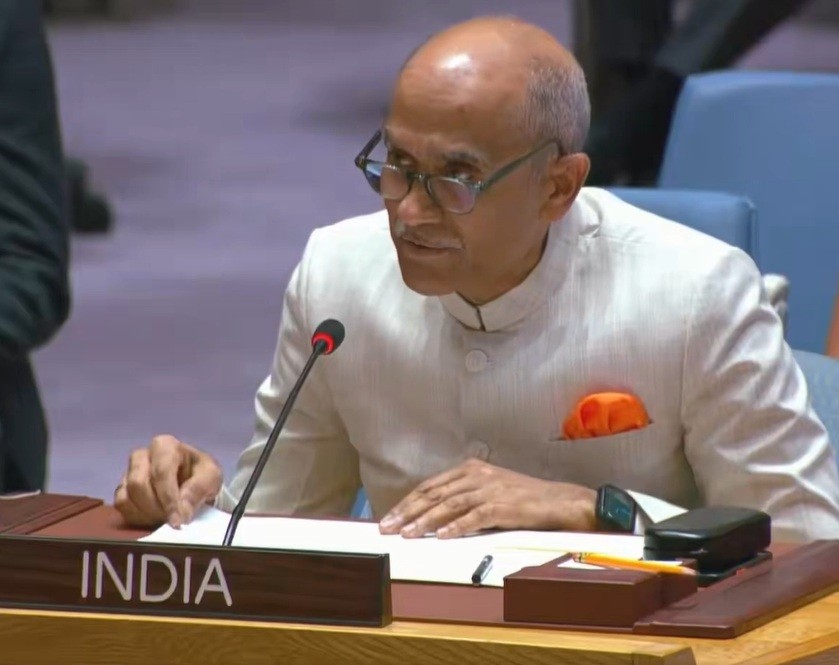
United Nations, August 26 (IANS) With conflicts creating one of the gravest threats to food security, India has said that the Security Council's immediate priority should be to act to mitigate the humanitarian fallout of conflicts.
"Today’s conflicts increasingly generate ripple effects far beyond the immediate theatre of hostilities", India's Permanent Representative P Harish said on Tuesday.
"Disruptions to energy markets, fertiliser supplies, maritime transport, humanitarian logistics and agricultural trade have demonstrated how regional conflicts can threaten food security across the world", he said.
Developing countries that are highly import-dependent face a disproportionate impact from the disruptions, he said at a Council open debate on "Food Under Fire: The Security Council's Role in Mitigating Global and Local Food Crises".
"The Council's immediate priority should be to mitigate the humanitarian consequences of conflict. This requires facilitating safe, rapid and unimpeded humanitarian access, supporting de-confliction arrangements", he said.
The Council should also ensure that its actions, like imposing sanctions, "do not inadvertently impede humanitarian assistance or legitimate food and agricultural trade", he said.
But ultimately, he said, "building resilient, food-secure societies remains primarily the responsibility of national governments, supported by the UN development system and the Rome-based agencies," rather than the Council's.
Harish cited India's efforts to achieve food security through its own investments in the sector, which has also made it a contributor to global food security.
"The National Food Security Act provides a statutory entitlement to subsidised food grains [and] direct benefit transfers to over 110 million farming households under the PM-KISAN [programme] have strengthened the economic resilience of small and marginal producers", he said.
India's promotion of the International Year of Millets in 2023 has catalysed global attention to climate-resilient, nutrient-rich crops as a viable pathway to diversified food security, he said.
"These efforts, underpinned by digital public infrastructure and climate-adaptive agricultural practices, have enabled India to remain both food-secure and a net contributor to global food supply", he added.
Harish spoke in general terms about the dangers posed by disruptions to commercial shipping and maritime trade routes to food security, and did not name the three conflicts in the Strait of Hormuz, the Black Sea, and the Red Sea.
But Secretary-General Antonio Guterres named the three conflicts threatening global food security.
"The war in Ukraine is affecting grain and energy exports in the Black Sea, both from Ukraine and Russia", he said.
The restrictions and closures at the Strait of Hormuz, the conduit for a fifth of global oil supplies, and a third of global fertiliser trade "have driven up commodity prices, and made availability plummet", he said.
"Attacks on commercial vessels in the Red Sea are further threatening supply chains for food and other commodities", he said.
Guterres said the UN has proposed practical mechanisms to allow fertilisers and foodgrains to get through the Hormuz through a protected corridor.
"This time-bound confidence-building effort would focus initially on fertilisers and related raw materials – but with the ability to be extended to other products", he said.
Building on original proposals made in March, Guterres announced on Monday that a task force led by the Office for Project Services (UNOPS) has developed a framework for registering and verifying ships carrying fertiliser and related products to facilitate their transit.
"What is needed now is the cooperation and political will of the parties", he said. "I urge all concerned to engage seriously and constructively".
World Food Programme's Acting Director Carl Skau warned that the "serious disruptions to maritime trade now threaten to push tens of millions more people into food insecurity".