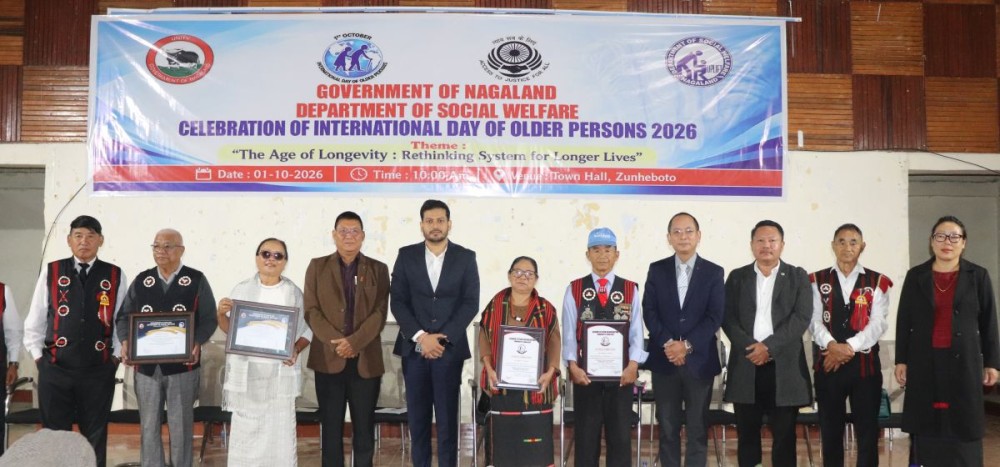
DC Zunheboto, Dharam Raj, IAS along with others during the International Day of Older Persons observed at Zunheboto Town Hall on October 1. (Morung Photo)
Morung Express News
Zunheboto | October 1
The International Day of Older Persons 2026 was observed at Zunheboto Town Hall on October 1 under the theme, ‘The Age of Longevity: Rethinking Systems for Longer Lives’ organised by the Department of Social Welfare Zunheboto in collaboration with the Senior Citizens Association Zunheboto (SCAZ), Zunheboto District Legal Services Authority (ZDLSA), Zunheboto Town Council and students.
Delivering the keynote address, R Imtinukshi, District Welfare Officer Zunheboto, said that adding years to life was a scientific achievement, while adding life to those years remained a collective social responsibility.
He said that in the Sümi Naga community, respect for elders formed an important part of the social fabric, describing senior citizens as living repositories of oral history, customary laws and indigenous knowledge. He called for a rethink of existing systems to support the growing older population, particularly in the areas of healthcare, infrastructure and accessibility, and social and intergenerational inclusion.
He noted, “The way we treat our elders today is the blueprint for how we will be treated tomorrow” while addressing the youth and urged them to take time to sit with them, listen to their stories, and learn from the generation that built the foundation you stand upon today.
Imtinukshi also highlighted the role of the Senior Citizens Association in providing fellowship, advocacy and a collective voice, while stressing the need for stronger interaction between younger and older generations. He urged policymakers, district administrators and community leaders to ensure that welfare schemes for senior citizens remained accessible and that older persons continued to remain active participants in community life.
Resource person Easter H Yeptho, Retainer Lawyer, ZDLSA, highlighted various welfare schemes and legal provisions available to senior citizens. She spoke on the National Social Assistance Programme (NSAP), Indira Gandhi National Old Age Pension Scheme, NSRLM elderly Self-Help Groups and vulnerable relief funds.
She also highlighted the Senior Citizen Savings Bank Account scheme through the Post Office, besides explaining that persons aged 60 years and above are recognised as senior citizens, while those aged 80 years and above are classified as super senior citizens.
Yeptho explained the Maintenance and Welfare of Parents and Senior Citizens Act, 2007, enacted to provide maintenance and welfare support to parents and senior citizens. She also informed the gathering about concessions available to senior citizens in public transportation through Nagaland State Transport, including 100 percent fare concession for four round trips in a year, subject to the required Aadhaar card, No Objection Certificate from the District Welfare Department and passport photographs.
She urged the Senior Citizens Association Zunheboto to pursue the establishment of a district-level day-care centre for senior citizens, even if an old-age home could not immediately be established in the district.
Deputy Commissioner Zunheboto, Dharam Raj, IAS, in his address, said the government was working towards increasing life expectancy while ensuring healthier and more productive lives. He noted that life expectancy in India had increased significantly compared to the period around Independence.
He said many people continued to remain productive after the age of 60 and some had taken up new professions after retirement. At the same time, he emphasised that longevity should also be accompanied by emotional well-being and social engagement.
Suggesting the establishment of old-age clubs or similar community spaces, DC Raj said such platforms could provide senior citizens opportunities to meet, interact and remain socially connected. He also stressed the importance of involving older persons in guiding younger generations through their experience and knowledge.
DC Raj said greater involvement of senior citizens could also contribute to preserving Nagaland’s traditions, customs and cultural heritage while enabling older persons to remain productive members of society.
The programme was chaired by Hokishe L Kiba, President SCAZ. Vihokhü Zhimomi, Assistant Pastor, Zunheboto Town Sümi Baptist Church, pronounced the invocation, and Dr Hutton Sümi, Pastor, Sümi Baptist Church, Zunheboto, offered the prayer for older persons. Er Hokhevi Muru, Vice President SCAZ, delivered the vote of thanks, and Kughavi V Chishi, Pastor, NCRC Sümi, Zunheboto, pronounced the benediction. State-level awards were presented to Kitoli Naje and H Kashito Yepthomi, while district-level awards were conferred on N Atoli Sema and N Toihe Sema. The programme concluded with a Medical Health Camp for senior citizens.