Participants, organisers and guests during the 6th Millet Festival at Shamator on August 6.
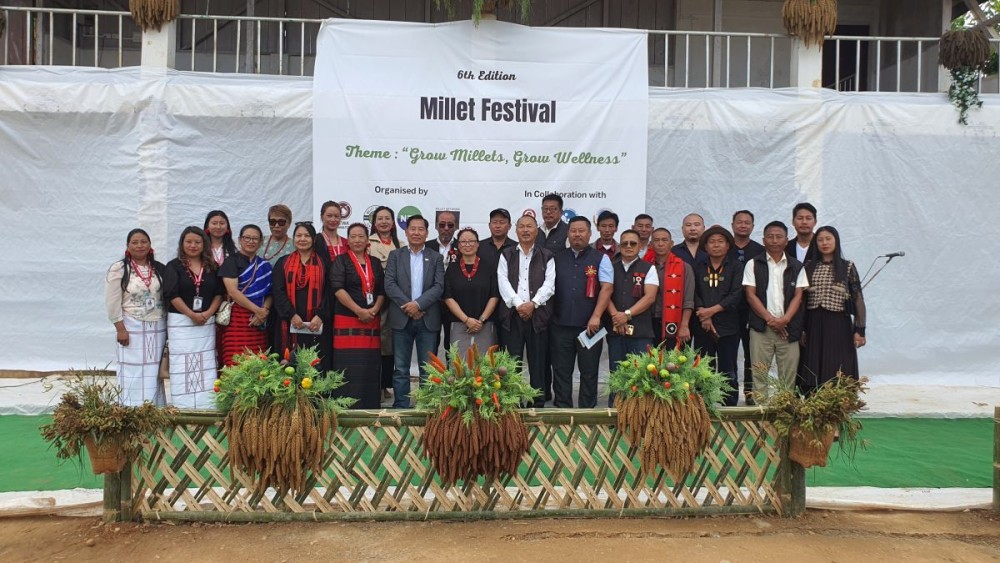
SHAMATOR, AUGUST 6 (MExN): The 6th Millet Festival was celebrated at the Public Ground in Shamator Town on Thursday under the theme ‘Grow Millets, Grow Wellness,’ with speakers highlighting the importance of millet cultivation for nutrition, sustainable agriculture and farmers' livelihoods.
The festival was jointly organised by Millet Sisters, SEWA Shamator District, North East Network (NEN) and the Millet Network of India (MINI) in collaboration with the Department of Agriculture and the Department of Social Welfare, Shamator.
President of the NPF Central Farmers' Wing and Managing Director of Okusa Toyota Pvt Ltd, Y Vikheho Swu, attended the programme as the special guest. He inaugurated the festival and visited exhibition stalls and a farmers' market displaying locally grown millet products, traditional farm produce and indigenous crafts.
Addressing the gathering, Swu said the festival's theme was timely as the world continues to face various health challenges, describing millets as a nutritious and sustainable food source. Stressing unity and harmony among the Naga tribes, he noted that India is the world's largest millet producer and said Nagaland has significant potential to expand millet cultivation, benefiting both farmers' incomes and public health.
He urged farmers to adopt modern agricultural technologies while preserving traditional jhum cultivation so that indigenous farming knowledge is passed on to future generations. Swu also expressed hope that the state's new Agriculture Policy would improve farmers' livelihoods and encourage more young people to take up agriculture.
Congratulating Shamator on becoming Nagaland's 16th district, he commended the people for maintaining unity and harmony and conveyed greetings from Chief Minister and NPF president Neiphiu Rio. Swu further stated that the NPF Farmers' Wing would continue to represent farmers' interests before the government and work towards the effective implementation of the state's agriculture policy.
Earlier, Millet Sisters Convenor Tsusola, in her welcome address, highlighted the need to revive millet cultivation to strengthen food security, improve nutrition and build resilience against climate change.
District Agriculture Officer, Shamator, L Kivika Chophy said millet was once a traditional staple crop but gradually declined with the increasing preference for rice. He acknowledged that the crop had received limited attention in the past but said the department is now actively promoting millet cultivation under the National Food Security Scheme by supporting millet-growing villages.
He said Nagaland's millet productivity is higher than the national average of 15-16 quintals per hectare and encouraged farmers to expand cultivation, citing the crop's nutritional, economic and climate-resilient benefits.
The keynote address was delivered by Wekoweu Tsuha (Akole), Advisor of SEWA Nagaland and Vice President of SEWA Bharat, who called for greater community participation in millet farming and women-led agricultural initiatives.
During the programme, Yimkhiung Women Organisation President K Ester presented the highest millet producer award to Yinsola Yimkhiung of Medical Ward and encouraged the gathering to continue promoting millet cultivation. Farmers' experiences in millet cultivation and community-based farming were also shared by Anong Lucy of Leangkongru Village.
The festival also featured prize distribution for millet-based cooking competitions, an exhibition-cum-sale of millet products, local produce and traditional crafts, along with cultural performances celebrating the region's heritage. Organisers said the annual festival continues to serve as a platform for promoting indigenous crops, strengthening farmers' livelihoods and raising awareness of the nutritional, environmental and economic benefits of millet cultivation.