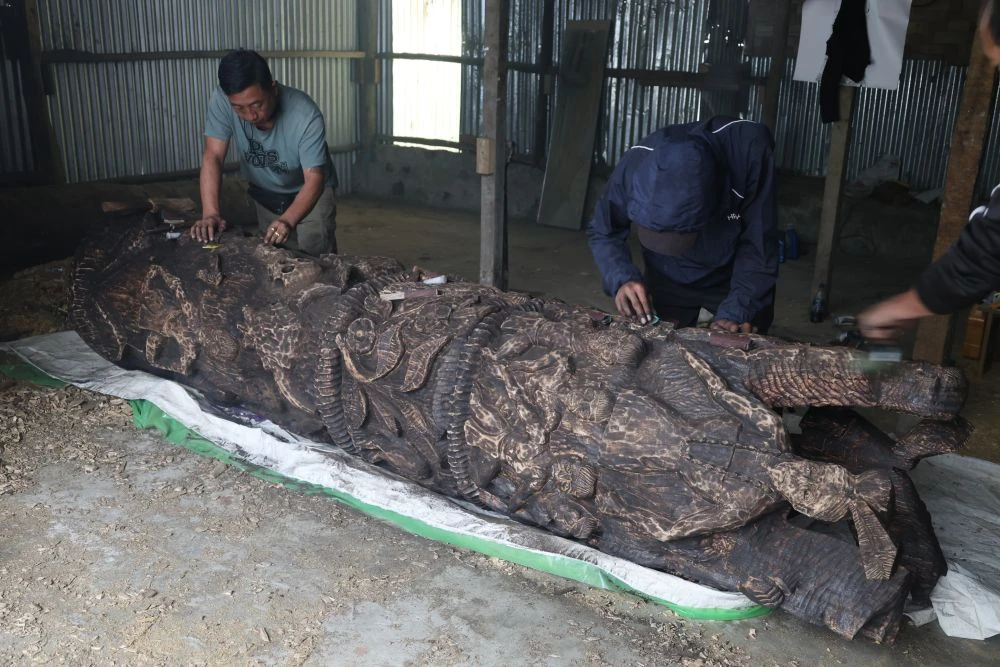
Meren Imsong works on intricate traditional Naga wood carvings on a massive timber log at the Heritage Village, Kisama. (Morung Photo)

Ketholeno Neihu
Kohima | November 28
A massive tree trunk is gradually taking the shape of a cultural narrative under the hands of Nagaland artisan Meren Imsong, whose 10-foot wooden sculpture celebrating Naga heritage, traditional knowledge and biodiversity is nearing completion ahead of the 27th Hornbill Festival.
Titled Pillar of Culture and Eco Diversity, the intricately carved work will soon find a permanent place at the Heritage Village, Kisama, where preparations are underway for the annual festival, popularly known as the Festival of Festivals.
Measuring 10 feet and 3 inches in height with a circumference of seven feet, the sculpture features traditional motifs and elaborate patterns carved directly into a massive tree trunk sourced from Dimapur district.
For the 48-year-old artisan from Merangkong village, the sculpture is more than an elaborate piece of woodwork. It is an attempt to give contemporary expression to Naga cultural identity while bringing together traditions, customary practices and the community’s relationship with the natural environment.
The idea took shape following Imsong’s visit to the Hornbill Festival last year. While acknowledging the presence of traditional handicrafts at the Heritage Village, he felt there was room to introduce something different that could further enrich the festival’s cultural landscape.
“When I went to the Hornbill Festival last year, I could see how traditional handicrafts still had their commonplace, but I had a yearning for something new and refined,” Imsong recalled.
The experience motivated him to create something significant for the festival. As the idea developed, he prepared a blueprint for the proposed sculpture, which received approval from the tourism department.
“I presented the blueprint of the concept and the tourism department gave a nod, so that was how the project began,” he said.
The resulting work is a layered representation of Naga cultural life, with each section carrying a distinct meaning.
Explaining the composition, Imsong said the bottom portion represents the heart of Naga cultural heritage, with the morung occupying a central place. Traditionally, the morung served as an institution for imparting indigenous knowledge, customs and traditions, besides teaching young people discipline, community values and social responsibilities.
The sculpture also incorporates head-hunting imagery, representing warriorhood, social status, community honour and certain customary beliefs.
Above this comes the mithun, whose symbolism extends beyond livestock and represents victory, wealth and prosperity, he said.
The sculpture also features detailed representations of flora and fauna, reflecting the close relationship between the ecosystem and Naga customs, beliefs, social organisation, indigenous knowledge and spiritual worldview.
The inclusion of the tragopan, mithun and hornbill highlights the region’s biodiversity while connecting the sculpture with the Hornbill Festival.
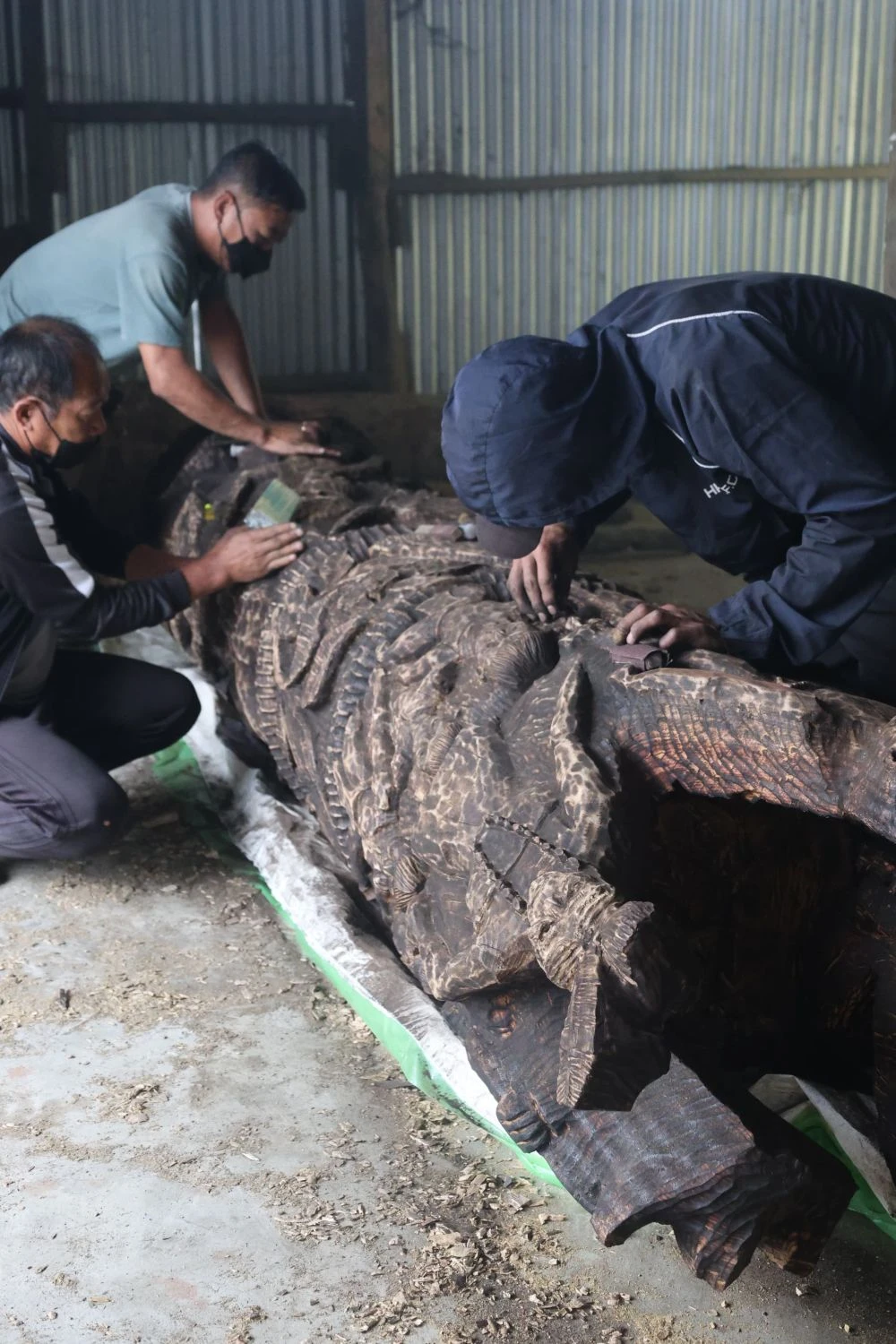
The uppermost portion symbolises the festival, with human figurines representing unity amidst diversity among the Nagas. From the morung and traditional warriorhood at the base to the natural world and human unity at the top, the sculpture seeks to present Naga heritage as a continuum of culture, community and ecology.
For Imsong, the project also represents more than two decades of engagement with an art form he entered without formal training.
Describing himself as a freelance artist, he said his work encompasses furniture-making, painting, handicrafts and different forms of woodwork. The craft is his full-time occupation and primary source of income.
His journey began as a hobby while growing up in Dimapur. He recalled that even after completing matriculation, PU and graduation in Dimapur, his interest in working with wood remained constant.
He credited much of his early inspiration and understanding of the craft to fellow artist Lepden Jamir, whose guidance helped him acquire valuable insights and techniques.
Despite the scale and intricacy of the present work, Imsong said he completed the sculpture in about a month without major setbacks. However, he said wood carving remained an unpredictable process, with designs sometimes changing depending on the material available.
“Creating an art cannot be predicted, the design may change any minute also. It also depends on the wood or the material we get,” he said.
Patience, concentration and coordination are essential to achieving finer details, he said, adding that traditional wood carving relies primarily on handcraftsmanship and basic tools such as chisels of different sizes and a hammer.
Unlike furniture-making, which has increasingly benefited from electronic tools and modern machinery, wood carving remains exclusively handcrafted.
“Although it is a woodwork, it is different from making a piece of furniture. Today, we have very good electronic tools or modern machineries to make furniture but a special thing about wood carving is that it is exclusively hand crafted,” Imsong said.
The artisan has undertaken several significant commissioned works in the past. His sculpture Burden of Man, featuring 23 human figures representing the burdens of life, earned him a state award in 2011.
Another major work, Pillar of Fear, measuring 13 feet and incorporating 62 human figures, was also featured at the Hornbill Festival.
Among his other notable creations is Pillar of Love, based on the Ao Naga folktale of Jina and Etiben. Several other life-sized wooden carvings by the artist are also found at Mopungchuket village.
With Pillar of Culture and Eco Diversity, Imsong is adding another significant work to his collection, placing cultural memory, ecological consciousness and collective identity within a single sculptural form.
Imsong is currently settled in Kohima and can be contacted through his Instagram page, Imsong Woodcrafts.