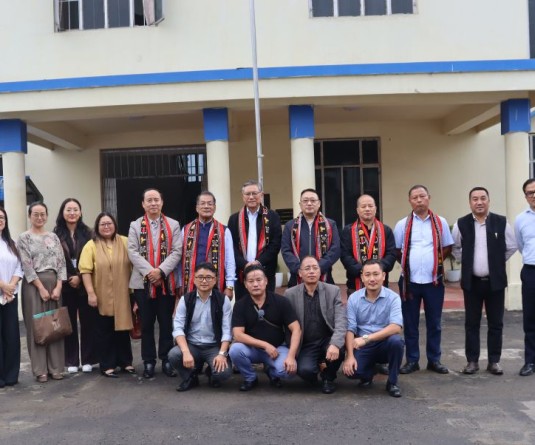
Tongpang L Jamir, State Commissioner for PwDs (7th from L) Kevekha Kevin Zehol, Chairman NSSB, (8th from L) Er Sabou Yashu, Director of IT&C (7th from R) seen with others officials and participants during the observance of GAAD at IT&C Conference Hall in Kohima on May 21.
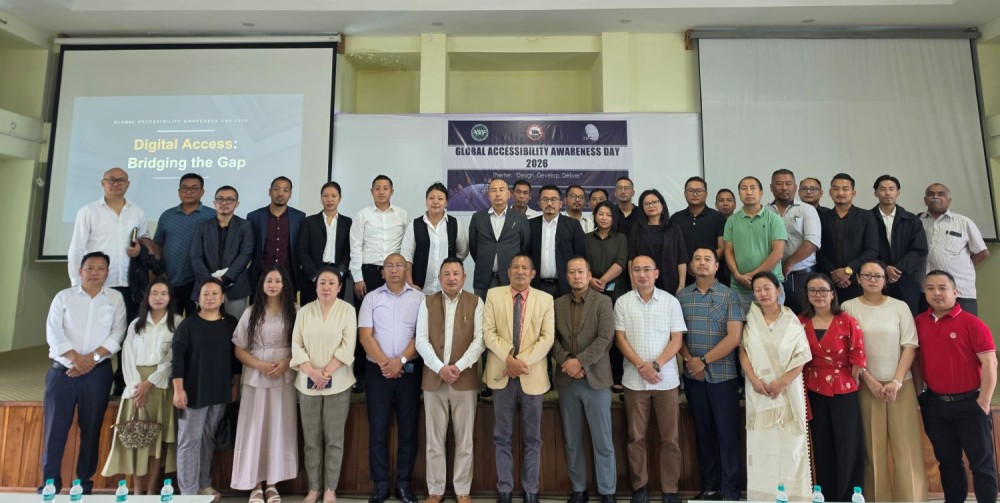
Global Accessibility Awareness Day Observed
Morung Express News
Kohima | May 21
Even as a lot of conversations surrounding Global Accessibility Awareness Day (GAAD) focuses on font sizes, screen readers and website code, Viketukho Nakhro, Program Officer, Office of State Commissioner for Persons With Disabilities (PWDs), on Thursday underscored that “a flawless, fully accessible website does not mean much to someone if they physically cannot get through the front door of the building to do their job.”
Speaking on the topic, ‘What is Physical Accessibility, Why is it important?’ on the occasion of GAAD jointly organised by the Office of State Commissioner for Persons With Disabilities and Department of Information Technology & Communication (IT&C) in the IT&C Conference Hall on May 21, he pointed out that digital access and physical access are two sides of the exact same co-independence.
With an estimated 1.3 billion people who live with a significant disability worldwide representing 16% of the world’s population, as per 2011 Census, India has 26.8 million persons with disabilities, constituting 2.21% of the total population and Nagaland has 29,631 persons with disabilities, or 1.5% of the state’s total population.
Terming this as ‘a gross underestimation’, he however exuded hope that the upcoming census would provide a more credible picture of disability prevalence in the state. In any case, he underlined that, “these significant numbers of people living with disabilities are why accessibility in all its aspects is both important and urgent.”
‘Accessibility is a right’
In Nagaland, he highlighted that “the accessibility situation for the disabled community across many areas still remains quite poor, despite the progress we have made in recent years.”
When we speak of accessibility, he added, “We often tend to think only in terms of ramps and wheelchairs.” However, he asserted, “it is about ensuring that all persons with disabilities, regardless of the nature of their disability, can access and participate in society on an equal basis with others.”
Pointing out that “physical accessibility includes step-free access to buildings, ramps of appropriate gradient, handrails, accessible toilets, lifts, tactile paving and signage for persons with visual impairments, adequate lighting, accessible parking, and safe pathways,” he highlighted that, “it also means ensuring that schools, workplaces, healthcare facilities, churches, markets, government offices, and public transport systems are accessible and usable by everyone.”
In this regard, he elaborated “for a wheelchair user, physical accessibility may mean being able to enter a building independently without having to be carried. For a blind person, it may mean tactile indicators, clear pathways free of obstacles, and accessible signage. For deaf persons, accessibility may include visual announcements and access to sign language interpretation in public services and events. For persons with intellectual or psychosocial disabilities, accessibility may mean clear communication, supportive environments, and information that is easier to understand.”
What we have to be clear about, he underlined is, “accessibility is not a favour, charity, or special privilege. It is a right.” More importantly, he said that accessibility benefits everyone, and “the absence of accessibility excludes persons with disabilities from education, employment, healthcare, worship, civic participation, recreation, and many everyday activities that others often take for granted.”
“Accessibility is what makes inclusion possible. Without accessibility, equal participation remains only an idea,” he asserted.
As we observe Global Accessibility Awareness Day, he also urged, “let us remember that accessibility in all its aspects should never be treated as an afterthought. It must be integrated into the way we design our buildings, services, communication, policies, and digital spaces from the very beginning. Inclusion begins with accessibility, and that is the vision - an accessible Nagaland where all citizens can participate with dignity, independence, and equality.”
‘Every individual deserves equal access’
In his keynote address, Tongpang L Jamir, State Commissioner for Persons with Disabilities said that Global Accessibility Awareness Day is a reminder of a simple yet powerful truth of accessibility being a basic human right. Expressing solidarity with Persons with Disabilities who face barriers every day, whether visible or invisible, he underscored that, “every individual deserves equal access to information, education, healthcare, employment, opportunities and full participation in society.”
Accessibility, he further asserted is about dignity, equality and respect, and creating a world where everyone - both able-bodied persons and Persons with Disabilities can learn, work, communicate and live independently with confidence and freedom.”
In today’s rapidly evolving digital world, he also remarked that accessibility has become more important than ever with technology influencing almost every aspect of our lives, from banking and education to healthcare, transport, government services and communication.
However, when digital systems are not designed inclusively, he maintained that they can deepen inequality instead of eliminating it.
Stating that true inclusion begins when accessibility is considered from the very beginning -in every conversation, every design, and every decision we make, he also underlined that “accessibility should never be treated as an afterthought or an optional feature; it must become a fundamental part of everything we do.”
Towards this end, he urged that, “Governments must develop inclusive policies. Schools and colleges must ensure equal learning opportunities. Businesses should create products and services that everyone can use. Developers and designers must embrace universal design principles that make spaces, systems and technologies accessible to all.”
Calling for prioritising accessibility, he also stated that churches have an important role in promoting inclusion, dignity and equal participation for persons with disabilities. By creating accessible spaces, use of digital tools, encouraging inclusive worship and spreading awareness against discrimination, he said that, “churches can help build a compassionate society where everyone feels welcomed, respected and valued.”
Further articulating that inclusion is not an act of charity, but a matter of fairness, equality, justice and human progress, he said the occasion is not only about acknowledging challenges, but also about celebrating the resilience, creativity, talent and achievements of Persons with Disabilities who continue to inspire society in countless ways.
“Let this day encourage us to move beyond words and take meaningful action towards building a more inclusive, accessible and compassionate world for all,” he expressed.
The Global Accessibility Awareness Day 2026 was held under the theme “Design, Develop, Deliver” with a welcome address by Er Sabou Yashu, Director of Information Technology & Communication, a presentation on “Digital Access” by Er Akumla Aier, Sr Program Officer, Information Technology & Communication, and vote of thanks by Ashe Kiba, Program Coordinator, Office of the State Commissioner for PWDs while Ruvuorienuo Juliana was the host and Ruokuokhrienuo Vizotha was the Sign Language Interpreter.
Kevekha Kevin Zehol, Chairman of the Nagaland Staff Selection Board (NSSB) also spoke on the occasion.