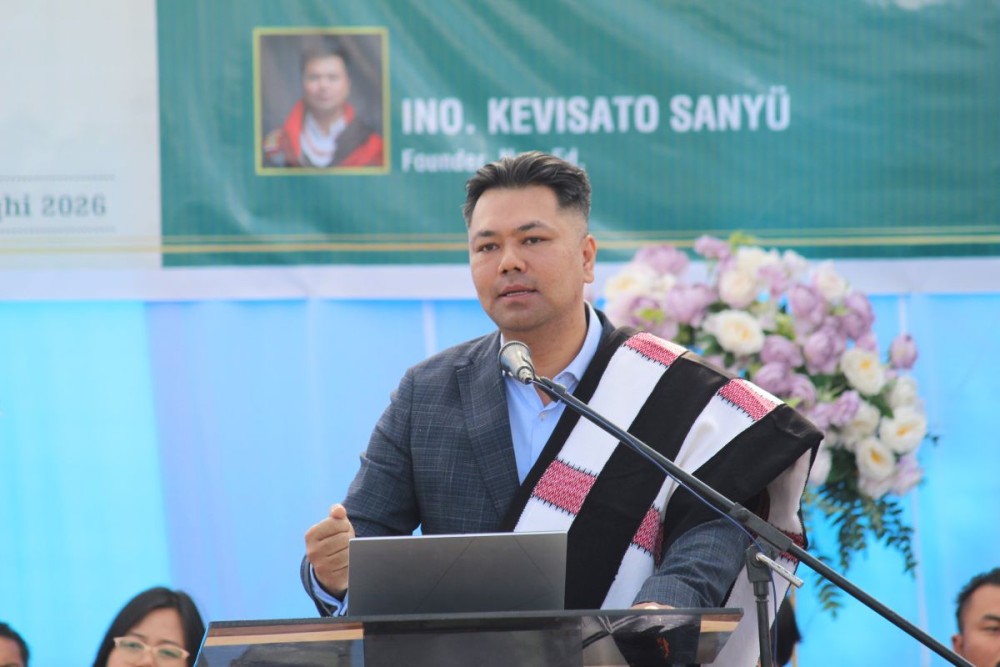
Kevisato Sanyü addresses the gathering during the 42nd AASU biennial conference held at Pimla village, Chümoukedima on January 11. (Morung Photo)
Morung Express News
Pimla | January 12
The last decade has been the most interconnected period in human history, opening unprecedented flows of ideas, skills, markets and relationships, NagaEd founder, Kevisato Sanyü said while underlining that Nagaland is navigating in one generation a transformation the developed world took over two centuries to absorb.
Speaking as the theme speaker of the 42nd Aqahuto Area Students’ Union (AASU) held at Pimla village on January 11, Sanyü said that learning, selling, mentoring and collaboration now move seamlessly across borders, both into and out of Nagaland.
“But this opportunity also brings responsibility, of what we export and what we import: values, stories and ideas that shape who we are and how the world sees us,” he said.
Tracing humanity’s industrial journey, he noted that while much of the world moved gradually from agriculture to steam power in the 17th century, electricity and factories in the 1800s, automation in the late 20th century, and today’s cyber-physical systems, communities in Nagaland are making that leap within a single generation.
“We are moving from farming communities straight into a digital, cyber-physical world. This is a great upheaval,” he said, citing everyday examples, from booking taxis and homestays through apps, to digital payments and online marketplaces, processes unimaginable to earlier generations.
For the first time, he observed, young people are being shaped by influences invisible to their elders. “We now have real relationships in cyberspace that influence our thinking and choices,” he said, warning that future generations will inhabit worlds even today’s youth cannot imagine.
Highlighting rapid technological disruption, he pointed to artificial intelligence already replacing a significant share of desk jobs and emerging neurotechnology such as brain-computer interfaces. “This raises urgent questions for students today—what knowledge will remain relevant 10 years from now?” he said.
He also cited climate change as a defining force of the future, referring to Pacific island nations preparing digital versions of their states as rising sea levels threaten their existence. “Entire nations are preparing to live partly in cyberspace,” he said.
Against this backdrop, Nagaland stands uniquely positioned, he argued, due to its abundant natural resources, space, water and clean air, assets increasingly scarce elsewhere. With nearly 1.6 billion people living in environmentally stressed regions nearby, the Northeast could emerge as a refuge, he warned, calling for preparation and foresight.
Likewise, he emphasised that Nagaland’s extraordinary cultural and linguistic diversity, among the densest in the world, is a strategic advantage in a borderless digital age. “We learn every day how to interact across cultures. That skill will define success in the future,” he said.
Equally important, he said, is the community’s adaptability and entrepreneurial mindset, developed through decades of rapid change. English proficiency, he added, gives Nagaland an edge in global services and digital employment.
Yet tools and skills alone will not endure, he cautioned. “What scales is character.” In an attention-driven digital economy, trust is the highest currency. “Most people we work with, we may never meet. What holds systems together is integrity.”
He urged the youth to practice daily discipline, speaking truthfully, repairing mistakes, and being “impeccable with one’s word”. “Trust is a muscle. Build it daily, and it will carry us through uncertainty,” he said.
As Nagaland steps into an unpredictable future, he concluded, resilience, community values and character will determine whether the transition becomes a crisis or an opportunity.