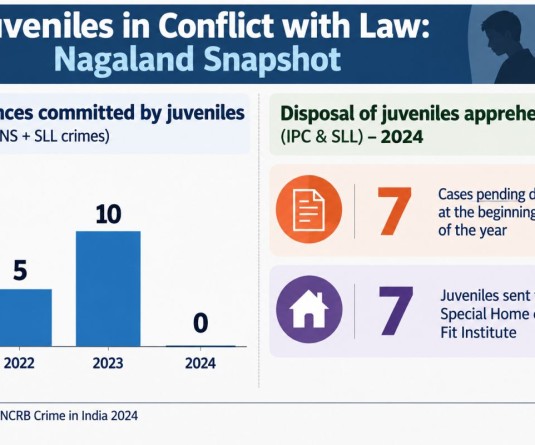
The Juvenile Justice (Care and Protection of Children) Act, 2015 (JJ Act), is considered India’s comprehensive child protection law, enabling a child-centred approach to justice, care, protection, rehabilitation and social reintegration in accordance with the principle of the best interests of the child. (AI-generated illustration)

Moa Jamir
Dimapur | August 24
“An Act to consolidate and amend the law relating to children alleged and found to be in conflict with law and children in need of care and protection by catering to their basic needs through proper care, protection, development, treatment, social re-integration, by adopting a child-friendly approach in the adjudication and disposal of matters in the best interest of children and for their rehabilitation through processes provided, and institutions and bodies established, herein under…”
- Preamble, The Juvenile Justice (Care and Protection of Children) Act, 2015
If the Protection of Children from Sexual Offences (POCSO) Act provides a legal shield against sexual crimes involving children, the Juvenile Justice (Care and Protection of Children) Act, 2015 (JJ Act) is India’s comprehensive child protection law.
As categorically stated in its preamble the JJA Act governs how when a child requires care, protection, rehabilitation or legal intervention for two sets of cohorts of children: Children in Conflict with Law (CCL) and Children in Need of Care and Protection (CNCP).
For CCLs, the core philosophy departs from the conventional criminal justice system by replacing retributive justice (punishment) with restorative justice, focusing on rehabilitation through the processes provided and the institutions and bodies established under the Act.
The second category comprises children requiring State intervention because of neglect, abuse, abandonment or vulnerability, though they are not alleged to have committed an offence.
For Nagaland, where traditional institutions and community stakeholders often play an active role in matters in matters involving children out of a sense of community responsibility, understanding the statutory framework is critical.
This Part-I of the sixth report in the Child Protection Awareness and Ethical Public Discourse series examines the JJ Act, focusing on its child-centred approach, institutional framework and legal safeguards for the care, protection and rehabilitation of children.
Who is a child?
The JJ Act defines a child or a juvenile as a “person who has not completed eighteen years of age.”
This reflects India’s obligations under the United Nations Convention on the Rights of the Child (UNCRC), ratified by India in 1992, which defines every human being below the age of eighteen as a child unless majority is attained earlier under national law.
The Convention also requires that the best interests of the child be a primary consideration in all actions concerning children.
Under the Act, a child’s age is determined as on the date of the alleged offence, not the date of apprehension or trial.
The Dual Mandate: CCL & CNCP
Recognising that children come into contact with the legal system under varied circumstances, the JJ Act classifies them into two distinct legal cohorts, each requiring different responses.
Child in Conflict with Law (CCL): The JJA defines CCL as “a child who is alleged or found to have committed an offence and who has not completed eighteen years of age on the date of commission of such offence.”
As noted above, turning 18 does not remove a person from the juvenile justice system if they were a child when the alleged offence was committed.
Further, it places clear limits on the punishment stipulating that no CCL can be sentenced to death or to life imprisonment without the possibility of release, whether under the Act or any other law in force.
To ensure that children are not exposed to the adult criminal justice system, the JJ Act strictly prohibits joint proceedings or trials pairing a child with an adult defendant.
The Act recognises three categories of offences:
• Petty offences – Section 2(45): Offences for which the maximum punishment under the law is imprisonment for up to three years.
• Serious offences – Section 2(54): Offences for which the punishment is imprisonment between three and seven years.
• Heinous offences – Section 2(33): Offences for which the minimum punishment is imprisonment for seven years or more.
Child in Need of Care and Protection (CNCP): The second cohort is the CNCP, which covers wide spectrum of children requiring State’s intervention because they are vulnerable, neglected, abused, at risk or in incapacitated environment.
These include children who are abandoned or orphaned, missing or runaway; living without shelter or means of subsistence; engaged in child labour or begging; survivors of physical or sexual abuse, trafficking or exploitation; those vulnerable to substance abuse or affected by civil unrest or natural disasters; and those facing imminent child marriage.
Crucially, the law specifies that a child does not lose their status as a CNCP simply because they reside with a parent, legal guardian, or relative.
Thus, the legal authority is empowered to intervene proactively if the adult custodian has abused, neglected, or exploited the child, or if there is a reasonable likelihood of risk.
This protective clause is particularly relevant in Nagaland, where domestic arrangements often involve children living away from their biological parents with relatives or host families for educational or economic reasons.
Guiding principles:
Best Interests of the Child
The JJ Act lays down a set of fundamental principles that guide every authority implementing its provisions, including governments, courts, police and child protection agencies.
At the outset, every child is presumed innocent of any mala fide or criminal intent up to the age of 18 years under the Principle of Presumption of Innocence.
The Principle of the Best Interests of the Child requires that every decision promotes the child’s safety, well-being and full potential.
While the biological, adoptive or foster family bears the primary responsibility for care, institutionalisation is recommended as a measure of last resort, with the emphasis on early restoration and reintegration into the family and community wherever it is in the child’s best interests.
The Act further advocates positive measures, encouraging governments, families and communities to work together to reduce children’s vulnerabilities and the need for legal intervention.
To safeguard a child’s future, the Principle of Fresh Start provides that a child’s past records should be erased so that childhood mistakes do not become lifelong barriers, except in special circumstances.
The Act also mandates non-stigmatising semantics, prohibits the waiver of a child’s legal rights, and guarantees every child’s right to dignity, participation, equality, safety, privacy and confidentiality throughout the legal process.
Complementing these safeguards, the Principle of Natural Justice requires fair, impartial and child-friendly proceedings, including the right to a fair hearing and review.
The Supreme Court has consistently held that the JJA is a beneficial, welfare-oriented legislation that must be interpreted liberally in favour of children, with the objective of promoting rehabilitation, reintegration and the opportunity for reform rather than punishment.
Glossary: Key terms under the JJ Act
Juvenile: Under the JJ Act, a child or Juvenile below the age of 18.
Child in Conflict with Law (CCL): A child alleged or found to have committed an offence and who had not completed 18 years of age on the date of the offence.
Child in Need of Care and Protection (CNCP): A child who requires State care and protection because of circumstances such as abandonment, neglect, abuse, exploitation, homelessness, lack of support, vulnerability or other risks to the child's safety and well-being.
Best Interest of the Child: The principle that decisions concerning a child must aim to fulfil the child's basic rights and needs, and promote their safety, social well-being, and physical, emotional and intellectual development.
Child-friendly: Any behaviour, practice, process, attitude or environment that is humane, considerate and in the best interests of the child.
Child under purview of JJA Act
The Act recognises two kinds of Children, one who has committed some offence (Child in Conflict with Law) and one who is a victim of crime or circumstances (Child in Need of Care and Protection).
Child in Conflict with Law (CCL) is defined under section 2(13) of the Act as a child who is alleged or found to have committed an offence and who has not completed eighteen years of age on the date of commission of offence.
A Child in Need of Care and Protection (CNCP) is defined under section 2(14) of the Act as a child who is:
• Without any home or settled place of abode or ostensible means of subsistence
• Found working in contravention of labour Laws or begging or living on street
• Residing with a person who has injured, exploited or abused or threatened to do so or killed, abused, neglected or exploited some other child
• Mentally ill or physically challenged having no one to support him.
• Parent or guardian unfit or incapacitated
• Orphan or abandoned child or surrendered child
• Missing or run-away child or whose parents cannot be found
• Child who is likely to be abused, tortured or exploited for the purpose of sexual abuse or illegal acts
• Child who is found vulnerable or likely to be inducted into drug abuse or trafficking
• Child who is likely to be abused for unconscionable gains
• Victim of armed Conflict, civil unrest or natural calamity
• Child who is at imminent risk of marriage
Fundamental Principles under the Act:
The principles which form the basis of entire juvenile justice system are mentioned in Section 3 of the Act as:
(i) Principle of presumption of innocence
(ii) Principle of dignity and worth
(iii) Principle of participation
(iv) Principle of best interest
(v) Principle of family responsibility
(vi) Principle of safety
(vii) Positive measures
(viii) Principle of non-stigmatizing semantics
(ix) Principle of non-waiver of rights
(x) Principle of equality and non-discrimination
(xi) Principle of right to privacy and confidentiality
(xii) Principle of institutionalization as a measure of last resort
(xiii) Principle of repatriation and restoration
(xiv) Principle of fresh start
(xv) Principle of diversion
(xvi) Principles of natural justice
Source: Frequently Asked Questions under JJ Act, 2015, Juvenile Justice Committee, Delhi High Court, https://jjcdhc.nic.in/?page_id=1619
This report is part of the ‘Media Fellowship Initiative on Child Protection Awareness and Ethical Public Discourse’ series, supported by DKA Austria and implemented by Prodigals’ Home. The content is intended for public legal literacy and preventive awareness and does not constitute legal advice.